fiction

Reading Comprehension - Language Arts

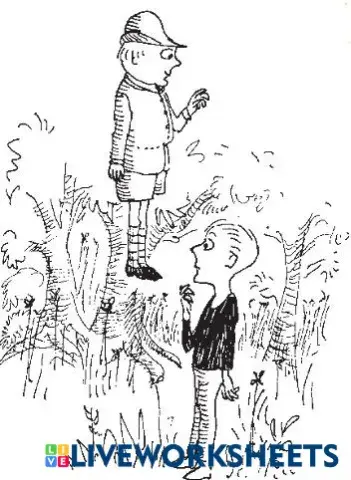
Fiction “It seems to me that almost everything is a waste of time,” Milo remarks as he walks dejectedly home from school. Until for no logical or predictable reason he is transported to a strange world of words, numbers and confusion. ‘Isn’t it beautiful?’ gasped Milo. ‘Oh, I don’t know,’ answered a strange voice. ‘It all depends on how you look at things.’ ‘I beg your pardon?’ said Milo, for he didn’t see who had spoken. ‘I said it depends how you look at things,’ repeated the voice. Milo turned around and found himself staring at two very neatly polished brown shoes, for standing directly in front of him (if you can use the word ‘standing’ for someone suspended in mid-air) was another boy just about his age, whose feet were easily three feet off the ground. ‘For instance,’ continued the boy, ‘if you happen to like deserts, you might not think this was beautiful at all.’ ‘For instance,’ said the boy again, ‘if Christmas trees were people and people were Christmas trees, we’d all be chopped down, put up in the living room, and covered with tinsel, while the trees opened our presents.’ ‘What does that have to do with it?’ asked Milo. 83 Year 6, Sequence 11 ‘Nothing at all,’ he answered, ‘but it’s an interesting possibility, don’t you think?’ ‘How do you manage to stand up there?’ for this was the subject that most interested him. ‘I was about to ask you a similar question,’ answered the boy, ‘for you must be much older than you look to be standing on the ground.’ ‘What do you mean?’ Milo asked. ‘Well,’ said the boy, ‘in my family everyone is born in the air, with his head at exactly the height it’s going to be when he’s an adult, and then we all grow towards the ground. When we’re fully grown up, or as you can see, grown down, our feet finally touch. Of course, there are a few of us whose feet never reach the ground, no matter how old we get, but I suppose it is the same in every family.’ He hopped a few steps in the air, skipped back to where he started, and then began again. ‘You certainly must be very old to have reached the ground already.’ ‘Oh no,’ said Milo seriously, ‘in my family we all start on the ground and grow up, and we never know how far until we actually get there.’ ‘What a silly system,’ the boy laughed. ‘Then your head keeps changing its height and you always see things in a different way? Why, when you’re fifteen things won’t look at all the way they did when you were ten, and at twenty everything will change again.’ ‘I suppose so,’ said Milo, for he had never really thought about the matter. ‘We always see things from the same angle,’ the boy continued. ‘It’s much less trouble that way. Besides it makes more sense to grow down and not up. When you’re very young, you can never hurt yourself from falling down if you’re in mid-air, and you certainly can’t get into trouble for scuffing your shoes or marking the floor if there’s nothing to scuff them on and the floor is three feet away

Aglaya

Reading and Text Analysis - Language Arts

  • Why is mathematics important in daily life?
  • Can you name any famous mathematicians?
  • mathematics, the science of structure, order, and relation that has evolved from elemental practices of counting, measuring, and describing the shapes of objects. It deals with logical reasoning and quantitative calculation, and its development has involved an increasing degree of idealization and abstraction of its subject matter. Since the 17th century, mathematics has been an indispensable adjunct to the physical sciences and technology, and in more recent times it has assumed a similar role in the quantitative aspects of the life sciences.

    In many cultures—under the stimulus of the needs of practical pursuits, such as commerce and agriculture—mathematics has developed far beyond basic counting. This growth has been greatest in societies complex enough to sustain these activities and to provide leisure for contemplation and the opportunity to build on the achievements of earlier mathematicians.

    All mathematical systems (for example, Euclidean geometry) are combinations of sets of axioms and of theorems that can be logically deduced from the axioms. Inquiries into the logical and philosophical basis of mathematics reduce to questions of whether the axioms of a given system ensure its completeness and its consistency. For full treatment of this aspect, see mathematics, foundations of.

    This article offers a history of mathematics from ancient times to the present. As a consequence of the exponential growth of science, most mathematics has developed since the 15th century ce, and it is a historical fact that, from the 15th century to the late 20th century, new developments in mathematics were largely concentrated in Europe and North America. For these reasons, the bulk of this article is devoted to European developments since 1500.

    This does not mean, however, that developments elsewhere have been unimportant. Indeed, to understand the history of mathematics in Europe, it is necessary to know its history at least in ancient Mesopotamia and Egypt, in ancient Greece, and in Islamic civilization from the 9th to the 15th century. The way in which these civilizations influenced one another and the important direct contributions Greece and Islam made to later developments are discussed in the first parts of this article.

    India’s contributions to the development of contemporary mathematics were made through the considerable influence of Indian achievements on Islamic mathematics during its formative years. A separate article, South Asian mathematics, focuses on the early history of mathematics in the Indian subcontinent and the development there of the modern decimal place-value numeral system. The article East Asian mathematics covers the mostly independent development of mathematics in China, Japan, Korea, and Vietnam.

  • Match the words with their meanings.
  • structure -the process of thinking logically about something
  • reasoning-a way that parts are organized or arranged
  • quantitative-a general idea rather than a concrete object
  • abstraction-related to numbers or amounts
  • commerce-to support or keep something going
  • sustain-the activity of buying and selling goods
  • axiom-a statement that can be proved using facts and logic
  • theorem-a statement that is accepted as true without proof
  • civilization-the power to affect how someone or something develops
  • influence-an advanced human society with culture and knowledge
  • Fill in the blanks with correct words from the list:
    (structure, reasoning, commerce, influence, civilization)
  • Ancient _______ like Egypt and Greece made big progress in mathematics.
  • Logical _______ is important for solving problems.
  • Trade and _______ helped mathematics grow.
  • The _______ of India was strong in Islamic mathematics.
  • Geometry studies the _______ of shapes.
  • Choose the correct form.
  • Mathematics (has / have) been important since ancient times.
  • It (developed / has developed) far beyond basic counting.
  • Many cultures (were / have been) influenced by Greek mathematics.
  • Mathematicians (worked / have worked) for centuries to create new ideas.
  • Since the 17th century, mathematics (became / has become) a part of science.
  • Reading Comprehension

    Answer the questions:

  • What is mathematics described as in the first paragraph?
  • Why did mathematics develop in many cultures?
  • What are mathematical systems made of?
  • Where did most mathematical development occur after the 15th century?
  • Why is it important to study ancient civilizations to understand European mathematics?
  • How did India influence Islamic mathematics?

สร้างและปรับแต่งใบงานสำหรับทุกห้องเรียน

LiveWorksheets ทำให้คุณครู ผู้ปกครอง และผู้สอนแบบโฮมสคูล สามารถออกแบบและมอบสื่อการเรียนรู้ที่น่าสนใจได้อย่างง่ายดาย เพียงอัปโหลดไฟล์ PDF หรือเริ่มต้นสร้างใหม่ทั้งหมด คุณก็สามารถทำได้ทุกอย่าง ไม่ว่าจะเป็นใบงานคณิตศาสตร์แบบโต้ตอบ ใบงานอ่านจับใจความ ใบงานการคูณ หรือใบงานสำหรับเด็กอนุบาล ด้วยขั้นตอนเพียงไม่กี่คลิก เครื่องมือแก้ไขแบบลากและวางของเรารองรับทุกระดับชั้นและทุกวิชา ช่วยให้คุณปรับเนื้อหาให้ตรงกับแผนการสอน การบ้าน หรือแบบทดสอบ ครูสอนภาษาอังกฤษ (ESL) ยังสามารถสร้างใบงาน ESL แบบเฉพาะ เพิ่มตารางเสียงภาษาอังกฤษ หรือออกแบบกิจกรรม ESL เพื่อให้การเรียนสนุกและมีส่วนร่วมมากขึ้น สร้างกิจกรรมที่ปรับระดับได้ ตรวจอัตโนมัติ ช่วยประหยัดเวลา และสนับสนุนการเรียนรู้ของนักเรียนให้ดียิ่งขึ้น

คลังสื่อการเรียนรู้ครบวงจรสำหรับ K-12 และ ESL

เข้าถึงใบงานที่พร้อมใช้หลายพันชุด ครอบคลุมทุกวิชาในระดับ K-12 รวมถึงใบงานอนุบาล ใบงานคณิตศาสตร์ แบบฝึกการคูณ แบบฝึกอ่านจับใจความ และทรัพยากร ESL เลือกค้นหาตามชั้นเรียน วิชา หรือระดับทักษะ เพื่อให้ได้สิ่งที่คุณต้องการ ไม่ว่าจะสำหรับห้องเรียนประถม ทบทวนในระดับมัธยมต้น หรือการฝึกในระดับมัธยมปลาย ครู ESL ยังสามารถสำรวจคลังใบงาน ESL และกิจกรรมภาษาอังกฤษที่ออกแบบมาเพื่อรองรับผู้เรียนทุกระดับ เนื้อหาใหม่ถูกเพิ่มเข้ามาอย่างต่อเนื่อง LiveWorksheets จึงเป็นทรัพยากรที่ยืดหยุ่นและช่วยสร้างผลลัพธ์การเรียนรู้ที่ยั่งยืน