Conjunctions So But And Because

Grammar -

Conjunctions are words that connect clauses, sentences, or words within the same clause. 

They help to create complex sentences and clarify relationships between ideas.


 So   Coordinating conjunction

   Usage: Used to indicate a result or consequence.  It connects an action to its result.

 Example:" She was tired, so she went to bed early."


 But Coordinating conjunction

     Usage: Used to contrast two ideas or statements.  It contrasts different ideas.

  Example: "She wanted to go for a walk, but she was tired."


 Because Subordinating conjunction

  Usage: Used to introduce a reason or explanation.   It provides a cause or justification

 Example: "She stayed home because she was feeling tired.”


 And Coordinating conjunction 

Usage: Used to connect words, phrases, or clauses that are similar or related in meaning.

Example: "She was tired and feeling sleepy.”


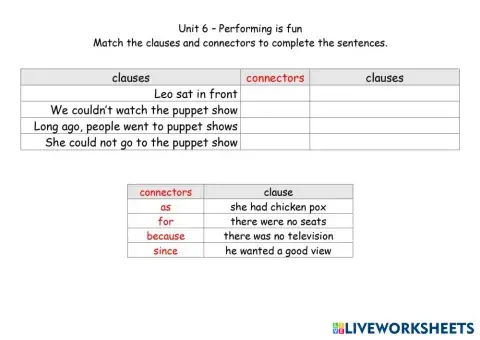
 Instructions:    Fill in each blank with the appropriate conjunction: so -but - because - and 


  1. 1. I wanted to go to the party, _____ I had too much homework to finish.
  2.  
  3. 2. She loves to read novels, _____ she often spends her weekends at the library.
  4.  
  5. 3. The weather was perfect for a picnic, _____ we decided to pack lunch and go to the park.
  6.  
  7. 4. He studied hard for the exam, _____ he still felt nervous about his results.
  8.  
  9. 5. I couldn’t attend the meeting _____ I was feeling unwell.
  10.  
  11. 6. We wanted to watch a movie, _____ the streaming service was down.
  12.  
  13. 7. She decided to take the job offer, _____ it was a great opportunity for her career.
  14.  
  15. 8. I enjoy hiking in the mountains, _____ I don’t have time to go often.
  16.  
  17. 9. He brought an umbrella, _____ it looked like it might rain later.
  18.  
  19. 10. They are planning to travel this summer, _____ they need to save more money first.
  20.  
  21.  

B2 - Grammar

English Language

Past tenses

B2 Narrative tenses, used to, would


Future

B2 Future forms – expressing future time

B2 Other ways to express future – be about to, be due to, etc.

B2 Future in the past


Modals, the imperative, etc .

B2 Modal verbs – permission, obligation, prohibition, necessity

B2 Speculation and deduction – modal verbs and expressions

B2 Verbs of the senses

B2 Get – different meanings


Conditionals, if, wish, etc.

B2 All conditionals – mixed conditionals, alternatives to if, inversion

B2 Mixed conditionals – If I were you, I wouldn’t have done it

B2 Wish, rather, if only, it’s time – unreal uses of past tenses

B2 Unless, even if, provided, as long as, etc. – other expressions in conditionals


Passive

B2 Distancing – expressions and passive of reporting verbs

B2 Passive verbs with two objects


-ing and the infinitive

B2 Verb + object + infinitive/gerund – verb patterns

B2 Gerunds and infinitives – complex forms


Articles, nouns, pronouns, and determiners.

B2 Reflexive and reciprocal pronouns

B2 Generic pronouns – common-gender pronouns

B2 Compound nouns and possessive forms

B2 Possessive ’s with time expressions – Two hours’ walk


Relative clauses, relative pronouns and adverbs

B2 Relative clauses – defining and non-defining


there and it

B2 There and it – preparatory subjects


Auxiliary verbs

B2 Have – auxiliary or main verb

B2 Ellipsis and substitution


Adjectives and adverbs

B2 Inversion with negative adverbials – adding emphasis


Conjunctions and clauses

B2 Clauses of contrast, purpose, reason and result

B2 Discourse markers – linking words

B2 Participle claus

es


Word order


B2 Cleft sentences – adding emphasis


Create and Customize Worksheets for Every Classroom

LiveWorksheets makes it easy for teachers, parents and homeschool educators to design and deliver engaging learning materials. Upload a PDF or start from scratch to create what you need: anything from interactive math worksheets to reading comprehension worksheets, multiplication worksheets, and kindergarten worksheets in just a few clicks. Our drag-and-drop editor works across all grade levels and subjects, so you can tailor content to your lesson plans, homework, or assessments. ESL teachers can also build custom ESL worksheets, add a common sound chart, or integrate ESL activities to make each class more engaging. Easily create differentiated, auto-graded activities that save valuable time and support better student learning.

A Complete Library of Learning Resources for K-12 and ESL

Access thousands of ready-to-use worksheets across K-12 subjects, including kindergarten worksheets, math worksheets, multiplication practice, reading comprehension exercises, and ESL resources. Filter by grade, subject, or skill level to find exactly what you need, whether it’s for an elementary classroom, middle school review, or high school practice. ESL teachers can explore our growing collection of ESL worksheets and English as a Second Language activities designed to support all levels of learners. With new content added regularly, LiveWorksheets is a flexible resource that helps build lasting learning outcomes.