Test1

English as a Second Language (ESL)

School Subjects May Soon Be a Thing of the Past in Finland

Despite having one of the best education systems in the world, Finland is introducing some extraordinary changes to classrooms around the country.

Under the new National Curriculum Framework, which came into effect in August 2016, schools must provide one phenomenon based learning (PBL) project per year.

Rather than focusing on a subject, phenomenon based learning focuses on a topic which students explore from multiple perspectives. A topic like climate change, for instance, could be studied form of the perspective of science, economics, environmental studies, and politics.

The aim of PBL is to highlight the connections between subjects, and to show how subjects relate to real world issues.

Kirsti Lonka, a professor of educational psychology at Helsinki University believes that PBL encourages critical thinking. Where traditional education teaches students what to think, PBL teaches students how to think – a skill which Lonka says is essential in the 21st century.

The idea of phenomenon based learning, however, is not without its critics.

Physics teacher Jussi Tanhuanpaa worries that students will not learn enough about individual subjects to be able to study them at a higher level. He also fears that while PBL may benefit brighter students, those who need guidance will struggle.

Some academics are concerned that there is little evidence showing the effectiveness of PBL.

Anneli Rautiainen of Finland's national agency for education recognizes these concerns and says that PBL is being introduced slowly. Education is highly decentralized in Finland, which gives educators in each municipality the freedom to arrange curriculums as they see fit.

Finland’s education system is already unique in many ways. Children start formal schooling at age 7, the school day is only around 5 hours long, class sizes are small, students are rarely assigned homework, and all teachers must have a master’s degree.

Media

English language

STUDENTS THINK FAKE NEWS IS FACT AND ARE USING IT IN THEIR SCHOOLWORK, SAY TEACHERS

Teachers are frustrated that students can’t accept that some stories on social networks are false, while experts suggest that students need better education about online dangers. Students believe that fake news is a fact, and are repeating it in lessons and using it in written work, teachers have warned. More than a third of teachers say their students have used false information that they found online, according to a survey by a teacher’s union.

The union’s general secretary Chris Keates said that the information was "worrying" and it showed that internet companies have a lot of power to influence people’s opinions, especially young people. International education experts are becoming more worried about the situation and say that teachers will need to teach children how to spot fake news. Others were frustrated that students didn’t believe that news they had seen on Facebook and other social media sites was not true, even when the problem was explained to them. One teacher said that students often thought that fake news sites were real, and also that anything that President Donald Trump said was a fact. Last week, German officials said they would give fines of up to 50 million euro to social networks if they didn’t take down illegal fake news posts. The new law would give social networks 24 hours to delete or block the content and seven days to concentrate on more complicated cases. Commenting on the results of the survey, Ms. Keates said that she was worried about the trend, particularly because many young people have never known a world without internet, and are less able to judge whether information that they read online is real or fake. She added that: "It is important for children and young people to be made aware that not everything they see and read online is real."

She said that teachers are trying to help educate students about using false information, but added that it was important for internet providers and websites to take responsibility for any material that is available, and also to deal with people who misuse their services. Last month, Andreas Schleicher, the director of education and skills at OECD (The Organization of Economic co-operation and Development) said that in the modern age, being able to tell the difference between what is real and what is fake is a critical skill. He added that: "This is something that we believe schools can do something about."

Adapted from the Independent by Rachel Pells, April 12th, 2017

CLIL

English as a Foreign Language (EFL)

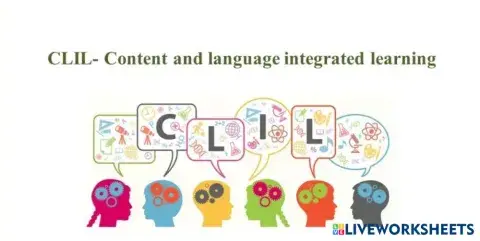
CLIL (Content and Language Integrated Learning), students learn various subjects like history, art, science and math in a foreign language. Rather than being a stand-alone subject, language becomes a skill acquired in the classroom while mastering other types of content.

Tips for Planning and Teaching CLIL Lessons 

As you can see from the lesson plans above, you can get creative with CLIL lessons and include diverse themes! Whether you want to make your own lesson plan or you’ll be working off these examples, here are some ways to make your CLIL lessons even more effective:  

Teach vocabulary separately 

Pick the important concepts and words and teach them in isolation from the main lesson. I usually prep students by doing this beforehand, but you can also choose to wait until after the class.

During the class, assume your students are native speakers of the target language and just teach the subject. For example, when the lesson is about math, teach actual addition and subtraction, not the translation of the word “addition” in German. Teach the math and be a math teacher for the duration of the activity.

In the course of the lesson, kids will be compelled to use their critical thinking skills to figure out the meanings of any unknown words. 

Include authentic materials

Aside from CLIL materials on the subject you want, look for authentic materials too about the subject at hand. For example, on top of CLIL-specific materials about philosophy in German, I’d look for native German discussions, blogs, websites, forums and book excerpts about philosophy too

There are three particular sites that I often check because they’re loaded with authentic materials and educational links:

  • Government sites and ministries. One of the aims of national leadership, for all states, is the education of their populace. So you can be sure that their websites have links to resources that can help you find material for CLIL. For example, the site for France’s Ministry of National Educationhas links to academic sites and even its own search engine.
  • Websites for the top universities in the country. Naturally, these sites are replete with links to the latest research, publications, lessons and journals. You may also find online libraries, databases and even e-books you could use. Take the example of Technische Universität München, one of the top universities in Germany.
  • Forums for native speakers. When you join these forums, you’ll have reached the inner sanctum of the country—at least online. Read the posts and discussion and you’ll have an insider’s look not only at their relationship problems, you’ll find in their postings, links to sites that native speakers actually use and recommend to each other. This one’s big in China.

Give simple worksheets

Keep any CLIL worksheets visually appealing and user-friendly. Avoid overcrowding it or making it too “busy.”

Use a consistent font and style throughout—ideally a basic font that won’t be distracting. Include lots of pictures and graphs to enhance the visual appearance. 

These are my favorite resource websites for worksheets:

  • One Stop English — This site provides unique English CLIL resources that can be adapted to any language. You’ll find puzzles, crosswords, vocabulary worksheets and more catering to a range of ages.
  • Teachers Pay Teachers — As the name suggests, this is a platform where teachers can sell resources that they’ve created to other teachers. Just look up “CLIL Teaching Resources,” and you can even filter for worksheets and select them by subject and grade. 
  • Scholastic’s Teacher Resources — This is a great place to find worksheet ideas to fit any subject you’re teaching through CLIL. You can get grade-appropriate lesson plans here on everything from literature to basic science to economics.
  • Instant Online Crossword Puzzle Maker— This non-traditional worksheet option is great for teaching vocabulary in any subject or language in an engaging way. You can use this instant crossword maker to easily produce fun worksheets targeting any vocabulary set you’re working on. 
  • Pinterest — Mostly known for craft and home decor inspiration, this popular platform is now also a go-to source for great lesson plan ideas, especially for elementary school children. Just type “CLIL” into the search bar plus the name of the target language (e.g. “CLIL italiano”). 

Do scaffolding

Give the students the temporary support they need to reach higher levels of comprehension and mastery, in terms of both the language and the content.

Begin with simple tasks and work your way up to those that are more complex. Give clear directions and explain concepts in multiple ways to ensure understanding.

I sometimes start with intro exercises where students match vocabulary with images, followed by guided readings where key vocabulary is highlighted. After that, students can do more involved discussions and activities that involve problem-solving and research.

Use gestures, visual aids and props. 

You used to just stand there and talk. With CLIL, not anymore. Illustrate what you’re speaking about, and you’ll see that students are better able to grasp your message.

Break up presentations with videos and images that students will find interesting. You can show mind maps or flowcharts to explain more complicated processes. 

I also try to bring props whenever I can. I’ve used 3D models of different shapes in math when explaining concepts like area or volume and even puppets for storytelling. If the subject is history or geography, these might be objects related to what the students are learning.


Create and Customize Worksheets for Every Classroom

LiveWorksheets makes it easy for teachers, parents and homeschool educators to design and deliver engaging learning materials. Upload a PDF or start from scratch to create what you need: anything from interactive math worksheets to reading comprehension worksheets, multiplication worksheets, and kindergarten worksheets in just a few clicks. Our drag-and-drop editor works across all grade levels and subjects, so you can tailor content to your lesson plans, homework, or assessments. ESL teachers can also build custom ESL worksheets, add a common sound chart, or integrate ESL activities to make each class more engaging. Easily create differentiated, auto-graded activities that save valuable time and support better student learning.

A Complete Library of Learning Resources for K-12 and ESL

Access thousands of ready-to-use worksheets across K-12 subjects, including kindergarten worksheets, math worksheets, multiplication practice, reading comprehension exercises, and ESL resources. Filter by grade, subject, or skill level to find exactly what you need, whether it’s for an elementary classroom, middle school review, or high school practice. ESL teachers can explore our growing collection of ESL worksheets and English as a Second Language activities designed to support all levels of learners. With new content added regularly, LiveWorksheets is a flexible resource that helps build lasting learning outcomes.