B2 - Grammar

English Language

Past tenses

B2 Narrative tenses, used to, would


Future

B2 Future forms – expressing future time

B2 Other ways to express future – be about to, be due to, etc.

B2 Future in the past


Modals, the imperative, etc .

B2 Modal verbs – permission, obligation, prohibition, necessity

B2 Speculation and deduction – modal verbs and expressions

B2 Verbs of the senses

B2 Get – different meanings


Conditionals, if, wish, etc.

B2 All conditionals – mixed conditionals, alternatives to if, inversion

B2 Mixed conditionals – If I were you, I wouldn’t have done it

B2 Wish, rather, if only, it’s time – unreal uses of past tenses

B2 Unless, even if, provided, as long as, etc. – other expressions in conditionals


Passive

B2 Distancing – expressions and passive of reporting verbs

B2 Passive verbs with two objects


-ing and the infinitive

B2 Verb + object + infinitive/gerund – verb patterns

B2 Gerunds and infinitives – complex forms


Articles, nouns, pronouns, and determiners.

B2 Reflexive and reciprocal pronouns

B2 Generic pronouns – common-gender pronouns

B2 Compound nouns and possessive forms

B2 Possessive ’s with time expressions – Two hours’ walk


Relative clauses, relative pronouns and adverbs

B2 Relative clauses – defining and non-defining


there and it

B2 There and it – preparatory subjects


Auxiliary verbs

B2 Have – auxiliary or main verb

B2 Ellipsis and substitution


Adjectives and adverbs

B2 Inversion with negative adverbials – adding emphasis


Conjunctions and clauses

B2 Clauses of contrast, purpose, reason and result

B2 Discourse markers – linking words

B2 Participle claus

es


Word order


B2 Cleft sentences – adding emphasis


Liz

Traveling

There was [vigorous ] debate about the reasons why people are so [desirous] of  travelling  the world, but [conventional ] wisdom says, "You [venture ] into unknown lands because that is where your heart will take you." So the [subtle ] question is: why does your heart do that?

A [nimble ] mind might come up with dozens of answers for why traveling is an [intrinsic ] part of our lives. I will share just a couple with you.

We are always excited to [embark ] on a new journey because we are eager to experience something new. Sometimes life turns [bland], and that's when travel comes into play. Imagine that you're exploring a new city, walking along narrow Italian streets, climbing the Great Wall of China and losing your breath, or enjoying some New York street food on the fly. It's a brand new feeling—a brand new you.

We travel for people. Now my friends are geographically [dispersed], and I am super excited to meet them, whether in an armpit of Indonesia or a giant [vibrant ] city.  It’s so curious how people of different cultures can come together. Trust me, you will never feel [desolate] traveling solo; you will always find like-minded people everywhere! Wherever I traveled, I was always welcomed and never given a [raw ]deal.

And not only human beings are objects of [scrutiny ] for travelers, but also culture. We tend to [scrutinize ]cultural differences and [latch ] onto some peculiarities between them—different world perceptions, religions, customs, and mindsets. For those who are [receptive ] and open-minded, there are heaps of things to explore!

So time and [tide ] wait for no man! Go and book your flight, have a whale of a time, and figure out what your reasons for traveling are!

Liz

Traveling

There was [vigorous ] debate about the reasons why people are so [desirous] of  travelling  the world, but [conventional ] wisdom says, "You [venture ] into unknown lands because that is where your heart will take you." So the [subtle ] question is: why does your heart do that?

A [nimble ] mind might come up with dozens of answers for why traveling is an [intrinsic ] part of our lives. I will share just a couple with you.

We are always excited to [embark ] on a new journey because we are eager to experience something new. Sometimes life turns [bland], and that's when travel comes into play. Imagine that you're exploring a new city, walking along narrow Italian streets, climbing the Great Wall of China and losing your breath, or enjoying some New York street food on the fly. It's a brand new feeling—a brand new you.

We travel for people. Now my friends are geographically [dispersed], and I am super excited to meet them, whether in an armpit of Indonesia or a giant [vibrant ] city.  It’s so curious how people of different cultures can come together. Trust me, you will never feel [desolate] traveling solo; you will always find like-minded people everywhere! Wherever I traveled, I was always welcomed and never given a [raw ]deal.

And not only human beings are objects of [scrutiny ] for travelers, but also culture. We tend to [scrutinize ]cultural differences and [latch ] onto some peculiarities between them—different world perceptions, religions, customs, and mindsets. For those who are [receptive ] and open-minded, there are heaps of things to explore!

So time and [tide ] wait for no man! Go and book your flight, have a whale of a time, and figure out what your reasons for traveling are!

IDIOMA 5

IDIOMA 5

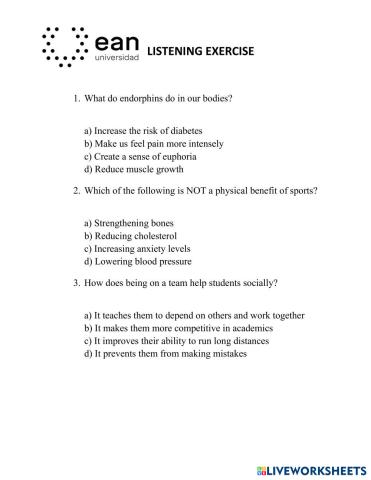
  1. What do endorphins do in our bodies?
    a) Increase the risk of diabetes
    b) Make us feel pain more intensely
    c) Create a sense of euphoria
    d) Reduce muscle growth
  2. Which of the following is NOT a physical benefit of sports?
    a) Strengthening bones
    b) Reducing cholesterol
    c) Increasing anxiety levels
    d) Lowering blood pressure
  3. How does being on a team help students socially?
    a) It teaches them to depend on others and work together
    b) It makes them more competitive in academics
    c) It improves their ability to run long distances
    d) It prevents them from making mistakes
  4. How can playing sports affect self-esteem?
    a) It lowers self-esteem by making people focus on failures
    b) It has no impact on confidence
    c) It helps build confidence through practice and improvement
    d) It only benefits professional athletes
  5. What does the term "growth mindset" mean?
    a) Believing that you can improve with practice
    b) Always winning in competitions
    c) Avoiding failure at all costs
    d) Having a physically strong body
  6. According to the passage, how does training help students?
    a) It guarantees that they will become professional athletes
    b) It helps them develop resilience and perseverance
    c) It teaches them that failure is a part of learning
    d) It only benefits their physical health
  7. What is one long-term benefit of playing sports?
    a) It helps students manage academic and social challenges
    b) It guarantees financial success
    c) It eliminates the need for studying
    d) It prevents all mental health issues
  8. Why is it important to choose the right sport?
    a) Because each person has different strengths and preferences
    b) Because some sports are only for professionals
    c) Because only competitive sports provide benefits
    d) Because physical activity is harmful if done incorrectly
  9. How does being committed to a team encourage regular exercise?
    a) It makes exercise more enjoyable and easier to maintain
    b) It forces people to exercise every day
    c) It prevents students from focusing on their studies
    d) It is only important for professional athletes
  10. What is one reason why people should not be discouraged by losing in sports?
    a) Because losing means they are not good at sports
    b) Because only winning brings benefits
    c) Because failure helps develop resilience and a growth mindset
    d) Because losing means they should quit the sport

Create and Customize Worksheets for Every Classroom

LiveWorksheets makes it easy for teachers, parents and homeschool educators to design and deliver engaging learning materials. Upload a PDF or start from scratch to create what you need: anything from interactive math worksheets to reading comprehension worksheets, multiplication worksheets, and kindergarten worksheets in just a few clicks. Our drag-and-drop editor works across all grade levels and subjects, so you can tailor content to your lesson plans, homework, or assessments. ESL teachers can also build custom ESL worksheets, add a common sound chart, or integrate ESL activities to make each class more engaging. Easily create differentiated, auto-graded activities that save valuable time and support better student learning.

A Complete Library of Learning Resources for K-12 and ESL

Access thousands of ready-to-use worksheets across K-12 subjects, including kindergarten worksheets, math worksheets, multiplication practice, reading comprehension exercises, and ESL resources. Filter by grade, subject, or skill level to find exactly what you need, whether it’s for an elementary classroom, middle school review, or high school practice. ESL teachers can explore our growing collection of ESL worksheets and English as a Second Language activities designed to support all levels of learners. With new content added regularly, LiveWorksheets is a flexible resource that helps build lasting learning outcomes.