Simple Present

Grammar - English Language

 📝 SIMPLE PRESENT – AFFIRMATIVE FORM

A2 Worksheet – 90 minutes

⏱️ ACTIVITY 1 – Read & Notice (10 minutes)

Read the sentences. Underline the verb.

Maria works in an office.

Carlos lives near the city.

Anna drinks coffee every morning.

Josh studies English at night.

Laura wakes up early on weekdays.

👉 Focus: verb + -s with he / she

⏱️ ACTIVITY 2 – Complete the Sentences (10 minutes)

Complete using the correct verb in the affirmative form.

(work – live – eat – study – play)

Sofia __________ in San Salvador.

Daniel __________ English every day.

Karla __________ lunch at noon.

Luis __________ soccer on weekends.

Emma __________ in an office.

⏱️ ACTIVITY 3 – Choose the Correct Verb Form (10 minutes)

Circle the correct option.

Mark (work / works) at a hospital.

Ana (study / studies) English online.

They (live / lives) near the park.

Josh (eat / eats) breakfast at home.

We (watch / watches) TV at night.

⏱️ ACTIVITY 4 – Match (10 minutes)

Match the subject with the correct sentence.

Subject

Sentence

1. Maria

a. work in an office

2. Maria and Paul

b. works in an office

3. I

c. eats lunch at noon

4. Daniel

d. eat lunch at noon

⏱️ ACTIVITY 5 – Fix the Sentence (Error Correction) (10 minutes)

Correct the sentences.

She work in a bank.

Carlos live in the city.

Anna drink coffee every day.

He study English at night.

Laura watch TV after dinner.

✍️ Write the correct sentence.

⏱️ ACTIVITY 6 – Sentence Building (10 minutes)

Use the words to write affirmative sentences.

(Karla / work / in a store)

(Josh / play / video games / at night)

(Maria / read / books / every day)

(Daniel and Ana / live / near the city)

(Emma / wake up / early)

⏱️ ACTIVITY 7 – Fill the Table (10 minutes)

Complete the table using affirmative simple present.

Name

Verb

Sentence

Luis

work

__________________________

Sofia

study

__________________________

Mark

eat

__________________________

Anna

live

__________________________

⏱️ ACTIVITY 8 – Choose the Best Ending (10 minutes)

Complete the sentence with the best option.

Julia works __________

a) every day

b) yesterday

Paul eats lunch __________

a) now

b) at noon

Emma studies English __________

a) every night

b) right now

⏱️ ACTIVITY 9 – Personalize with Names (10 minutes)

Write sentences using the names given.

David + work

→ _______________________________

Laura + drink coffee

→ _______________________________

Josh and Mark + play soccer

→ _______________________________

Sofia + live near the park

→ _______________________________

⏱️ ACTIVITY 10 – Short Paragraph (10 minutes)

Write a short paragraph (5–6 sentences) about one person.

Use:

name

job or activity

routine

time expression

📝 Example starter:

“Maria works in an office. She wakes up early…”

⏱️ ACTIVITY 11 – Circle the Rule (10 minutes)

Circle the correct rule for each sentence.

She works at a store.

→ a) base verb

→ b) verb + s

They live near the city.

→ a) base verb

→ b) verb + s

He studies English.

→ a) -s

→ b) -ies

The Last Name Project - African-American History

History - Social Studies

📝 My Last Name Project Worksheet
Discovering the Meaning Behind Your Family Name

Name: _________________________  Date: _________________________


🔍 Part 1: Discover Your Name

1. What Does My Last Name Mean?
Go to a name website like BehindTheName.com or talk to a family member.

My last name is: _______________________________

It comes from (country or culture): _______________________________

It means: ________________________________________________________


2. How Did African Americans Get Their Last Names?
Read, research, or discuss how African Americans received their last names (from enslavers, free ancestors, or choosing their own).

Write 3–4 sentences:

🏡 Part 2: Family & Identity

1. Ask a Family Member
Talk to a parent, grandparent, or guardian and write what you learn.

  • Do you know where our last name comes from?
  • Has it changed over time?
  • What does it mean to our family?

Write 2–3 sentences about what you learned:

2. If You Could Choose a Last Name...
If you could pick a last name that shows who you are, what would it be?

My chosen name would be: _______________________________________

Why?

🎨 Part 3: Show What You Learned

✅ Choose ONE way to show what you discovered about your name:

Poster – Draw your name, its meaning, and pictures or symbols that represent your family.
Short Report – Write 1 page (or a paragraph) explaining everything you learned.
Family Tree – Draw a simple family tree that shows people with your last name.
Video or Audio Interview – Record yourself explaining what you learned!

🧠 Need Help?

  • Ask your teacher for a printed family interview sheet.
  • Use a sentence starter if you're stuck.
  • Draw instead of writing where needed!

Aglaya

  • English Language
  • 8th grade

Aglaya

Reading and Text Analysis - English Language

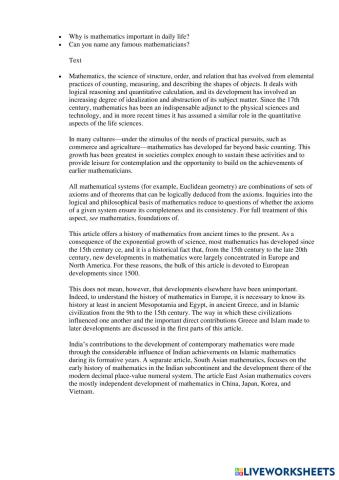
  • Why is mathematics important in daily life?
  • Can you name any famous mathematicians?
  • mathematics, the science of structure, order, and relation that has evolved from elemental practices of counting, measuring, and describing the shapes of objects. It deals with logical reasoning and quantitative calculation, and its development has involved an increasing degree of idealization and abstraction of its subject matter. Since the 17th century, mathematics has been an indispensable adjunct to the physical sciences and technology, and in more recent times it has assumed a similar role in the quantitative aspects of the life sciences.

    In many cultures—under the stimulus of the needs of practical pursuits, such as commerce and agriculture—mathematics has developed far beyond basic counting. This growth has been greatest in societies complex enough to sustain these activities and to provide leisure for contemplation and the opportunity to build on the achievements of earlier mathematicians.

    All mathematical systems (for example, Euclidean geometry) are combinations of sets of axioms and of theorems that can be logically deduced from the axioms. Inquiries into the logical and philosophical basis of mathematics reduce to questions of whether the axioms of a given system ensure its completeness and its consistency. For full treatment of this aspect, see mathematics, foundations of.

    This article offers a history of mathematics from ancient times to the present. As a consequence of the exponential growth of science, most mathematics has developed since the 15th century ce, and it is a historical fact that, from the 15th century to the late 20th century, new developments in mathematics were largely concentrated in Europe and North America. For these reasons, the bulk of this article is devoted to European developments since 1500.

    This does not mean, however, that developments elsewhere have been unimportant. Indeed, to understand the history of mathematics in Europe, it is necessary to know its history at least in ancient Mesopotamia and Egypt, in ancient Greece, and in Islamic civilization from the 9th to the 15th century. The way in which these civilizations influenced one another and the important direct contributions Greece and Islam made to later developments are discussed in the first parts of this article.

    India’s contributions to the development of contemporary mathematics were made through the considerable influence of Indian achievements on Islamic mathematics during its formative years. A separate article, South Asian mathematics, focuses on the early history of mathematics in the Indian subcontinent and the development there of the modern decimal place-value numeral system. The article East Asian mathematics covers the mostly independent development of mathematics in China, Japan, Korea, and Vietnam.

  • Match the words with their meanings.
  • structure -the process of thinking logically about something
  • reasoning-a way that parts are organized or arranged
  • quantitative-a general idea rather than a concrete object
  • abstraction-related to numbers or amounts
  • commerce-to support or keep something going
  • sustain-the activity of buying and selling goods
  • axiom-a statement that can be proved using facts and logic
  • theorem-a statement that is accepted as true without proof
  • civilization-the power to affect how someone or something develops
  • influence-an advanced human society with culture and knowledge
  • Fill in the blanks with correct words from the list:
    (structure, reasoning, commerce, influence, civilization)
  • Ancient _______ like Egypt and Greece made big progress in mathematics.
  • Logical _______ is important for solving problems.
  • Trade and _______ helped mathematics grow.
  • The _______ of India was strong in Islamic mathematics.
  • Geometry studies the _______ of shapes.
  • Choose the correct form.
  • Mathematics (has / have) been important since ancient times.
  • It (developed / has developed) far beyond basic counting.
  • Many cultures (were / have been) influenced by Greek mathematics.
  • Mathematicians (worked / have worked) for centuries to create new ideas.
  • Since the 17th century, mathematics (became / has become) a part of science.
  • Reading Comprehension

    Answer the questions:

  • What is mathematics described as in the first paragraph?
  • Why did mathematics develop in many cultures?
  • What are mathematical systems made of?
  • Where did most mathematical development occur after the 15th century?
  • Why is it important to study ancient civilizations to understand European mathematics?
  • How did India influence Islamic mathematics?

Create and Customize Worksheets for Every Classroom

LiveWorksheets makes it easy for teachers, parents and homeschool educators to design and deliver engaging learning materials. Upload a PDF or start from scratch to create what you need: anything from interactive math worksheets to reading comprehension worksheets, multiplication worksheets, and kindergarten worksheets in just a few clicks. Our drag-and-drop editor works across all grade levels and subjects, so you can tailor content to your lesson plans, homework, or assessments. ESL teachers can also build custom ESL worksheets, add a common sound chart, or integrate ESL activities to make each class more engaging. Easily create differentiated, auto-graded activities that save valuable time and support better student learning.

A Complete Library of Learning Resources for K-12 and ESL

Access thousands of ready-to-use worksheets across K-12 subjects, including kindergarten worksheets, math worksheets, multiplication practice, reading comprehension exercises, and ESL resources. Filter by grade, subject, or skill level to find exactly what you need, whether it’s for an elementary classroom, middle school review, or high school practice. ESL teachers can explore our growing collection of ESL worksheets and English as a Second Language activities designed to support all levels of learners. With new content added regularly, LiveWorksheets is a flexible resource that helps build lasting learning outcomes.