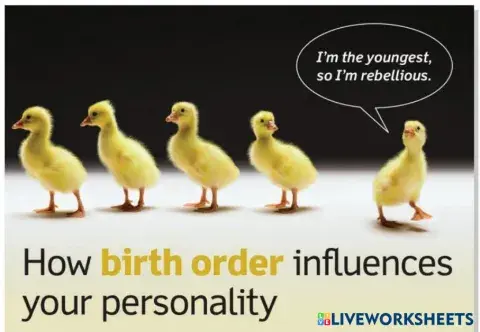
How birth order influences your personality

Reading - ESL

THE OLDEST CHILD

Firstborn children often have to look after their younger brothers and sisters, so they're usually sensible and responsible as adults.

They also tend to be ambitious, and they make good leaders. On the negative side, oldest children can be insecure and anxious. This is because -1-H. when the second child was born, they lost some of their parents' attention, and maybe they felt rejected

THE MIDDLE CHILD

Middle children are more relaxed than the oldest children, probably because -2- C. their parents were more relaxed themselves by the time the second child arrived. They're usually very sociable - the kind

of people who get on with everybody. They are also usually sensitive to what other people need, because -3-A. they grew up between older and younger brothers and sisters. For the same reason, they're often quite good at sorting out arguments, and they're always sympathetic to the ones on the losing side, or in general, to people who are having problems. On the other hand, middle children can sometimes be unambitious, and they can lack direction in life.

THE YOUNGEST CHILD

Youngest children are often very outgoing and charming. This is the way they try to get the attention of both their parents and their older brothers and sisters. They are often more rebellious, and this is probably because

-4-B. it's easier for them to break the rules - by the time they were born, their parents were more relaxed about discipline. They can also be immature and disorganized, and they often depend too much on other people, because -5-E. they have always been the baby of the family.

THE ONLY CHILD

Only children usually do very well at school, because they have a lot of contact with adults. They get a lot of love and attention from their parents, so they're typically self-confident. They're also independent, as they spend so much time by themselves. And because -6-F. they spend a lot of time with adults, they're often very organized. Only children can sometimes be spoilt, because -7-D. they are given everything they ask for by their parents. They can also be quite selfish and get impatient, especially when things go wrong. This is because -8-G. they've never had to sort out problems with other brothers and sisters.

Reading Task 2

Reading - ESL

THE OLDEST CHILD

Firstborn children often have to look after their younger brothers and sisters, so they're usually sensible and responsible as adults.

They also tend to be ambitious, and they make good leaders. On the negative side, oldest children can be insecure and anxious. This is because -1-H. when the second child was born, they lost some of their parents' attention, and maybe they felt rejected

THE MIDDLE CHILD

Middle children are more relaxed than the oldest children, probably because -2- C. their parents were more relaxed themselves by the time the second child arrived. They're usually very sociable - the kind

of people who get on with everybody. They are also usually sensitive to what other people need, because -3-A. they grew up between older and younger brothers and sisters. For the same reason, they're often quite good at sorting out arguments, and they're always sympathetic to the ones on the losing side, or in general, to people who are having problems. On the other hand, middle children can sometimes be unambitious, and they can lack direction in life.

THE YOUNGEST CHILD

Youngest children are often very outgoing and charming. This is the way they try to get the attention of both their parents and their older brothers and sisters. They are often more rebellious, and this is probably because

-4-B. it's easier for them to break the rules - by the time they were born, their parents were more relaxed about discipline. They can also be immature and disorganized, and they often depend too much on other people, because -5-E. they have always been the baby of the family.

THE ONLY CHILD

Only children usually do very well at school, because they have a lot of contact with adults. They get a lot of love and attention from their parents, so they're typically self-confident. They're also independent, as they spend so much time by themselves. And because -6-F. they spend a lot of time with adults, they're often very organized. Only children can sometimes be spoilt, because -7-D. they are given everything they ask for by their parents. They can also be quite selfish and get impatient, especially when things go wrong. This is because -8-G. they've never had to sort out problems with other brothers and sisters.

Reading Comprehension - The Golestan Palace in Tehran

Reading Comprehension

Reading Comprehension - The Golestan Palace in Tehran


Resources:

UNESCO “Nomination of Golestan Palace For Inscription on the world heritage list”


Disclaimer:

I’m neither a native speaker of English nor a professional educationalist. I’m just a simple person whose native tongue is Arabic. I’m trying to make a positive impact on this world, and I believe that passing knowledge to them young minds coming after us is one way to do that. If you have any suggestions regarding the content of this worksheet, please don’t hesitate to reach out to me at Skype: [email protected]. Please remember that I’d always be pleased to hear from you all!!


Call to donate:

Hi there!! If you are reading this, then you probably are either a learner or having a career in the educational sector. In each case, you mostly are having enough to deal with in your own life. Please remember that you are free to print this worksheet and distribute it in the way you find suitable and promoting to learners. Yet, if you have a suggestion regarding modifying part or all of it, then I’d be really pleased to hear from you first so that we can help as many learners as possible. I know this is not the perfect place to ask this, but if you think that you can donate to help me produce more worksheets similar to this one, then please reach out to me at my Skype account: [email protected] so I can send you my credit card number or see how you can do that some other possible ways. Thanks in advance!!

Interview with a celebrity

Grammar - English Language

Fill in the gap with a suitable word of the following interview. 


Instructions:
Complete the interview with the correct verb tense (Present Simple or Present Continuous) or a suitable missing word.

Interviewer: Hello everyone, and welcome to our show! Today we’re joined by the super talented Bruno Mars. Welcome, Bruno!
Bruno Mars: Hey! Thanks for [1] ______. I’m excited to be here.

1. Interviewer: How [2] ______ you [3] ______ today?
Bruno Mars: I’m doing great! I’m just [4] ______ after a long week in the studio.

2. Interviewer: [5] ______ you [6] ______ new songs right now?
Bruno Mars: Yes, I [7] ______. I’m working on some funky tracks with my band.

3. Interviewer: What kind of music do you usually [8] ______?
Bruno Mars: I usually make pop and funk music, but I also [9] ______ R&B.

4. Interviewer: [10] ______ you [11] ______ this year?
Bruno Mars: Not yet, but we [12] ______ a big tour for next summer.

5. Interviewer: How often do you [13] ______ with your band?
Bruno Mars: We practise almost every day when we’re preparing for a concert.

6. Interviewer: Who [14] ______ the lyrics for your songs?
Bruno Mars: I do! But sometimes I write together with my bandmates.

7. Interviewer: Do you [15] ______ any instruments?
Bruno Mars: Yes, I play the guitar, drums, and piano.

8. Interviewer: [16] ______ you [17] ______ any new instruments these days?
Bruno Mars: I’m trying to learn the trumpet — it’s harder than I [18] ______!

9. Interviewer: What’s your favourite song that you’ve [19] ______?
Bruno Mars: Probably “Treasure” — it always makes people smile.

10. Interviewer: Are you [20] ______ at any festivals this year?
Bruno Mars: Yes, I’m performing at Coachella and a few others.

11. Interviewer: What do you do when you’re not [21] ______ music?
Bruno Mars: I spend time with my family, play basketball, and watch movies.

12. Interviewer: Do you [22] ______ nervous before going on stage?
Bruno Mars: Always! But once I start singing, the nerves [23] ______.

13. Interviewer: [24] ______ you [25] ______ any love songs at the moment?
Bruno Mars: Yes, I am. Love songs are my favourite — they never get old!

14. Interviewer: How many hours a day [26] ______ you [27] ______ in the studio?
Bruno Mars: About six or seven hours. Time [28] ______ when I’m making music.

15. Interviewer: Who [29] ______ you the most as an artist?
Bruno Mars: Michael Jackson, Elvis Presley, and Prince — they’re legends.

16. Interviewer: Are you [30] ______ to collaborate with anyone soon?
Bruno Mars: Yes, I’m talking to Anderson .Paak about a new Silk Sonic project.

17. Interviewer: Do you [31] ______ travelling for concerts?
Bruno Mars: Yes, I love meeting fans all over the world.

18. Interviewer: How do you [32] ______ after a show?
Bruno Mars: I hang out with the band, eat good food, and listen to old records.

19. Interviewer: What advice [33] ______ you [34] ______ to young musicians?
Bruno Mars: Work hard, stay humble, and keep practising every day.

20. Interviewer: Thank you, Bruno, for [35] ______ us today!
Bruno Mars: Thank you! It’s been a pleasure. See you on tour!

Answer key

  1. having
  2. are
  3. doing
  4. relaxing
  5. Are
  6. recording
  7. am
  8. make
  9. love
  10. Are
  11. touring
  12. are planning
  13. practise
  14. writes
  15. play
  16. Are
  17. learning
  18. expected
  19. written
  20. performing
  21. making
  22. get
  23. disappear
  24. Are
  25. writing
  26. do
  27. work
  28. flies
  29. inspires
  30. planning
  31. enjoy
  32. relax
  33. would
  34. give
  35. joining

Crea y personaliza fichas interactivas para cada aula

LiveWorksheets facilita a profesorado, familias y personas que educan en casa el diseño y la entrega de materiales de aprendizaje atractivos. Solo tienes que subir un PDF o empezar desde cero para crear lo que necesites: desde fichas interactivas de matemáticas hasta ejercicios de comprensión lectora, fichas de multiplicación o actividades para infantil, todo en unos pocos clics. Nuestro editor de arrastrar y soltar funciona en todos los cursos y asignaturas, lo que te permite adaptar el contenido a tus programaciones, deberes o evaluaciones. Quienes enseñan inglés como segunda lengua (ESL) también pueden crear sus propias fichas, añadir cuadros de sonidos comunes o integrar actividades de ESL para hacer cada clase más participativa. Además, podrás diseñar fácilmente tareas diferenciadas y autocorregidas que ahorran tiempo y apoyan un mejor aprendizaje del alumnado.

Una biblioteca completa de recursos para K-12 y ESL

Accede a miles de fichas listas para usar en todas las asignaturas de K-12, incluidas actividades para infantil, matemáticas, práctica de multiplicación, comprensión lectora y recursos de ESL. Filtra por curso, materia o nivel de competencia para encontrar exactamente lo que necesitas, ya sea para un aula de primaria, una revisión en secundaria o actividades de práctica en bachillerato. El profesorado de ESL puede explorar nuestra colección en constante crecimiento de fichas y actividades de inglés como segunda lengua, diseñadas para apoyar a estudiantes de todos los niveles. Con nuevo contenido añadido de forma regular, LiveWorksheets es un recurso flexible que ayuda a lograr aprendizajes duraderos.