Thanksgiving

Writing - ESL

A Time for Thanks... and Reflection: The Story of

Thanksgiving is like, the most American holiday ever, right? We picture Pilgrims, turkeys, and a big

feast, all about being thankful. But there's way more to it than just that. It's got a long history, and

not all of it is as simple as the stories we hear in elementary school.

Harvest festivals and giving thanks have been around forever. Think ancient Greeks honoring

Demeter or Jewish celebrations like the Feast of the Tabernacles. Even way back in 1607, British

colonists in Maine gave thanks for arriving safely. But the Thanksgiving we know today? That story

gets a little more complicated.

Some people think the first Thanksgiving actually happened in Virginia in 1619. A colony called

Berkley Hundred held a religious service to celebrate their ship's arrival and said they'd do it every

year. But that colony didn't last, so the Pilgrims got all the credit. The Pilgrims, who landed near

Plymouth Rock, are usually credited with holding a harvest celebration with the Wampanoag tribe

in 1621. They ate things like lobster, clams, and, of course, "wild turkeys".

Here's where it gets tricky. The story we usually hear is all about Pilgrims and Native Americans

having a friendly meal together. But that's only one side of the story. Many Native Americans see

Thanksgiving as a reminder of what they lost when Europeans came to America. After that first

Thanksgiving, things changed quickly. There were massacres and wars, and Native Americans lost

their land and independence. So, for them, Thanksgiving isn't always a happy holiday.

Created with web.diffit.meIt's important to remember that history isn't always simple. There are different perspectives, and

it's good to hear them all. Some people might argue that focusing on the negative aspects of

Thanksgiving is disrespectful to the Pilgrims and the idea of giving thanks. They might say that it's

important to celebrate the good things in our history, even if they're not perfect. But others would

say that ignoring the negative aspects is disrespectful to Native Americans and their experiences.

They might argue that it's important to acknowledge the full history of Thanksgiving, both the

good and the bad.

Over time, Thanksgiving became more than just a harvest celebration. Presidents started

declaring days of Thanksgiving, and Abraham Lincoln made it a national holiday in 1863. The White

House even has its own Thanksgiving traditions, like the turkey pardon. The turkey pardon became

a tradition when President George H.W. Bush pardoned a turkey in 1989.

Today, Thanksgiving is a mix of traditions. We travel to see family, eat a big feast, watch parades

and football, and maybe even break a wishbone. Some people volunteer to help others in need.

But it's also a time to remember the real history of Thanksgiving, with all its complexities, and to

be respectful of different viewpoints. It's a time to be thankful, but also to think about the past

and how it affects the present

Grammar

Vocabulary - Language Arts


1️⃣ Nhắc nhanh lý thuyết thì Hiện tại đơn

🔹 Cách dùng

  • Diễn tả thói quen, việc lặp lại thường xuyên
    👉 always, usually, often, every day/week, once a week…

  • Diễn tả sự thật hiển nhiên
    👉 Water boils at 100°C.

🔹 Công thức

1. Khẳng định

  • I / You / We / They + V nguyên mẫu

  • He / She / It + V-s / V-es

👉 Ví dụ:

  • I go to school.

  • He goes to school.

2. Phủ định

  • I / You / We / They + do not (don’t) + V

  • He / She / It + does not (doesn’t) + V

3. Nghi vấn

  • Do + I / you / we / they + V…?

  • Does + he / she / it + V…?

⚠️ Lưu ý: Sau do/does → động từ luôn ở dạng nguyên mẫu

2️⃣ Hướng dẫn từng câu + đáp án

1. I never (go) … to work on Sunday

👉 Chủ ngữ I → V nguyên mẫu
go

➡️ I never go to work on Sunday.

2. My father usually (get) … up at six

👉 Chủ ngữ My father (He) → V-s
gets

➡️ My father usually gets up at six.

3. Nam (be) … a good student

👉 Chủ ngữ Nam (He) → be = is
is

➡️ Nam is a good student.

4. They (play) … soccer once a week

👉 Chủ ngữ They → V nguyên mẫu
play

➡️ They play soccer once a week.

5. My brother (listen) … to music in his free time

👉 Chủ ngữ My brother (He) → V-s
listens

➡️ My brother listens to music in his free time.

6. We (be) … late for school

👉 Chủ ngữ We → be = are
are

➡️ We are late for school.

7. Lan and Nga (not skip) … rope at recess

👉 Chủ ngữ Lan and Nga (They)
👉 Phủ định: do not + V
do not skip / don’t skip

➡️ Lan and Nga don’t skip rope at recess.

8. Ba often (do) … his homework after dinner

👉 Chủ ngữ Ba (He) → V-s
does

➡️ Ba often does his homework after dinner.

9. What … you (do) … every evening?

👉 Câu hỏi – chủ ngữ you
👉 Do + you + V
do / do

➡️ What do you do every evening?

10. She (not go) … to school in the afternoon

👉 Chủ ngữ She
👉 Phủ định: does not + V
does not go / doesn’t go

➡️ She doesn’t go to school in the afternoon.

11. Hoa (watch) … TV every evening

👉 Chủ ngữ Hoa (She) → V-s
watches

➡️ Hoa watches TV every evening.

12. Mr. Minh (brush) … his teeth after meals

👉 Chủ ngữ Mr. Minh (He) → V-s
👉 brush → brushes
brushes

➡️ Mr. Minh brushes his teeth after meals.

13. Water (boil) … at 100°C

👉 Sự thật hiển nhiên → thì HTĐ
👉 Chủ ngữ Water (It) → V-s
boils

➡️ Water boils at 100°C.

3️⃣ Tổng hợp đáp án nhanh

  1. go

  2. gets

  3. is

  4. play

  5. listens

  6. are

  7. don’t skip

  8. does

  9. do – do

  10. doesn’t go

  11. watches

  12. brushes

  13. boils


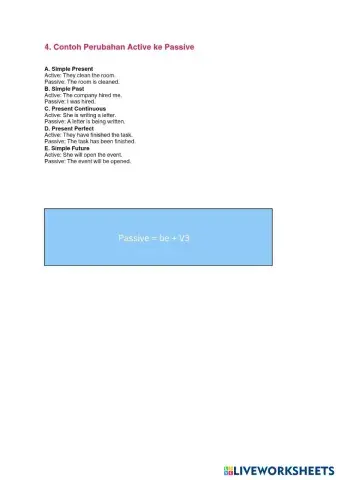
PASSIVE VOICE

Vocabulary - Language Arts

Pilihan Ganda

1. The new policy has been implemented by the company.
A) The company has implemented the new policy.
B) The new policy is implemented by the company.
C) The company is implementing the new policy.
D) The new policy was implemented by the company.
E) The company implements the new policy.

2. The ball was thrown by John.
A) John throws the ball.
B) John threw the ball.
C) John is throwing the ball.
D) John has thrown the ball.
E) John will throw the ball.

3. The play is being performed by the students.
A) The students are performing the play.
B) The students performed the play.
C) The students will perform the play.
D) The students have performed the play.
E) The play was performed by the students.

4. The package was delivered to my doorstep.
A) Someone delivers the package to my doorstep.
B) Someone delivered the package to my doorstep.
C) Someone is delivering the package to my doorstep.
D) Someone will deliver the package to my doorstep.
E) Someone has delivered the package to my doorstep.

5. The new employee is being trained by the manager.
A) The manager trains the new employee.
B) The manager trained the new employee.
C) The manager is training the new employee.
D) The manager will train the new employee.
E) The manager has trained the new employee.

Uraian

1. Ubahlah kalimat berikut menjadi passive voice: "The teacher is explaining the lesson."

2. Ubahlah kalimat berikut menjadi passive voice: "The company has hired a new manager."

3. Ubahlah kalimat berikut menjadi passive voice: "The students are doing their homework."

4. Ubahlah kalimat berikut menjadi passive voice: "The chef is preparing the meal."

5. Ubahlah kalimat berikut menjadi passive voice: "The police officer is investigating the crime."

Crea y personaliza fichas interactivas para cada aula

LiveWorksheets facilita a profesorado, familias y personas que educan en casa el diseño y la entrega de materiales de aprendizaje atractivos. Solo tienes que subir un PDF o empezar desde cero para crear lo que necesites: desde fichas interactivas de matemáticas hasta ejercicios de comprensión lectora, fichas de multiplicación o actividades para infantil, todo en unos pocos clics. Nuestro editor de arrastrar y soltar funciona en todos los cursos y asignaturas, lo que te permite adaptar el contenido a tus programaciones, deberes o evaluaciones. Quienes enseñan inglés como segunda lengua (ESL) también pueden crear sus propias fichas, añadir cuadros de sonidos comunes o integrar actividades de ESL para hacer cada clase más participativa. Además, podrás diseñar fácilmente tareas diferenciadas y autocorregidas que ahorran tiempo y apoyan un mejor aprendizaje del alumnado.

Una biblioteca completa de recursos para K-12 y ESL

Accede a miles de fichas listas para usar en todas las asignaturas de K-12, incluidas actividades para infantil, matemáticas, práctica de multiplicación, comprensión lectora y recursos de ESL. Filtra por curso, materia o nivel de competencia para encontrar exactamente lo que necesitas, ya sea para un aula de primaria, una revisión en secundaria o actividades de práctica en bachillerato. El profesorado de ESL puede explorar nuestra colección en constante crecimiento de fichas y actividades de inglés como segunda lengua, diseñadas para apoyar a estudiantes de todos los niveles. Con nuevo contenido añadido de forma regular, LiveWorksheets es un recurso flexible que ayuda a lograr aprendizajes duraderos.