Adjective suffixes

Vocabulary - English Language

🌟 Exercise 1: Choose the Correct Adjective
(Use -ed or -ing)

  1. The movie was really __________ (bore). I almost fell asleep.
  2. She felt __________ (disappoint) after she failed the exam.
  3. That was a very __________ (confuse) question.
  4. I’m so __________ (excite) about our trip to Japan!
  5. The lecture was __________ (interest), and everyone listened carefully.
  6. He looks __________ (tire) after working all night.
  7. The story was __________ (amaze); I didn’t expect that ending!
  8. I felt __________ (frustrate) when my phone stopped working.

💡 Exercise 2: Complete the Sentences with -ful or -less

  1. Be __________ (care) when you cross the road.
  2. She’s so __________ (hope); she never gives up!
  3. Don’t be __________ (fear); everything will be fine.
  4. That was a very __________ (use) idea — thank you!
  5. This pen is __________ (use); it doesn’t even write.
  6. He is always __________ (help); he loves to assist others.
  7. The child looked __________ (care); he didn’t notice the danger.
  8. She gave me a __________ (meaning) gift — I’ll always remember it.

✍️ Exercise 3: Fill in the Blanks with the Correct Adjective

(bored – boring – helpful – careless – excited – tiring – hopeful – useless)

  1. The teacher was very __________ and explained everything clearly.
  2. I felt __________ after running for two hours.
  3. Don’t be __________; pay attention to what you’re doing!
  4. This tool is completely __________ — it doesn’t work at all.
  5. The kids were __________ when they saw the fireworks.
  6. That was the most __________ class I’ve ever had.
  7. He’s still __________ about finding a new job soon.
  8. I was so __________ that I started scrolling my phone during the movie.

Thanksgiving

Writing - ESL

A Time for Thanks... and Reflection: The Story of

Thanksgiving is like, the most American holiday ever, right? We picture Pilgrims, turkeys, and a big

feast, all about being thankful. But there's way more to it than just that. It's got a long history, and

not all of it is as simple as the stories we hear in elementary school.

Harvest festivals and giving thanks have been around forever. Think ancient Greeks honoring

Demeter or Jewish celebrations like the Feast of the Tabernacles. Even way back in 1607, British

colonists in Maine gave thanks for arriving safely. But the Thanksgiving we know today? That story

gets a little more complicated.

Some people think the first Thanksgiving actually happened in Virginia in 1619. A colony called

Berkley Hundred held a religious service to celebrate their ship's arrival and said they'd do it every

year. But that colony didn't last, so the Pilgrims got all the credit. The Pilgrims, who landed near

Plymouth Rock, are usually credited with holding a harvest celebration with the Wampanoag tribe

in 1621. They ate things like lobster, clams, and, of course, "wild turkeys".

Here's where it gets tricky. The story we usually hear is all about Pilgrims and Native Americans

having a friendly meal together. But that's only one side of the story. Many Native Americans see

Thanksgiving as a reminder of what they lost when Europeans came to America. After that first

Thanksgiving, things changed quickly. There were massacres and wars, and Native Americans lost

their land and independence. So, for them, Thanksgiving isn't always a happy holiday.

Created with web.diffit.meIt's important to remember that history isn't always simple. There are different perspectives, and

it's good to hear them all. Some people might argue that focusing on the negative aspects of

Thanksgiving is disrespectful to the Pilgrims and the idea of giving thanks. They might say that it's

important to celebrate the good things in our history, even if they're not perfect. But others would

say that ignoring the negative aspects is disrespectful to Native Americans and their experiences.

They might argue that it's important to acknowledge the full history of Thanksgiving, both the

good and the bad.

Over time, Thanksgiving became more than just a harvest celebration. Presidents started

declaring days of Thanksgiving, and Abraham Lincoln made it a national holiday in 1863. The White

House even has its own Thanksgiving traditions, like the turkey pardon. The turkey pardon became

a tradition when President George H.W. Bush pardoned a turkey in 1989.

Today, Thanksgiving is a mix of traditions. We travel to see family, eat a big feast, watch parades

and football, and maybe even break a wishbone. Some people volunteer to help others in need.

But it's also a time to remember the real history of Thanksgiving, with all its complexities, and to

be respectful of different viewpoints. It's a time to be thankful, but also to think about the past

and how it affects the present

Reading Worksheet - PFlores

English as a Second Language (ESL)

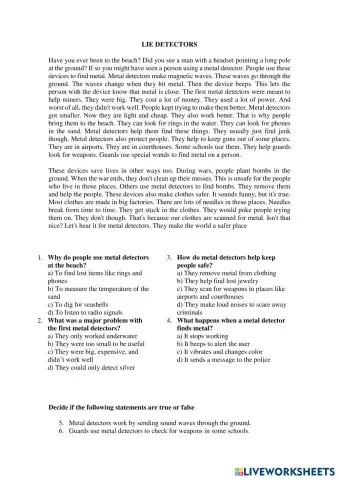
Have you ever been to the beach? Did you see a man with a headset pointing a long pole at the ground? If so you might have seen a person using a metal detector. People use these devices to find metal. Metal detectors make magnetic waves. These waves go through the ground. The waves change when they hit metal. Then the device beeps. This lets the person with the device know that metal is close. The first metal detectors were meant to help miners. They were big. They cost a lot of money. They used a lot of power. And worst of all, they didn't work well. People kept trying to make them better. Metal detectors got smaller. Now they are light and cheap. They also work better. That is why people bring them to the beach. They can look for rings in the water. They can look for phones in the sand. Metal detectors help them find these things. They usually just find junk though. Metal detectors also protect people. They help to keep guns out of some places. They are in airports. They are in courthouses. Some schools use them. They help guards look for weapons. Guards use special wands to find metal on a person.

These devices save lives in other ways too. During wars, people plant bombs in the ground. When the war ends, they don't clean up their messes. This is unsafe for the people who live in those places. Others use metal detectors to find bombs. They remove them and help the people. These devices also make clothes safer. It sounds funny, but it's true. Most clothes are made in big factories. There are lots of needles in these places. Needles break from time to time. They get stuck in the clothes. They would poke people trying them on. They don't though. That's because our clothes are scanned for metal. Isn't that nice? Let's hear it for metal detectors. They make the world a safer place

TRAVELLING

ENGLISH

Exploring Natural Wonders


Read the following passage and fill in the gaps with the correct form of the adjectives (irregular comparatives and superlatives) 


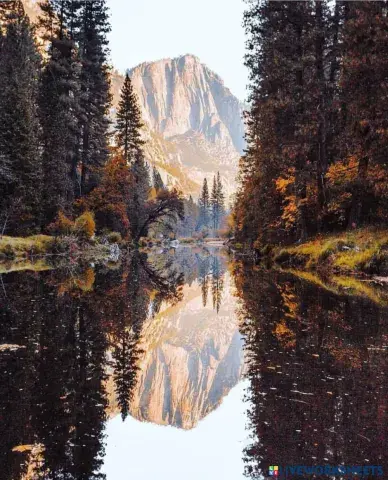
Last summer, I went on a trip to explore some of the most beautiful geographical features in the country. The journey started at the (beautiful) __________ coast I've ever seen. The cliffs there are much (high) __________ than the ones near my hometown.

Next, we visited a beach that was even (nice) __________ than the coast. The sand was softer, and the waves were gentler. After spending a day at the beach, we hiked to a (steep) __________ hill that gave us a panoramic view of the countryside.

Our next stop was a hidden cave, which was definitely (dark) __________ and (cool) __________ than the beach. We had to use flashlights to see the stunning formations inside.

We also saw a majestic waterfall that was the (powerful) __________ I've ever encountered. The sound of the water crashing down was much (loud) __________ than anything I've heard before.

The countryside was our next destination, and it was far (peaceful) __________ than the bustling city. We walked through a valley that seemed (green) __________ and (fertile) __________ than anywhere else on our journey.

One of the most memorable moments was when we followed a stream that led us to a winding river. The river was (wide) __________ and (clear) __________ than the stream, providing a perfect spot for a refreshing swim.

Towards the end of our trip, we ventured into a dense rainforest. It was (humid) __________ and (lush) __________ than any forest I've ever been to. The variety of plants and animals there was simply (astonishing) __________.

Finally, we ended our adventure in the desert. The landscape was (dry) __________ and (hot) __________ than any other place we visited. Despite the harsh conditions, the desert had its own unique beauty.

Crea y personaliza fichas interactivas para cada aula

LiveWorksheets facilita a profesorado, familias y personas que educan en casa el diseño y la entrega de materiales de aprendizaje atractivos. Solo tienes que subir un PDF o empezar desde cero para crear lo que necesites: desde fichas interactivas de matemáticas hasta ejercicios de comprensión lectora, fichas de multiplicación o actividades para infantil, todo en unos pocos clics. Nuestro editor de arrastrar y soltar funciona en todos los cursos y asignaturas, lo que te permite adaptar el contenido a tus programaciones, deberes o evaluaciones. Quienes enseñan inglés como segunda lengua (ESL) también pueden crear sus propias fichas, añadir cuadros de sonidos comunes o integrar actividades de ESL para hacer cada clase más participativa. Además, podrás diseñar fácilmente tareas diferenciadas y autocorregidas que ahorran tiempo y apoyan un mejor aprendizaje del alumnado.

Una biblioteca completa de recursos para K-12 y ESL

Accede a miles de fichas listas para usar en todas las asignaturas de K-12, incluidas actividades para infantil, matemáticas, práctica de multiplicación, comprensión lectora y recursos de ESL. Filtra por curso, materia o nivel de competencia para encontrar exactamente lo que necesitas, ya sea para un aula de primaria, una revisión en secundaria o actividades de práctica en bachillerato. El profesorado de ESL puede explorar nuestra colección en constante crecimiento de fichas y actividades de inglés como segunda lengua, diseñadas para apoyar a estudiantes de todos los niveles. Con nuevo contenido añadido de forma regular, LiveWorksheets es un recurso flexible que ayuda a lograr aprendizajes duraderos.