Simple Past Tense Verbs Reg & Irregular

Writing

Write the simple PAST tense of the verbs in parentheses.


1. Bianca and her friends ______ (plan) to have a picnic but the weather was bad, and they had to cancel.

2. One of the older ladies __________ (trip) and ______ (fall) because there were many rocks and pebbles on the path.

3. Do you know where my group ____ (go)? I _____ (lose) them in the crowd.

4. Although the dancing squad _________ (practice) for weeks, they did not come in first place in the competition.

5. Every day I put my cell phone away in class. Yesterday, I _______ (leave) it there because I _________ (forget) to take it with me.

6. My best friend and I ______ (argued) yesterday. She _____ (hurt) my feelings because she ____ (say) mean things about me.

7. After we _____ (calm) down and _____ (talk), she ________ (apologize) and we _________ (become) friends again.

8. My Dad _________ (want) to buy something very special for my mother on their anniversary. He ________ (save) money in order to buy it.

9. When he saw the bracelet on sale, he __________ (order) it and ________ (buy) it.

10. The guys _______(be) disappointed that their team did not win the game. They ______ (spend) a lot of money on the tickets and _____ (drive) a long way to get there.

11. You ___________ (visit) your uncle and aunt in Tennessee, didn't you? I ____ (try) to call you, but my calls were not going through.

12. He ______ (tell) you how to build the doghouse and it appears that you ___________ (listen) well because it looks very sturdy.

13. If you ____ (have) another chance to past the test, you should have ______ (study) hard to get a better grade.

14. We ____ (use) all of the supplies at the campsite. When we ____ (run) out of everything, we _____ (have) to go to the store.

15. At the park, we ______ (drink) a lot of water, because it ___ (is) very hot. We also ____ (feed) bread to the ducks at the lake.

16. At the end of the day, I ____ (feel) tired, so I _____ (take) my vitamins and ___ (go) to bed.

Mid-course test MIFA301 LIVE

English

GRAMMAR AND VOCABULARY TEST

I - Choose the correct answer (14 points)

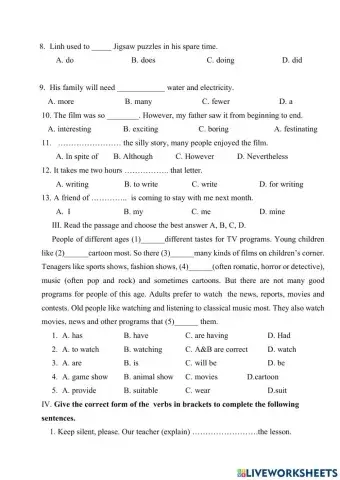
1. Thomas Edison, ____________ was American, invented many things, including the light bulb.

A. which                    B. who                        C. was                         D. that

2. My MP3 player is better than __________!

A. you                         B. your                       C. yours                      D. mine

3. "What happened to the old postman?"

- "He ____________ to a new neighborhood to work".

A. has sent                  B. was send                C. was sent                 D. sent

4. This job is much ____________ than the last one!

A. hard                       B. hardest                   C. harder                    D. more hard

5. Our company is moving into a ____________ building next week.

A. larger                     B. largest                    C. more large             D. most large

6. What’s the ___________job you’ve ever had?

A. most good             B. best                        C. better                      D. good

7. Those towns ____________ you were looking at in Gaul are small.

A. who                        B. where                     C. which                     D. whom

8. The women ____________ I gave the money were glad.

A. to whom                B. to who                    C. for whom               D. for that

9. I know a boy ____________ name is John.


A. who                        B. whose                    C. whom                    D. that

10. This is the place ____________ we have tea.

A. what                       B. where                      C. which                    D. that

11. The house ____________ in the storm has now been rebuilt.

A. destroyed              B. destroying              C. which destroyed    D. was destroyed

12. The man ____________ at the blackboard is our teacher.

A. stood                     B. stands                     C. standing                 D. to stand

13. Gold ____________ in California in the nineteenth century.

A. was discovered        B. has been discovered     C. was discovere       D. they discovered

14. If I ____________ 20 years younger, I ____________ her.

A. were/would love   B. am/will love                 C. were/ loves      D. had/would love


II - Change the verbs in the brackets (10 points)

1. My bike ________________ (steal)! Call the police!

2. “The longest fish in the contest was eighteen inches long.”

- “It ________________ (catch) by Thelma Rivers.”

3. “What ____________________ (you do) when you saw the man?”, the police officer asked.

4. Do you think Curtis ___________________ (win) the car race tomorrow?

5. It’s the first time I ___________________ (get) all the answers right in a test!

6. Watch out, or you __________________ (fall) off the boat!

7. The exam ___________________ (already start) when Jimmy finally found the right room.

8. I’m tired because I ___________________ (work) since eight this morning.

9. I broke my leg when Tony and I ___________________ (practice) for the school sports day.

10. I ______________________ (travel) around the world one day.


III - Finish the following sentences without changing the meaning of the sentences printed before them. (10 points)

1. I usually get up earlier than my wife.

=> My wife __________________________________________________________________ .

2. You drink too much coffee, that’s why you can’t sleep.

=> If you ____________________________________________________________________ .

3. I’ve never played this game before.

=> This is the first time _________________________________________________________ .

4. He hides the broken cup in the drawer.

=> The broken cup ____________________________________________________________ .

5. The new words are very difficult. I have to learn them. (use “which”)

=> The new words ____________________________________________________________ .

6. Mary’s coat is more expensive than Kate’s.

=> Kate’s coat ________________________________________________________________ .

7. My mother is retired. She has decided to learn Chinese. (use “who”)

=> My mother ________________________________________________________________ .

8. I’m not good at persuading people. (use “Wish”)

=> I  ________________________________________________________________________ .

9. I missed the bus yesterday. I still went to school on time. (use “Although”) =>__________________________________________________________________________ .

10. Lucy came down with a flu last week. She didn’t go to work yesterday. (use “because”) =>__________________________________________________________________________ .


IV. Fill in the blank with one word (15 points)  and make 3 compound sentences, 3 complex sentences using the words given. (6 points)

1. Have a talent ________

2. _______ the exam(s) with flying colors

3. Be a _________ learner

4. Miss/meet the ___________

5. Get __________ in heavy traffic

6. Have a healthy and balanced _______

7. Fall _____ with

8. Strike up a _______________

9. Have a lot ______ common

10. _______ my own business

11. Have good promotion ________________

12. Get _______ shape

13. Have a heavy ___________

14. ___________ a work-life balance

15. Earn a _________ salary

Reflexive pronoun

English Grammar

Reflective Pronouns Worksheet for Grade 5

Section 1: Theory and Rules with Example Sentences

Suggested Time: 10 minutes

What Are Reflexive Pronouns?
Reflexive pronouns are pronouns that end in “-self” or “-selves” and are used when the subject and the object of a sentence are the same person or thing. They are used to reflect the action back onto the subject.

Reflexive Pronouns:

  • Singular: myself, yourself, himself, herself, itself
  • Plural: ourselves, yourselves, themselves

When Do We Use Reflexive Pronouns?

  1. When the subject and object are the same:
    • Example: "I taught myself to play the piano."
    • Explanation: The subject "I" is the same person who is the object "myself."
  2. For emphasis (to emphasize that the subject did the action alone):
    • Example: "She cooked the entire meal herself."
    • Explanation: This emphasizes that "she" did the cooking without help.

Common Errors:

  • Incorrect: "Please give it to myself."
  • Correct: "Please give it to me."
  • Incorrect: "Himself went to the store."
  • Correct: "He went to the store by himself."

Section 2: Challenging NAPLAN-Style Questions

Suggested Time: 10 minutes

Instructions: Choose the correct reflexive pronoun to complete each sentence. Pay close attention to context and ensure the pronoun agrees with the subject.

  1. "After making the cake, Julia decorated it ______."

    • a) herself
    • b) himself
    • c) itself
    • d) themselves
  2. "The committee members decided to handle the problem ______."

    • a) themselves
    • b) itself
    • c) ourselves
    • d) himself
  3. "The robot fixed ______ after the malfunction."

    • a) himself
    • b) itself
    • c) themselves
    • d) ourselves
  4. "You must learn to rely on ______ if you want to be independent."

    • a) myself
    • b) yourselves
    • c) himself
    • d) yourself
  5. "The magician performed all the tricks ______, without any help."

    • a) itself
    • b) themselves
    • c) himself
    • d) herself

Short Answer Section: Instructions: Fill in the blank with the correct reflexive pronoun.

  1. "The cat saw ______ in the mirror and jumped back."
  2. "I taught ______ how to play the guitar by watching videos online."
  3. "The children built the treehouse all by ______."
  4. "During the test, remember to pace ______."
  5. "We enjoyed ______ at the amusement park yesterday."

Section 3: Writing Task to Practice Errors

Suggested Time: 15 minutes

Instructions: Write a short paragraph (4-5 sentences) about a time when you learned to do something by yourself. Use at least two reflexive pronouns in your paragraph.

Example Prompt: "Write about a time you learned a new skill or completed a task by yourself, such as riding a bike, cooking, or doing a school project. Describe what you did and how you felt."

Example Response: "I remember when I learned to bake cookies by myself. I followed the recipe carefully and didn’t ask for any help. I felt proud of myself when the cookies came out delicious. It was fun to bake all by myself!"

REVIEW G6-U3

Grammar - English Language

EX1: Viết các câu sau ở thể khẳng định (+), thể phủ định (-), thể nghi vấn (?) ở thì quá khứ đơn.

1.         (+) They decided to leave soon.

(-) They didn't decide to leave soon.

(?) Did they decide to leave soon?

2.         (+) ________________________________________________________________.

(-) There were not many homeless people here ten years ago.

(?) ________________________________________________________________?

3.         (+) ________________________________________________________________.

(-) _________________________________________________________________.

(?) Did Tom’s grandfather use to be a soldier?

4.         (+) My teacher started teaching here 6 years ago.

(-)_________________________________________________________________.

(?) _________________________________________________________________?

5.         (+) Jane often went to school on foot 3 years ago.

(-) _________________________________________________________________.

(?) _________________________________________________________________?

6.         (+) _________________________________________________________________.

(-) The cat didn’t want to eat yesterday.

(?) _________________________________________________________________?

7.         (+) _________________________________________________________________.

(-) __________________________________________________________________.

(?) Did the train arrive late yesterday?

8.         (+) _________________________________________________________________.

(-) There wasn’t anything left in the fridge.

(?) _________________________________________________________________?

EX2. Chia các động từ trong ngoặc ở thì quá khứ đơn.

  1. Picasso __________ (be)born in 1881.
  2. You _______(be) my inspiration when I was a boy.
  3. Neil Armstrong (be)__________ the first person to walk on the moon.
  4. Last night, I (be)___________ sick.
  5.  Last week, my mother (take) _____________ me to the zoo.
  6. Yesterday, she (be)___________ at home yesterday.
  7. Lorena and I (be)_________ in the same class when we were in secondary school.
  8. When we (arrive) _____________ at the party, there (not be) _____________ many people there.
  9. My mother (say) _____________ that she (buy) _____________ me a new dress.
  10. Last summer, my father (teach) _____________ me to drive.
  11. I (start) _____________ doing charity when I (be) _____________ a first year student.
  12. Many rich people (donate) _____________ money for this volunteer program.
  13. My friend (ring) _____________ me yesterday and (invite) _____________ me to his party.
  14. What (you/ watch) _____________ on TV last night?
  15. When my father (be) _____________ young, he (use to) ______ be the most handsome boy in the village.
  16.  _____________ (you/ go) to see the concert yesterday?
  17. My performance (not be) _____________ really good. I (not feel) _____________ happy about it
  18. Jim (spend) _____________ the whole day taking after his brother
  19. I (write) _____________ a letter to my foreign friend but he (not write) _____________ back.
  20.  _____________ (they/ be) students of our school?

EX3. Viết các câu sau ở thể khẳng định (+), thể phủ định (-), thể nghi vấn (?) ở thì hiện tại hoàn thành.

1.         (+) I have finished my homework.

(-) ________________________________________________________________.

(?) ________________________________________________________________?

2.         (+) ________________________________________________________________.

(-) My uncle hasn’t been to Singapore before.

(?) ________________________________________________________________?

3.         (+) ________________________________________________________________.

(-) ________________________________________________________________.

(?) Have they found their keys?

4.         (+) Jim has just played video games with his brother.

(-) ________________________________________________________________.

(?) ________________________________________________________________?

5.         (+) ________________________________________________________________.

(-) My grandmother hasn’t visited me since November.

(?) ________________________________________________________________?

6.         (+) ________________________________________________________________.

(-) ________________________________________________________________.

(?) Has your sister studied Medicine for 2 years?

7.         (+) It has been long since our last encounter.

(-) ________________________________________________________________.

(?) ________________________________________________________________?

8.         (+) ________________________________________________________________.

(-) We haven’t graduated yet.

(?) ________________________________________________________________?

EX4. Điền “for” hoặc “since” vào chỗ trống sao cho thích hợp.

1. I (learn)________ Japanese for 3 months.

2. May (work)_________ for a non-profit organization since he graduated.

3. Kim (unemploy)  _________ for half a year.

4. I miss my friend. I (see)________ her for  months.

5. We (live)_______ in the dorm since our first year at university.

6. Jim and Jane (know)_____each other for quite a long time.

7. The baby’s hungry. He (not eat) __________anything since the morning.

8. (you/use)________ this laptop for 4 years?

9. They(be)_________ close friends since they started college.

10. My grandmother (be)________ a vegetarian for several years.


Sentence Structures

English as a Second Language (ESL)

1. Simple Sentence

A simple sentence contains only one independent clause (a complete thought). It has a subject and a verb, and it expresses a complete idea.

Structure:

Subject + Verb (and sometimes an object or complement)

Examples:

  1. I eat lunch every day.
    (Subject: "I", Verb: "eat")
  2. She studied for the exam.
    (Subject: "She", Verb: "studied")
  3. The dog barked loudly.
    (Subject: "The dog", Verb: "barked")

2. Compound Sentence

A compound sentence consists of two or more independent clauses joined by a coordinating conjunction (for, and, nor, but, or, yet, so), or by a semicolon.

Structure:

Independent clause + coordinating conjunction + independent clause

Examples:

  1. I wanted to go to the party, but I was too tired.
    (Two independent clauses: "I wanted to go to the party" and "I was too tired," joined by "but")
  2. She likes reading books, and he enjoys playing sports.
    (Two independent clauses: "She likes reading books" and "He enjoys playing sports," joined by "and")
  3. I am studying for my test; I will take a break later.
    (Two independent clauses joined by a semicolon)

3. Complex Sentence

A complex sentence contains one independent clause and at least one dependent clause (a clause that cannot stand alone and does not express a complete thought). Dependent clauses are connected to the independent clause by a subordinating conjunction (because, although, if, when, since, etc.).

Structure:

Independent clause + subordinating conjunction + dependent clause

Examples:

  1. I stayed home because it was raining.
    (Independent clause: "I stayed home" and dependent clause: "because it was raining")
  2. Although she was tired, she finished her homework.
    (Independent clause: "She finished her homework" and dependent clause: "although she was tired")
  3. We will go to the park if it doesn't rain.
    (Independent clause: "We will go to the park" and dependent clause: "if it doesn't rain")

4. Compound-Complex Sentence

A compound-complex sentence is a combination of both a compound sentence and a complex sentence. It contains at least two independent clauses and at least one dependent clause.

Structure:

Independent clause + coordinating conjunction + independent clause + subordinating conjunction + dependent clause

Examples:

  1. I wanted to go to the beach, but it started raining, so we stayed home.
    (Independent clauses: "I wanted to go to the beach" and "it started raining," joined by "but"; dependent clause: "so we stayed home")
  2. Although I studied hard, I didn't pass the test, and I felt disappointed.
    (Independent clauses: "I didn't pass the test" and "I felt disappointed," joined by "and"; dependent clause: "Although I studied hard")
  3. She loves reading books, and she often reads late into the night, because she finds it relaxing.
    (Independent clauses: "She loves reading books" and "She often reads late into the night," joined by "and"; dependent clause: "because she finds it relaxing")

The last Sunday

English

The Last Saturday


Last Saturday, Emily and her friends went to the amusement park. They arrived early in the morning because they wanted to enjoy the whole day there. Emily tried the big roller coaster, and it was very exciting, but also a little scary. Her friend, Jake, didn't like the roller coaster, so he waited for her near the food stalls. After the ride, they all ate hot dogs and drank lemonade. Later, they played games to win prizes, but only Emily won a small teddy bear. At the end of the day, they watched a firework show. They were very tired but happy. It was a fun day.


Vocabulario

  1. Amusement park – parque de diversiones
  2. Roller coaster – montaña rusa
  3. Exciting – emocionante
  4. Scary – aterrador/a
  5. Food stalls – puestos de comida
  6. Hot dog – perro caliente
  7. Lemonade – limonada
  8. Teddy bear – oso de peluche
  9. Firework show – espectáculo de fuegos artificiales

Preguntas de Comprensión

  1. 1. Where did Emily and her friends go last Saturday?
  2. 2. What time of day did they arrive at the amusement park?
  3. 3. What ride did Emily try?
  4. 4. Who didn’t like the roller coaster?
  5. 5. What did they eat after the ride?
  6. 6. What did they drink with their hot dogs?
  7. 7. Who won a prize at the amusement park games?
  8. 8. What kind of prize did Emily win?
  9. 9. What did they watch at the end of the day?
  10. 10. How did Emily and her friends feel at the end of the day?


Complete the sentences using verbs into brackets (simple past tense):


  1. 1. Emily and her friends _____ (go) to the amusement park last Saturday.
  2. 2. They _____ (arrive) early in the morning.
  3. 3. Emily _____ (try) the big roller coaster.
  4. 4. Her friend Jake _____ (not like) the roller coaster.
  5. 5. At the end of the day, they _____ (watch) a firework show.

Crea y personaliza fichas interactivas para cada aula

LiveWorksheets facilita a profesorado, familias y personas que educan en casa el diseño y la entrega de materiales de aprendizaje atractivos. Solo tienes que subir un PDF o empezar desde cero para crear lo que necesites: desde fichas interactivas de matemáticas hasta ejercicios de comprensión lectora, fichas de multiplicación o actividades para infantil, todo en unos pocos clics. Nuestro editor de arrastrar y soltar funciona en todos los cursos y asignaturas, lo que te permite adaptar el contenido a tus programaciones, deberes o evaluaciones. Quienes enseñan inglés como segunda lengua (ESL) también pueden crear sus propias fichas, añadir cuadros de sonidos comunes o integrar actividades de ESL para hacer cada clase más participativa. Además, podrás diseñar fácilmente tareas diferenciadas y autocorregidas que ahorran tiempo y apoyan un mejor aprendizaje del alumnado.

Una biblioteca completa de recursos para K-12 y ESL

Accede a miles de fichas listas para usar en todas las asignaturas de K-12, incluidas actividades para infantil, matemáticas, práctica de multiplicación, comprensión lectora y recursos de ESL. Filtra por curso, materia o nivel de competencia para encontrar exactamente lo que necesitas, ya sea para un aula de primaria, una revisión en secundaria o actividades de práctica en bachillerato. El profesorado de ESL puede explorar nuestra colección en constante crecimiento de fichas y actividades de inglés como segunda lengua, diseñadas para apoyar a estudiantes de todos los niveles. Con nuevo contenido añadido de forma regular, LiveWorksheets es un recurso flexible que ayuda a lograr aprendizajes duraderos.