CAE REVISION COMPLETE UNITS 1+2

English as a Second Language (ESL)

COMPLETE ADVANCED UNITS 1+2

Exercise 1: Underline the correct options to complete the sentences.

  1. 1. After waiting in line for hours, we finally had / ate / would eat / were eating something small. By then, we were very hungry.
  2. 2. Alicia still hadn’t found / wasn’t finding / didn’t use to find / didn’t find a job when I last spoke to her.
  3. 3. By the time we arrived, most of the dessert already went / had already gone / would go / was already going. Only a few pieces were left.
  4. 4. Aaron wouldn’t leave / hadn’t left / didn’t use to leave / didn’t leave until red finished his homework.
  5. 5. As soon as we were collecting / collected / had collected / would collect our bags, we hurried to find our friends.
  6. 6. Claudia is learning / has been learning / has learned / learned guitar since the start of term. She is really enjoying it.
  7. 7. Are you finishing / Did you finish / Had you finished / Have you finished making the decorations yet? People will be here soon.
  8. 8. When Ben got home today, he had gone out / went out / would go out / was going out to join his friends at the park.
  9. 9. We didn’t live / wouldn’t live / hadn’t lived / didn’t use to live in our town for very long before the new library was built.
  10. 10 I wouldn’t see / haven’t seen / didn’t see / wasn’t seeing Rafael in a while. Do you think he has moved?


Exercise 2: Complete the sentences with the correct form of the verb in brackets.


  1. 1. When my brother and I were younger, we often ________ to our cousin’s farm in the summer. (go)
  2. 2. Our history teacher said she ________ the violin in an orchestra when she was younger. (play)
  3. 3. I ________ spicy food, but now I eat it regularly. (like)
  4. 4. My father ________ in a coffee shop when he met my mother. (work)
  1. 5. When Luis lived in Argentina, he often ________ dinner around 10:00 pm. (eat)
  2. 6. I ________ in a big city when I was younger. It’s quite different from where I live

    now. (live)

  3. 7. A: ________ a snack when Natalia called? (have)

    B: No, we had already finished.

  4. 8. A: ________ cartoons on Sunday mornings when you were little? (watch)

    B: No, we didn’t have cable TV.

  5. 9. Nina ________ in this bookstore during her summer break when she was in college.

    (work)

  6. When Maia had tests, she ________ stressed easily. (feel)

Exercise 3: Underline the correct options in the text.


Last year, I (1) was going / had gone / went / used to go on a school trip to Rome. I (2) would go / was going / used to go / went on holiday to Italy with my family as a child, but I (3) hadn’t gone / wasn’t going / didn’t go / wouldn’t go in many years, so I felt very excited. We (4) all used to study / had all been studying / have all studied / would all study Italian that semester, so we (5) were looking / used to look / had looked / would look forward to practising speaking with locals. I had a funny experience when I (6) would buy / was buying / used to buy / had bought a pizza slice. The vendor began speaking to me in English, and I felt confused because I thought he (7) was speaking / used to speak / has spoken / would speak only Italian. Eventually, I explained I was from the UK. He said he (8) would see / had been seeing / was seeing / had seen me with a group of English students and thought I was with them. In the end, he (9) had spoken / spoke / was speaking / would speak to me in Italian. I felt quite proud that I (10) had managed / would manage / was managing / had been managing to order food in Italian – finally!


Exercise 4: Complete


Last year, she decided to __________ in marketing to improve her career prospects. During the conference, the CEO was invited to __________ to an audience of 500. If you’re unhappy with the service, don’t hesitate to __________ to the manager.
I have to __________ later, so please remind me to charge my phone.

My goal this year is to __________ at an international company with opportunities for growth.
After several setbacks, he finally decided to __________ and switch to a more fulfilling job.

On weekends, I usually __________ to buy groceries and household essentials. Before I leave for vacation, I want to __________ to my travel plans to make everything perfect.
To fund her education, Sarah was given __________ through a scholarship program. Since she was already in the city, she decided to __________ and get a few things she needed.


Exercise 5: Complete the sentences with the correct words from the box.


Choose the correct words from the box to complete the sentences.

Box: conscientious, considerate, hilarious, imaginative, insensitive, naïve, protective, supportive, thoughtful, well-organised

  1.  
  2. 1. My friend Mark recommended a new comedy show, so I watched it last night. It was absolutely __________. I couldn’t stop laughing.
  3. 2. Ella felt uncomfortable with the TV host’s comments about people’s looks. She thought they were quite __________.
  4. 3. Thanks so much for the card and gift! It was a really __________ gesture.
  5. 4. Annie is very __________ of her little brother. She always makes sure he’s safe and

    checks on him after school.

  6. 5. Leo is probably the most __________ student in our class. He studies outside class

    hours and plans to apply for a top university scholarship.

  7. 6. One of my favorite authors writes sci-fi novels with very creative storylines. Her plots

    are always so __________, and I often wonder how she dreams up her ideas.

  8. 7. My cousin Max disliked school and wanted to train as a chef when he was 16.

    Fortunately, his parents were __________ and helped him find the right culinary

    program.

  9. 8. Final-year students need to be very __________ if they want to succeed. They need to

    track their study hours and keep a calendar for all assignments.

  10. 9. When I first entered the job market, I was a little __________. I thought my degree

    alone would guarantee a job quickly, but that wasn’t the case.

  11. 10. My parents taught me to be __________ of other people’s feelings. When I have

    friends over, I make sure we aren’t too noisy so as not to disturb the neighbors.

Exercise 6: Underline the correct options to complete the sentences.

Select the best option to complete each sentence.

  1. 1. I __________ with Sofia at the grocery store. She was on her lunch break from her new job.

    1. a) hit it off
    2. b) bumped into
    3. c) fell out with
    4. d) headed off
  2. 2. I need someone to water my plants while I’m away. I thought of asking Rob, but I’ve been __________ by him in the past. I need someone more dependable.

     a) let down

  1. b) bumped into
  2. c) taken to
  3. d) wound up

3. Since the shops are closed now, we’ll have to __________ milk until tomorrow.
 a) do without

  1. b) settle down
  2. c) turn up
  3. d) take to
  1. 4. My new roommate and I really __________. We both love books, and we have similar interests.

    1. a) hit it off
    2. b) fell out
    3. c) settled down
    4. d) fell apart
  2. 5. When Aaron retires, he hopes to __________ in a small, quiet village.
  3.  a) settle down
  4.  b) catch up
  5.  c) head off
  6. d) dwell on
  7. 6. Chris quickly __________ skiing. I think it’s because he already enjoyed snowboarding.

    a) took to
    b) wound up

  8. c) turned up
  9. d) fell apart
  10. 7. Layla blames her headaches on the stress she’s feeling from her exams. She __________ it to all the studying she’s doing.

    1. a) puts it down
    2. b) gets in the way
    3. c) does without
    4. d) took to
  11. 8. Ever since they __________ over a year ago, Leo and Isabel haven’t spoken. I really wish they would make up.

    a) wound up

  1. b) fell out
  2. c) hit it off
  3. d) caught up

9. Working hard is essential, but don’t let it __________ spending time with family.

  1. a) wind up
  2. b) get in the way of
  3. c) fall apart
  4. d) dwell on

10. It’s normal to feel let down when plans don’t work out, but it’s important not to __________ it. There are other opportunities ahead.

  1. a) fall apart
  2. b) fall out
  3. c) dwell on
  4. d) wind up

The Story of Coca-Cola

English as a Second Language (ESL)

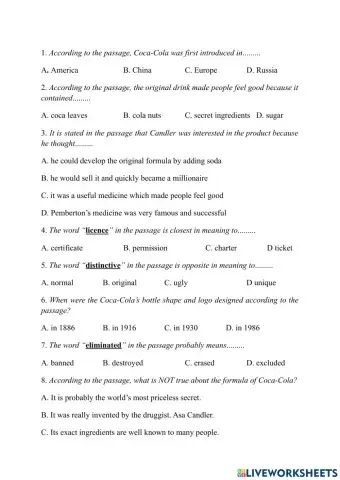
Coca-Cola was invented in 1886 by John Pemberton, a druggist living in Atlanta. The original drink was a type of syrup, using coca leaves, sugar and cola nuts, plus a few other secret ingredients! Pemberton sold it as a medicine; and with its coca (the source of cocaine), it must have made people feel good!
Nevertheless, Pemberton’s medicine was not very successful, so he sold his secret formula to another druggist, Asa Candler. Candler was interested, because he had another idea that Pemberton’s “medicine” would be much better if it was mixed with soda. Candler was thus the man who really invented the drink Coca-Cola. Candler also advertised his new drink, and soon people were going to drugstores just to get a drink of Coca-Cola.
Before long, other people became interested in the product, including a couple of businessmen who wanted to sell it in bottles. Candler sold them a licence to bottle the drink, and very quickly the men became millionaires. The famous bottle, with its very distinctive shape, was designed in 1916. And the famous Coca-Cola logo is the most famous logo in the world. Unlike any other famous commercial logos, it has not changed in 100 years!
During the First World War, American soldiers in Europe began asking for Coca-Cola, so the Coca-Cola company began to export to Europe. It was so popular with soldiers that they then had to start bottling the drink in Europe.
Today, Coca-Cola is made in countries all over the world, including Russia and China; it is the world’s most popular drink.
As for the famous formula, it is probably the world’s most valuable secret! The exact ingredients for making Coca-Cola are only known to a handful of people. And as for the “coca” that was in the original drink, that was eliminated in 1903. It was a drug, and too dangerous. Today’s Coca-Cola contains caffeine, but not cocaine!

How to Become a DJ: 10 Tips to Start DJing in 2025

English as a Second Language (ESL)

How to Become a DJ: 10 Tips to Start DJing in 2025

The world of DJing has evolved far beyond simply spinning dance records at night clubs. It's now a vibrant global community for independent artists to express themselves, create unique musical experiences, and become the next big name in the electronic scene.

How to become a DJ for beginners

Before diving headfirst into the deep and diverse world of DJing, it's crucial to immerse yourself in various genres of music. Explore everything from electronica to hip-hop, techno, house, and beyond. Your unique musical taste is what's going to set you apart from everyone else and help you craft out your niche as a DJ - not to mention provide that much-needed inspiration to get you started.

How to start DJing in 2025

1. Learn the basics of DJing

Got your eye on the latest speakers or headphones? Hold your horse. It's probably better to get a decent grasp of the fundamentals of DJing before forking out on a fancy new home studio setup. Some key topics you might wanna initially brush up on include:

Beatmatching

This is all about syncing the beats of two (or more) different tracks, ensuring a smooth transition between each song.

Mixing

Mixing is the part where you'll blend these tracks seamlessly - adjusting your volume, EQ, and adding any effects.

Phrasing

Phrasing will help you recognise different song structures and create cohesive mixes.

Scratching & effects

Once you've played about with the other stuff, you can start experimenting with advanced techniques like scratching and applying extra effects. This'll help you boost your live sets.

There are loads of online courses, tutorials, and production schools that offer in-depth training on these all of these topics, so it's worth dedicating some time to practice regularly and fine-tune your skills.

2. Invest in the right equipment

Basics ticked off. Now you need to pick out the right equipment. 

While professional setups can be expensive, there are loads of budget-friendly options for beginners. Consider purchasing a DJ controller, headphones, and a laptop loaded with DJ software. It might be pricey, but quality equipment is essential for honing your skills and creating top-notch mixes.

But this doesn't necessarily mean splashing out on the most expensive options. Northern Irish Producer & DJ, The Cyclist, has these tips for starting out and developing your skills:

“Start experimenting and learning the tools. There are so many free versions of everything to get started. Try searching for ‘free VSTs’ and go from there.”

3. Build your music library

Your DJ career ultimately hinges on the quality of music you play and how well it goes down with your crowd. To cover your own back during potentially tricky sets, you’ll want to build up a diverse and extensive music library. This will include a mix of tracks that resonate with your style and also the preferences of your target audience. 

Explore electronic music platforms like Beatport, buy sample packs from stores like Splice, and consider subscribing to DJ record pools for access to a wide selection of music.

4. Define your sound

Just as bands and solo artists need to nurture their own specific sound, DJs need to carve out their particular style and decide on the sound that they're going to build their career around.

Use other artists you're a fan of as reference and start playing about with certain sounds or samples that you like. This is the start of your journey so be experimental!

“Writing loops/beats/riffs is great fun and a place to start, but you need to finish tracks. Work on arranging these into a full track format - use other tracks as reference and for ideas on improving your production and arrangement.” - The Cyclist

5. Create your brand and identity

As an independent DJ, your brand is everything. Develop a unique name, logo, and visual style that reflects your personality and musical style. Your music branding should be consistent across all your promotional materials, from social media profiles to event flyers.

Once you’ve established your brand, you’ll be able to get a better understanding of your following and lean further into producing the sounds you're becoming associated with.


Take Fred Again.. as an example. His brand of honest and personal social media marketing lead to him selling out global tours as well as headlining Glastonbury and Coachella in 2023. A lot of the hype built up around Fred's came from his branding, a simple '..' - which was used across his merch and discography as well as used to tease appearances online and get more people chatting about him.

A large-scale example, but good branding strategy which you can apply to your own music.


AI

English as a Second Language (ESL)

AI

You've probably heard a lot about AI recently, but what is it, really?

AI, or artificial intelligence, is when we teach computers how to do things that usually require human intelligence, like identifying an object, understanding human speech, and even talking.

But how do you teach a computer  to "learn" and "think"?


What is AI

Well, it's kind of like when you train a pet to do tricks. Think of AI as a robot dog that you're training to fetch a toy. At first, your robot dog might not even know what a "dog toy" is!

So that's the first thing you need to teach it. You show it lots of pictures of "dog toys" so that  it learns to recognize them quickly and easily. It might make some mistakes at first, but  with each correct answer, it gets a reward. Over time, the dog's recognition improves, the same way you improve at any task the more you do it. And once the robot dog gets really good at recognizing what a dog toy is, you can move on to teaching it the next step of playing fetch – running after the toy and bringing it back to you.

This is basic AI, which learns by analyzing lots of data –in this case, pictures of dog toys and how to play fetch. But there's something even more complex, called generative AI,

which is more like a creative robot that can improvise when it comes to making art or writing.

Unlike the robot dog, the creative robot  learns from everything on the internet – videos, text, photos, you name it! When you ask it a question or give a hint,  it uses what it has learned from  the internet to create new things – like answers, stories, or even pictures.


The Catch

But here's the catch: that creative robot can sometimes make mistakes. And it doesn't know the  difference between good and bad. It doesn't know if what it creates is helpful or hurtful. It can't always tell facts from fiction,  or know where its information comes from.

It might even use someone's work without crediting them. It just sucks up all the random or not-so-random information that's floating out there on the internet. That's why we, as humans, have to think hard and be critical about the information we receive from AI. We have to know what it does well and what it doesn't do well. As we use generative AI in our lives, remember  that we have to be smart and responsible with how we use it.


Crea y personaliza fichas interactivas para cada aula

LiveWorksheets facilita a profesorado, familias y personas que educan en casa el diseño y la entrega de materiales de aprendizaje atractivos. Solo tienes que subir un PDF o empezar desde cero para crear lo que necesites: desde fichas interactivas de matemáticas hasta ejercicios de comprensión lectora, fichas de multiplicación o actividades para infantil, todo en unos pocos clics. Nuestro editor de arrastrar y soltar funciona en todos los cursos y asignaturas, lo que te permite adaptar el contenido a tus programaciones, deberes o evaluaciones. Quienes enseñan inglés como segunda lengua (ESL) también pueden crear sus propias fichas, añadir cuadros de sonidos comunes o integrar actividades de ESL para hacer cada clase más participativa. Además, podrás diseñar fácilmente tareas diferenciadas y autocorregidas que ahorran tiempo y apoyan un mejor aprendizaje del alumnado.

Una biblioteca completa de recursos para K-12 y ESL

Accede a miles de fichas listas para usar en todas las asignaturas de K-12, incluidas actividades para infantil, matemáticas, práctica de multiplicación, comprensión lectora y recursos de ESL. Filtra por curso, materia o nivel de competencia para encontrar exactamente lo que necesitas, ya sea para un aula de primaria, una revisión en secundaria o actividades de práctica en bachillerato. El profesorado de ESL puede explorar nuestra colección en constante crecimiento de fichas y actividades de inglés como segunda lengua, diseñadas para apoyar a estudiantes de todos los niveles. Con nuevo contenido añadido de forma regular, LiveWorksheets es un recurso flexible que ayuda a lograr aprendizajes duraderos.