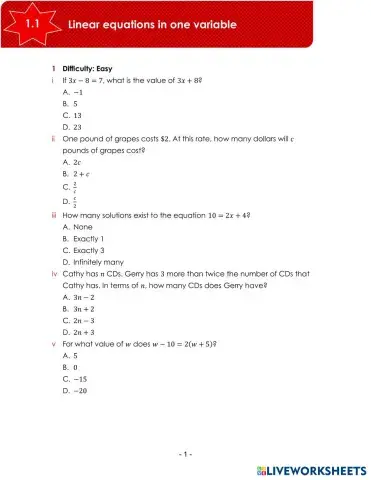
1.1. Linear equations in one variable

Algebra - Math

The questions in this section address a number of important math skills.

Use of a calculator is permitted for all questions. A reference sheet, calculator, and these directions can be accessed throughout the test.

Unless otherwise indicated:

  • All variables and expressions represent real numbers.
  • Figures provided are drawn to scale.
  • All figures lie in a plane.
  • The domain of a given function f is the set of all real numbers x for which f(x) is a real number.

For multiple-choice questions, solve each problem and choose the correct answer from the choices provided.

Each multiple-choice question has a single correct answer

For student-produced response questions, solve each problem and enter your answer as described below.

  • If you find more than one correct answer, enter only one answer.
  • You can enter up to 5 characters for a positive answer and up to 6 characters (including the negative sign) for a negative answer.
  • If your answer is a fraction that doesn't fit in the provided space, enter the decimal equivalent.
  • If your answer is a decimal that doesn't fit in the provided space, enter it by truncating or rounding at the fourth digit.
  • If your answer is a mixed number (such as 3½), enter it as an improper fraction (7/2) or its decimal equivalent (3.5).
  • Don't enter symbols such as a percent sign, comma, or dollar sign.

Example 1: 3.5

Acceptable ways to enter the answer:

3.5

3.50

7/2

3 1/2

Unacceptable (will NOT receive credit):

31/2

Example 2: 2/3

Acceptable ways to enter the answer:

2/3

.6666

.6667

0.666

0.667

Unacceptable (will NOT receive credit):

0.66

.66

0.67

.67

Example 3: −1/3

Acceptable ways to enter the answer:

-1/3

-.3333

Unacceptable (will NOT receive credit):

-0.33

-.33

The Last Name Project - African-American History

History - Social Studies

📝 My Last Name Project Worksheet
Discovering the Meaning Behind Your Family Name

Name: _________________________  Date: _________________________


🔍 Part 1: Discover Your Name

1. What Does My Last Name Mean?
Go to a name website like BehindTheName.com or talk to a family member.

My last name is: _______________________________

It comes from (country or culture): _______________________________

It means: ________________________________________________________


2. How Did African Americans Get Their Last Names?
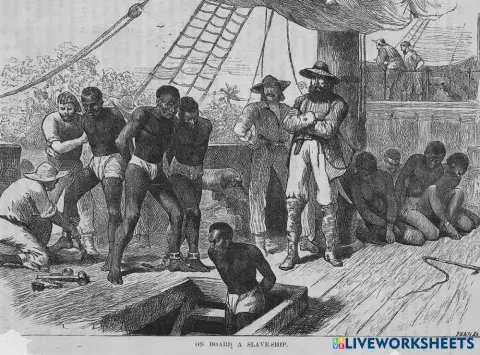
Read, research, or discuss how African Americans received their last names (from enslavers, free ancestors, or choosing their own).

Write 3–4 sentences:

🏡 Part 2: Family & Identity

1. Ask a Family Member
Talk to a parent, grandparent, or guardian and write what you learn.

  • Do you know where our last name comes from?
  • Has it changed over time?
  • What does it mean to our family?

Write 2–3 sentences about what you learned:

2. If You Could Choose a Last Name...
If you could pick a last name that shows who you are, what would it be?

My chosen name would be: _______________________________________

Why?

🎨 Part 3: Show What You Learned

✅ Choose ONE way to show what you discovered about your name:

Poster – Draw your name, its meaning, and pictures or symbols that represent your family.
Short Report – Write 1 page (or a paragraph) explaining everything you learned.
Family Tree – Draw a simple family tree that shows people with your last name.
Video or Audio Interview – Record yourself explaining what you learned!

🧠 Need Help?

  • Ask your teacher for a printed family interview sheet.
  • Use a sentence starter if you're stuck.
  • Draw instead of writing where needed!

AUDIO/VIDEO PRODUCTION WORKSHEET

Film

Part 1: Microphone Basics

Directions: Answer the questions below to the best of your ability.

  1. What is the main purpose of a microphone in video production?
  1. Match the microphone type to its correct description:
    a. Lavalier Mic          1. A handheld mic often used by singers and reporters
    b. Shotgun Mic           2. Small mic clipped to clothing for hands-free use
    c. Handheld Mic       3. Long, narrow mic used to pick up sound from a distance

a: ___ b: ___ c: ___

  1. Which microphone is best for interviews?
    A. Lavalier  B. Shotgun  C. Boom  D. Boundary

Part 2: Audio Connectors

Directions: Choose the best answer or fill in the blanks.

  1. Which of the following is a common professional audio connector?
    A. USB
    B. RCA
    C. XLR
    D. HDMI
  2. What is the difference between balanced and unbalanced audio cables?
  1. Draw a simple sketch of an XLR connector in the space below and label its pins:
    (Use stick figures or symbols if needed.)

Part 3: Picture Composition

Directions: Answer the questions below.

  1. What is the Rule of Thirds?
  1. Match the shot type to the correct description:
    a. Wide Shot (WS)       1. Frames the subject from the waist up
    b. Medium Shot (MS)     2. Shows the full body of the subject
    c. Close-Up (CU)        3. Focuses on the subject’s face or detail

a: ___ b: ___ c: ___

  1. Why is leading lines an important composition technique in video production?

Part 4: Camera Movements

Directions: Match each term to its correct definition.

  1. Pan        A. The camera moves side to side
  2. Tilt        B. The camera moves up or down
  3. Zoom      C. The camera lens moves closer or farther
  4. Dolly      D. The entire camera moves forward or backward

10: ___ 11: ___ 12: ___ 13: ___

  1. What is the difference between a pan and a dolly shot?

Crea y personaliza fichas interactivas para cada aula

LiveWorksheets facilita a profesorado, familias y personas que educan en casa el diseño y la entrega de materiales de aprendizaje atractivos. Solo tienes que subir un PDF o empezar desde cero para crear lo que necesites: desde fichas interactivas de matemáticas hasta ejercicios de comprensión lectora, fichas de multiplicación o actividades para infantil, todo en unos pocos clics. Nuestro editor de arrastrar y soltar funciona en todos los cursos y asignaturas, lo que te permite adaptar el contenido a tus programaciones, deberes o evaluaciones. Quienes enseñan inglés como segunda lengua (ESL) también pueden crear sus propias fichas, añadir cuadros de sonidos comunes o integrar actividades de ESL para hacer cada clase más participativa. Además, podrás diseñar fácilmente tareas diferenciadas y autocorregidas que ahorran tiempo y apoyan un mejor aprendizaje del alumnado.

Una biblioteca completa de recursos para K-12 y ESL

Accede a miles de fichas listas para usar en todas las asignaturas de K-12, incluidas actividades para infantil, matemáticas, práctica de multiplicación, comprensión lectora y recursos de ESL. Filtra por curso, materia o nivel de competencia para encontrar exactamente lo que necesitas, ya sea para un aula de primaria, una revisión en secundaria o actividades de práctica en bachillerato. El profesorado de ESL puede explorar nuestra colección en constante crecimiento de fichas y actividades de inglés como segunda lengua, diseñadas para apoyar a estudiantes de todos los niveles. Con nuevo contenido añadido de forma regular, LiveWorksheets es un recurso flexible que ayuda a lograr aprendizajes duraderos.