Group 2 Exercises
General Information
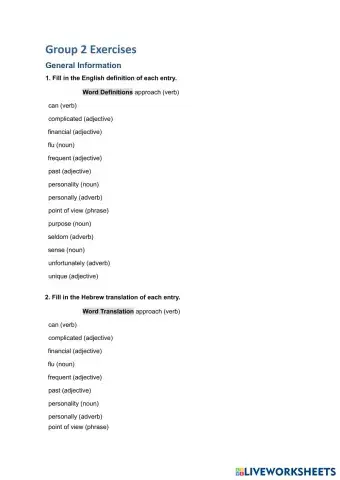
1. Fill in the English definition of each entry.
Word Definitions approach (verb)
can (verb)
complicated (adjective)
financial (adjective)
flu (noun)
frequent (adjective)
past (adjective)
personality (noun)
personally (adverb)
point of view (phrase)
purpose (noun)
seldom (adverb)
sense (noun)
unfortunately (adverb)
unique (adjective)
2. Fill in the Hebrew translation of each entry.
Word Translation approach (verb)
can (verb)
complicated (adjective)
financial (adjective)
flu (noun)
frequent (adjective)
past (adjective)
personality (noun)
personally (adverb)
point of view (phrase)
Word Translation
purpose (noun)
seldom (adverb)
sense (noun)
unfortunately (adverb)
unique (adjective)
3. Write at least one sentence with each entry.
Word Example sentences
approach (verb)
can (verb)
complicated (adjective)
financial (adjective)
flu (noun)
frequent (adjective)
past (adjective)
personality (noun)
personally (adverb)
point of view (phrase)
purpose (noun)
seldom (adverb)
sense (noun)
unfortunately (adverb)
unique (adjective)
Reading Comprehension
Read the following text and answer the questions following.
In the past, Mark had a unique way of seeing the world. His personality was vibrant, and he often shared his point of view with anyone willing to listen. Personally, I found his perspectives enlightening, but others found them complicated. Mark seldom talked about his financial troubles, but everyone knew he struggled. He believed money was not the sole purpose of life, and he approached life with a deeper sense of meaning. He would frequently say, "You can find happiness without being rich." However, unfortunately, Mark caught the flu last winter. His illness became a frequent topic of conversation among our friends.
Despite the challenges, his approach to life remained steadfast, showing us that it's essential to stay true to oneself.
Reading Comprehension Questions:
1. How did Mark view the world in the past?
a. With disdain.
b. Indifferently.
c. With a unique perspective.
d. With confusion.
2. How did the narrator feel about Mark's perspectives?
a. They were boring.
b. They were too easy.
c. They were enlightening.
d. They were too familiar.
3. How often did Mark discuss his financial troubles?
a. Always.
b. Often.
c. Rarely.
d. Every day.
4. What was Mark's belief regarding money?
a. Money was the sole purpose of life.
b. Money brought happiness.
c. You couldn't be happy without money.
d. You can find happiness without being rich.
5. What illness did Mark contract last winter?
a. A cold.
b. Pneumonia.
c. Flu.
d. COVID-19.
6. After getting sick, what became a common topic among friends? a. Mark's financial issues.
b. Mark's unique perspectives.
c. Mark's flu.
d. Mark's past.
7. What remained consistent about Mark despite his challenges? a. His financial status.
b. His complaints about money.
c. His approach to life.
d. His disdain for others.
8. How did others find Mark's perspectives?
a. Enlightening.
b. Confusing.
c. Complicated.
d. Boring.
9. What does the narrator personally feel about Mark's perspectives? a. They are too familiar.
b. They are enlightening.
c. They are too complicated.
d. They are common.
10. What does Mark believe is not the sole purpose of life? a. Fame.
b. Achievements.
c. Money.
d. Happiness.
Question 11: Give the text a title and explain your answer.
Matching Definitions
Match 3 words to their definitions:
Question 1:
1. approach (verb)
2. can (verb) a. To come near or closer to something or someone.
3. complicated (adjective) b. Difficult to understand or analyse.
4. financial (adjective) c. Related to money.
5. flu (noun)
6. frequent (adjective)
Question 2:
1. personality (noun)
2. personally (adverb) a. A person's individual character or traits. 3. point of view (phrase) b. From a time before now.
4. past (adjective) c. An individual's perspective or opinion. 5. purpose (noun)
6. seldom (adverb)
Question 3:
1. sense (noun)
2. unfortunately (adverb) a. One of a kind; not like any other.
3. unique (adjective) b. A feeling or understanding about something.
4. approach (verb) c. Illness that affects the nose, throat, and lungs.
5. flu (noun)
6. past (adjective)
Question 4:
1. financial (adjective)
2. frequent (adjective) a. Happening often.
3. complicated (adjective) b. The reason for which something is done. 4. purpose (noun) c. To be able to do something.
5. sense (noun)
6. can (verb)
Question 5: Match 3 words to their definitions:
1. personally (adverb)
2. point of view (phrase) a. In one's own opinion.
3. seldom (adverb) b. Not often; rarely.
4. unique (adjective) c. In a way that is sad or disappointing.
5. unfortunately (adverb)
6. personality (noun)
Fill-In
Fill in the sentences with the words from the word-group.
1. Her vibrant ________ makes her popular among her peers.
2. _______, the event had to be postponed due to rain.
3. This math problem seems very ________.
4. Each person's fingerprint is ________.
5. We ________ see them these days as they've moved to another city.
6. The primary ________ of the event is to raise funds for charity.
7. The museum displayed artifacts from the ________ century.
8. From my ________, the situation seems very different.
9. Many people get the ________ vaccine during winter.
10. The scientist will ________ the mysterious island tomorrow.
11. Before making a big purchase, you should review your ______ situation.
12. The ________ visits to the library made her more knowledgeable.
13. I don't think I ________ do it without some extra help.
14. I have a strong ________ that something good is about to happen.
15. ________, I think that's the best decision.


 Switch to New Search Page