Reading

English

                                                                                 The Earth

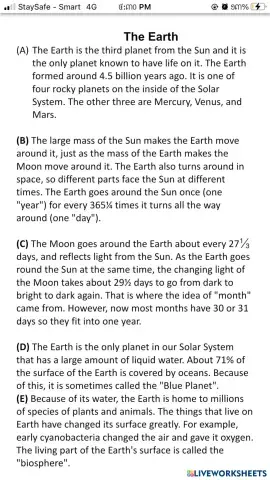
  1. The Earth is the third planet from the Sun and it is the only planet known to have life on it. The Earth formed around 4.5 billion years ago. It is one of four rocky planets on the inside of the Solar System. The other three are Mercury, Venus, and Mars.


(B) The large mass of the Sun makes the Earth move around it, just as the mass of the Earth makes the Moon move around it. The Earth also turns around in space, so different parts face the Sun at different times. The Earth goes around the Sun once (one "year") for every 365¼ times it turns all the way around (one "day").


(C) The Moon goes around the Earth about every 27⅓ days, and reflects light from the Sun. As the Earth goes round the Sun at the same time, the changing light of the Moon takes about 29½ days to go from dark to bright to dark again. That is where the idea of "month" came from. However, now most months have 30 or 31 days so they fit into one year.


(D) The Earth is the only planet in our Solar System that has a large amount of liquid water. About 71% of the surface of the Earth is covered by oceans. Because of this, it is sometimes called the "Blue Planet".

(E) Because of its water, the Earth is home to millions of species of plants and animals. The things that live on Earth have changed its surface greatly. For example, early cyanobacteria changed the air and gave it oxygen. The living part of the Earth's surface is called the "biosphere".


(F) The Earth is part of the eight planets and many thousands of small bodies that move around the Sun as its Solar System. The Solar System is moving through the Orion Arm of the Milky Way Galaxy now, and will be for about the next 10,000 years.

(G) The Earth is generally 150,000,000 kilometers or 93,000,000 miles away from the Sun (this distance is named an "Astronomical Unit"). The Earth moves along its way at an average speed of about 30 km or 19 mi a second. The Earth turns all the way around about 365¼ times in the time it takes for the Earth to go all the way around the Sun. To make up this extra bit of a day every year, an additional day is used every four years. This is named a "leap year".


(H) The Moon goes around the Earth at an average distance of 400,000 kilometers (250,000 mi). It is locked to Earth, so that it always has the same half facing the Earth; the other half is called the "dark side of the Moon". It takes about 27⅓ days for the Moon to go all the way around the Earth but, because the Earth is moving around the Sun at the same time, it takes about 29½ days for the Moon to go from dark to bright to dark again. This is where the word "month" came from, even though most months now have 30 or 31 days.


Questions 1–8

Reading Passage 1 has eight paragraphs A-H. Which paragraph contains the following information?  Write the correct letter, A–H, in boxes 1–8 on your answer sheet.

1. Earth’s natural satellite  ____
2. Distance between Earth and Sun  ____
3. General information about Earth  ____
4. The Solar System  ____
5. Length of most moths  ____
6. Another name for Earth  ____
7. The living part of the Earth's surface  ____
8. The movements of Earth around the Sun ____

Questions 9-13

Complete the sentences below.

Choose NO MORE THAN THREE WORDS from the text for each answer.

Write your answers in boxes 9-13 on your answer sheet.

9. Apart from Earth, other rocky planets in our Solar Systems are Venus, Mars and ____________ 

10. Moon ____________ from the Sun on Earth.

11. There are millions of ___________ of plants and animals that inhabit Earth.

12. Now the Solar System is travelling through ______________.

13. The dark side of the Moon is the side, which _____________ faces Earth.


additions and subtraction

Maths

Addition and Subtraction Quiz

Question 1

Sarah has 45 apples. She gives 12 apples to her friend and then buys 8 more apples. How many apples does Sarah have now?

  • A)41
  • B)39
  • C)33
  • D)45

Correct Answer: A) 41

Difficulty: Medium

Question 2

On a number line, if you start at -3 and move 7 units to the right, where do you end up?

  • A)4
  • B)5
  • C)3
  • D)2

Correct Answer: D) 4

Difficulty: Medium

Question 3

John had xx dollars. He spent $15 on a book and $10 on lunch. If he has $25 left, how much money did he have initially?

  • A)$50
  • B)$40
  • C)$60
  • D)$55

Correct Answer: C) $60

Difficulty: Medium

Question 4

On a number line, if you start at 10 and move 15 units to the left, where do you end up?

  • A)-5
  • B)-3
  • C)-4
  • D)-2

Correct Answer: A) -5

Difficulty: Medium

Question 5

Emily has 120 candies. She gives 30 candies to her brother and 25 candies to her sister. How many candies does she have left?

  • A)65
  • B)70
  • C)75
  • D)85

Correct Answer: C) 65

Difficulty: Medium

Question 6

On a number line, if you start at 5 and move 9 units to the left, where do you end up?

  • A)-4
  • B)-3
  • C)-2
  • D)-1

Correct Answer: B) -4

Difficulty: Medium

Question 7

A store had 200 shirts. They sold 75 shirts on Monday and 50 shirts on Tuesday. How many shirts are left in the store?

  • A)75
  • B)85
  • C)95
  • D)100

Correct Answer: C) 75

Difficulty: Medium

Question 8

On a number line, if you start at -7 and move 12 units to the right, where do you end up?

  • A)5
  • B)4
  • C)3
  • D)2

Correct Answer: D) 5

Difficulty: Medium

Question 9

Tom has 150 marbles. He loses 20 marbles and then finds 10 more. How many marbles does Tom have now?

  • A)140
  • B)130
  • C)135
  • D)145

Correct Answer: D) 140

Difficulty: Medium

Question 10

On a number line, if you start at 0 and move 20 units to the left, where do you end up?

  • A)-20
  • B)-15
  • C)-10
  • D)-5

Correct Answer: A) -20

Difficulty: Medium

Death's Lines

Reading Comprehension - English Language

(Everyone turns.)

Gillian: Who are you?

Zoe: Do you have brains?

(Ad-libbed responses: “Fair enough,” “Good idea,” “Safer that way,” etc.)

William: De’Ath? Don’t you mean Death?

Gillian: Murder? Hang on, why aren’t you scared of us? Boo!

Bella: Slightly? We’re dead, and you’re having a chat like it’s tea time!

Winnie: Zoe likes open minds too—different reason though.

Malcolm: Of course I am!

Bella: (Fake sobbing.) Oh, Victor! My darling! Who could do this to you?

Winnie: Ernest.

Gillian: (Hands De’Ath the card.)

Bella: Don’t forget Patti.

Zoe: Patti the Poltergeist.

Malcolm: Well, technically, we all did.

William: Wait. You said murder? You can’t mean this is murder!

Bella: Oh, must this take long? If Victor—or Ernest or whatever—stays dead, I’ll need a new potential husband. They’re all dressed so splendidly… clearly wealthy enough to keep me in the manner I deserve.

Zoe: Basingstoke?

Gillian: True. I became a ghost immediately after dying. Didn’t even have time to dry off.

Winnie: Unless the CCTV shows nothing, it’s unclear who did it.

(A beat.)

Zoe: Oh, shame—I wanted to watch this on YouBoo.

Malcolm: Zoe, you don’t need to watch—you’re here.

Winnie: Just a minute, Inspector. If one of us is nicked, how do you punish a ghost?

Gillian: Why me?

Winnie: Because you’re easiest to imagine not being there.

Zoe: What? No! I done nothing.

Bella: That’s just how she talks, Inspector. She don’t know no different.

De’Ath: So one or more of you is responsible for the deaths of Professor Ernest Jones and Patti the Poltergeist. I intend to find out who!

Zoe: And then what?

De’Ath: Then the guilty will face consequences.

Malcolm: Consequences! Missed that one.

Zoe: (To Gillian) What did he say?

Gillian: You’ll be nicked.

Zoe: But I didn’t do nothing!

(All groan.)

Gillian: Life? Are you sure?

Zoe: We’re already dead… haha.

Malcolm: A week in Basingstoke?

Gillian: (To audience.) We have a murder to solve. So, ladies and gentlemen, let us see if we can, between us, solve these crimes, as we open up the floor to questions from the audience.

(Audience questions – see production notes.)

Scene 2 – The Reveal

Winnie: Her real name was Sharon.

Zoe: Sharon?

Winnie: Yes, she told me while I was doing her hair before we came out tonight.

William: She didn’t have any ingredients for potions.

Bella: Oh, well surmised, Inspector! Bravo!

Malcolm: (To Gillian) So we can go?

Zoe: What? Me? No! I liked Patti. She was my friend.

Malcolm: That doesn’t sound like Zoe. She only pulls hair off if she’s going to eat their… B-R-A-I-N-S.

William: Real wine!

Winnie: What? Me? No, don’t be silly. Why would I want to kill Victor? And why would I want to kill Patti? I helped her get ready for tonight, for goodness’ sake. I helped her with her hair!

William: So that’s why you wanted me to spend time with Patti! You wanted her sneezes to use in your spells! She and Gillian are the only ones who are officially spooks!

Winnie: Yes, yes, OK. I stabbed him, but I didn’t know then he wasn’t a vampire. He accused me of shoddy spells.

Zoe: Is that near Cognito?

Bella: Yes Zoe, yes, it is. Just down the road.

Gillian: Look, Inspector – Victor, or Ernest, whoever he was, must have known the risks when he came to live with us. Anyone could have found out at any time he wasn’t a vampire. It wouldn’t have taken a genius.

William: Keeping up standards, Winnie, good girl.

Malcolm: Zoe, I’m sorry to say, the house belonged to Victor, I think we’re all going to have to move to… (braces himself) Basingstoke!

(All except De’Ath.) Nooooooo!

(Curtain.)

Crea y personaliza fichas interactivas para cada aula

LiveWorksheets facilita a profesorado, familias y personas que educan en casa el diseño y la entrega de materiales de aprendizaje atractivos. Solo tienes que subir un PDF o empezar desde cero para crear lo que necesites: desde fichas interactivas de matemáticas hasta ejercicios de comprensión lectora, fichas de multiplicación o actividades para infantil, todo en unos pocos clics. Nuestro editor de arrastrar y soltar funciona en todos los cursos y asignaturas, lo que te permite adaptar el contenido a tus programaciones, deberes o evaluaciones. Quienes enseñan inglés como segunda lengua (ESL) también pueden crear sus propias fichas, añadir cuadros de sonidos comunes o integrar actividades de ESL para hacer cada clase más participativa. Además, podrás diseñar fácilmente tareas diferenciadas y autocorregidas que ahorran tiempo y apoyan un mejor aprendizaje del alumnado.

Una biblioteca completa de recursos para K-12 y ESL

Accede a miles de fichas listas para usar en todas las asignaturas de K-12, incluidas actividades para infantil, matemáticas, práctica de multiplicación, comprensión lectora y recursos de ESL. Filtra por curso, materia o nivel de competencia para encontrar exactamente lo que necesitas, ya sea para un aula de primaria, una revisión en secundaria o actividades de práctica en bachillerato. El profesorado de ESL puede explorar nuestra colección en constante crecimiento de fichas y actividades de inglés como segunda lengua, diseñadas para apoyar a estudiantes de todos los niveles. Con nuevo contenido añadido de forma regular, LiveWorksheets es un recurso flexible que ayuda a lograr aprendizajes duraderos.