Sentence Structures

English as a Second Language (ESL)

1. Simple Sentence

A simple sentence contains only one independent clause (a complete thought). It has a subject and a verb, and it expresses a complete idea.

Structure:

Subject + Verb (and sometimes an object or complement)

Examples:

  1. I eat lunch every day.
    (Subject: "I", Verb: "eat")
  2. She studied for the exam.
    (Subject: "She", Verb: "studied")
  3. The dog barked loudly.
    (Subject: "The dog", Verb: "barked")

2. Compound Sentence

A compound sentence consists of two or more independent clauses joined by a coordinating conjunction (for, and, nor, but, or, yet, so), or by a semicolon.

Structure:

Independent clause + coordinating conjunction + independent clause

Examples:

  1. I wanted to go to the party, but I was too tired.
    (Two independent clauses: "I wanted to go to the party" and "I was too tired," joined by "but")
  2. She likes reading books, and he enjoys playing sports.
    (Two independent clauses: "She likes reading books" and "He enjoys playing sports," joined by "and")
  3. I am studying for my test; I will take a break later.
    (Two independent clauses joined by a semicolon)

3. Complex Sentence

A complex sentence contains one independent clause and at least one dependent clause (a clause that cannot stand alone and does not express a complete thought). Dependent clauses are connected to the independent clause by a subordinating conjunction (because, although, if, when, since, etc.).

Structure:

Independent clause + subordinating conjunction + dependent clause

Examples:

  1. I stayed home because it was raining.
    (Independent clause: "I stayed home" and dependent clause: "because it was raining")
  2. Although she was tired, she finished her homework.
    (Independent clause: "She finished her homework" and dependent clause: "although she was tired")
  3. We will go to the park if it doesn't rain.
    (Independent clause: "We will go to the park" and dependent clause: "if it doesn't rain")

4. Compound-Complex Sentence

A compound-complex sentence is a combination of both a compound sentence and a complex sentence. It contains at least two independent clauses and at least one dependent clause.

Structure:

Independent clause + coordinating conjunction + independent clause + subordinating conjunction + dependent clause

Examples:

  1. I wanted to go to the beach, but it started raining, so we stayed home.
    (Independent clauses: "I wanted to go to the beach" and "it started raining," joined by "but"; dependent clause: "so we stayed home")
  2. Although I studied hard, I didn't pass the test, and I felt disappointed.
    (Independent clauses: "I didn't pass the test" and "I felt disappointed," joined by "and"; dependent clause: "Although I studied hard")
  3. She loves reading books, and she often reads late into the night, because she finds it relaxing.
    (Independent clauses: "She loves reading books" and "She often reads late into the night," joined by "and"; dependent clause: "because she finds it relaxing")

Revision for Mid-term I examination

Vocabulary - ESL

Task 1. Complete the sentences with correct words. 

  1. Lisa doesn’t mind speaking in public because she is very ____________
  2. Diane always tell everyone what to do because she is very ____________
  3. Grace is very ____________ because he always makes me laugh.
  4. Tia doesn’t often joke or smile because she is very ____________
  5. I am interested ____________ playing games because it helps me relax.
  6. I am excited ____________ attending the Coldplay concert tomorrow.
  7. I am bad ____________ Maths because I don’t like working with numbers.
  8. I am bored ____________ studying all day because it is so tiring.

Task 3: Complete the passage with given words.

Passage 1:  accent   complaint   excuse   explanation   greeting   interrupted   out loud   repeated   translation. 

My family and I were looking forward to eating at this restaurant but the menu was in the local language and we couldn’t understand it. We asked the waiter for a menu with an English (1) ____________ but he didn’t have one. He tried to give us an (2)  ____________of each item on the menu but it was taking him ages and his (3)  ____________ was hard for us to understand, so it didn’t help. My dad (4)  ____________ him and said we’d be OK. I tried to read some of the meals (5)  ____________ to see if that helped but it didn’t. In the end, we made an (6)  ____________ about not feeling well and left.

Passage 2:  back down   out (x3)   up (x2)   with

All of our smartphones and tablets have a built-in digital assistant these days. You press a button, ask a question and the assistant finds (1)  ____________the answer for you. One day, our digital assistant will end (2)  ____________ organising all aspects of our lives.She’ll carry (3)  ____________boring chores for us, such as ordering the weekly shopping.She’ll help us get (4)  ____________ home if we’re lost.
If the car breaks (5)  ____________, she’ll call a mechanic and ask them to come and fix it.
In fact, any problem we have, our assistant will deal (6)  ____________ it by calling someone who can help.We might even find that our assistant is happy to call up our partner and break (7)  ____________ with them for us!I’m not sure that’s true, but the biggest problem will be how dependent we are on the assistant. We won’t know what to do when our phone runs (8)  ____________ of battery!

Task 2. Complete the sentences with the correct form of the verbs in brackets.

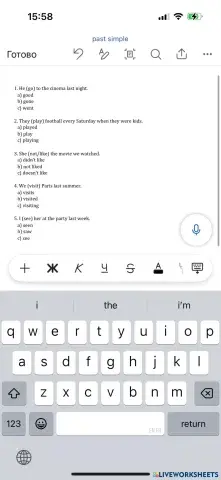
1. They (visit)____________ Paris next month. They (plan) ____________for this trip for a whole month.

2. Jack (play)____________ a video game when his brother (enter)____________ the room without any permission.

3. She (walk)____________ to school yesterday because there (be) no bus. 

4. A: I (be)____________ so hungry, mom.

    B: I (make)____________ some sandwiches.

5. Be careful. The cooker is still very hot. You (burn)____________ yourself.

6. I hate (play)____________ chess with my brother because he (always/win).

7. A: I want to tell you a secret.

    B: Okay. I (not tell)____________ anyone.

8. He likes acting. He (be) ____________an actor in the future.

9. (You/play)____________ football at 3 o’clock yesterday?

10. John (listen)____________ to music while his parents (watch) TV news.

11. Yesterday, Lisa (made)____________ a pizza. First, she (mold) ____________the bun then she (put)____________ it into the oven.

12.  I (note like)____________ (go)____________ to the museum because I am not interested in (look)____________ at old things.

13. Watch out! It (rain)____________. You should stay at home.

14. A: Hey Mark! What (you/do)____________ when you finish your final exam?

    B: You (not believe)____________ it but I (visit)____________ the UK for the first time in my life.

    A: Really! That’s so nice. I am sure you (love) ____________it.

    B: I think so. My family and I (stay)____________ in a hotel near Swiss Alps.

15. Tom (never/late)____________ for school because he (always/wake)____________ up early.

16. Ella doesn’t like (speak) ____________in front of other people because she is very shy.

17. Cathay (usually/have)____________ burger for her lunch but today she (have) a salad.

18. I (have)____________ dinner now so please call me later. 

19. Don’t eat that cake. It (smell)____________ terrible.

20. What (this symbol/mean)____________?

21. My brother (have)____________ two cats and one dog at home.

22. He (look)____________ happy in his new job because he (believe)____________ his choice.

23. (Eat)____________ too much sugar can cause tooth decay.

24. (Listen)____________ to music is the most interesting hobby.

25. Last night, Sue (water)____________ the flower when it (start)____________ to rain.


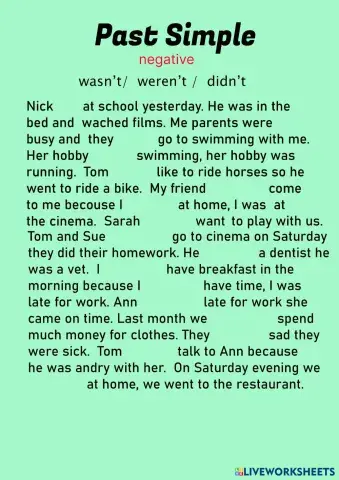
Past Simple vs Present Perfect

Practical English


  1. 1. Match the time expressions with the correct tense:

A:

• Since 2015

• Yesterday

• Just

• Last week

• Already

• Two days ago

• Ever

• In 2001


B:

1. Past Simple

2. Present Perfect


  1. 2. Fill in the blanks with the correct verb form:

1. We __________ (visit) the Louvre when we were in Paris.

2. She __________ (never / try) sushi before.

3. He __________ (finish) his homework an hour ago.

4. I __________ (just / call) you, but you didn’t answer.

5. They __________ (move) to New York in 2019.

6. She __________ (not / see) this movie yet.


  1. 3. Choose the correct option:

1. I (have seen / saw) this film twice.

2. She (wrote / has written) three books so far.

3. They (bought / have bought) a car last summer.

4. He (has lived / lived) in Rome for ten years, but now he’s in Milan.

5. We (just finished / have just finished) our project.


  1. 4. Rewrite the sentences using the other tense:

1. I have never been to Japan. → (Past Simple)

2. He bought a new phone last month. → (Present Perfect)

3. They have visited Spain several times. → (Past Simple)

4. She didn’t call me yesterday. → (Present Perfect)

5. We have known each other for five years. → (Past Simple)


  1. 5. Correct the mistakes in the sentences:

1. I have seen him yesterday. ❌

2. He has buy a new laptop. ❌

3. They lived here since 2010. ❌

4. We didn’t never go to that restaurant. ❌

5. Have you ever went to London? ❌


IGNORANCE

English Language Arts (ELA)

Children of certain very naive clan were taught by ignorant mullah. He was illiterate and couldn’t even read in Uzbek. He gave every boy a paper with some lines scratched. The lesson he instructed the, was as follows:
— The price for wedding is the horse.
— The birth of child is great happiness and is followed with great reward.
— The price for giving a name is a strong horse.
— The price for circumcision is three camels.
— The price for pardoning sins is five camels.
Once some other mullah who was wise and literate visited that aul. When he entered madrasah, illiterate mullah start talking to some boy as if teaching him a lesson, though indeed he was addressing the other mullah:
— There is no need to talk much, who needs this chatting? I have fifteen camels and one horse. The half is mine and other half will be yours.

B
One Tatar once run out from his house on midnight not even taking a hat. He was followed by his scared wife and kinds. Tatar run first, as fast as he could, broke into his neighbor’s house and started looking for the best place to hide.
“What happened?” — the neighbor asked him.
Tatar gathered his breath for a moment and told his story, “For a very long time imps and jinns have been dwelling in my house. Every night when we go to bed, shaitans[19] summon on our roof, they play there, and bump and knock through all the night. I have summoned mullahs to my home for several times already, they said lot of prayers and I spent lot of money, but I still can’t get rid of them. This night imps started run and bump as they do it usually; I lay sleepless also. Suddenly one jinn broke through the roof and jump right upon me. I got up, passed over him and run away. When I was running, I accidentally touched his horns. Apyrai, I didn’t even know shaitans have got horns!
The neighbor was a man wise, so he said, “Let’s go to your house with lantern and take a look at it in the light.
They have asked three or four men with them and went to Tatar’s house. When they entered, they saw that the roof was made of bulrush and was not very sound, and in the middle of the roof there was a hole. Then they looked around the house, and in the corner they saw a nanny goat. It was lying calmly and chewed something.
In a while they heard little goatlings crying on the roof. The goat also heard it, it got up and begun to bleat. Goatlings then descended from the roof through the hole as well, and joined their mother. It turned out, that the nanny goat and goatlingsbelonged to that Tatar and his neighbors. In the nights they came to eat hay, with which the roof was covered, and played there. The nanny goat, that was found in the house, was simply too big, so it broke down inside, leaving the hole in the roof.

Crea y personaliza fichas interactivas para cada aula

LiveWorksheets facilita a profesorado, familias y personas que educan en casa el diseño y la entrega de materiales de aprendizaje atractivos. Solo tienes que subir un PDF o empezar desde cero para crear lo que necesites: desde fichas interactivas de matemáticas hasta ejercicios de comprensión lectora, fichas de multiplicación o actividades para infantil, todo en unos pocos clics. Nuestro editor de arrastrar y soltar funciona en todos los cursos y asignaturas, lo que te permite adaptar el contenido a tus programaciones, deberes o evaluaciones. Quienes enseñan inglés como segunda lengua (ESL) también pueden crear sus propias fichas, añadir cuadros de sonidos comunes o integrar actividades de ESL para hacer cada clase más participativa. Además, podrás diseñar fácilmente tareas diferenciadas y autocorregidas que ahorran tiempo y apoyan un mejor aprendizaje del alumnado.

Una biblioteca completa de recursos para K-12 y ESL

Accede a miles de fichas listas para usar en todas las asignaturas de K-12, incluidas actividades para infantil, matemáticas, práctica de multiplicación, comprensión lectora y recursos de ESL. Filtra por curso, materia o nivel de competencia para encontrar exactamente lo que necesitas, ya sea para un aula de primaria, una revisión en secundaria o actividades de práctica en bachillerato. El profesorado de ESL puede explorar nuestra colección en constante crecimiento de fichas y actividades de inglés como segunda lengua, diseñadas para apoyar a estudiantes de todos los niveles. Con nuevo contenido añadido de forma regular, LiveWorksheets es un recurso flexible que ayuda a lograr aprendizajes duraderos.