phân biệt tính trạng vị trí enough và tính từ thêm đuôi ED, ING

English

1. Check your work…..

==a. carefully                              b. careful

c. carefulness                               d. care                               

2. I know them…..

a. good                                       ==b. well

c. best                                         d. better

3. She sometimes goes to school …..

a. laterly                                     b. lately

c. later                                        ==d. late

4. Jane is … because her job is …..

a. tired/tired                                 ==b. tired/tiring

c. tiring/tired                               d. tiring/tiring

5.  He has lived in London for some years so he speaks …..

a. fluently English                                 b. English fluent

c. fluent English                                             ==d. English fluently

6. "How does Amy like her new school?"

"Fine. And she's doing_____ in her courses"

a. extreme good                                    ==b. extremely well

c. extremely good                                 d. extreme well

7. "Your son seems to be an excellent skier"

"They say he's_____ for his age".

==a. surprisingly competent                            b. surprising competent

c. competently surprising                                d. surprising competently

8. "The students all went to the circus yesterday".

"I heard it was really_____".

a. amused                                                      ==b. amusing

c. amuse                                                       d. amusingly

9. "I was_____ that Jan couldn't come to the party".

"Her boss made her work overtime"

==a. disappointing                                         b. disappointedly

c. disappoint                                         d. disappointed

10. "I can’t believe that Jim is marrying the vice-president's daughter".

"That they would get married is_____".

a. surprised                                          b. surprising

==c. surprisingly                                            d. surprise

11 . My brother is_________to drive a car.

==A. Old enough

B. Enough old

12. I don’t think you are ___________ to lift this table.

==A. Strong enough

B. Enough strong

13. Mike doesn’t have __________ to meet her.

A. Time enough

==B. Enough time

14. He is __________ to eat 10 apples.

==A. Hungry enough

B. Enough hungry

15. Is your cake _____________?

==A. Sweet enough

B. Enough sweet

16. Helen doesn’t have_____________to buy a new phone

==A. enough money

B. money enough

17.  She isn’t _____________to carry this bag

A. enough strong

==B. strong enough

18. Bill isn’t _____________to understand what I say

==A. intelligent enough

B. enough intelligent

19. She lost the match simply because she didn’t play

==A. well enough

B. enough well

20. Even if you use a green house, it will never be_____________to grow bananas in this climate

==A. warm enough

B enough warm

21. We went to the cinema but the film was really

A. bored

==B. boring

22. It’s an___________book

A. amazed

==B. amazing

23. The direction he gave us were really___________

A. confused

==B. confusing

24. I felt___________after running a marathon

==A. exhausted

B. exhausting

25. I was___________to see my best friend at the party

==A. surprised

B. surprising

26. The challenging puzzle was___________and required careful thought to solve

==A. puzzling

B. puzzled

27. You should take a rest. You look really___________

==A. tired

B. tiring

28. The journey was___________. Twenty hours by train made us___________

A. bored/exhausted

B. boring/exhausting

==C. boring/exhausted

D. bored/exhausting

29. Don’t show my baby photos to others, Mum! It’s so___________!

==A. embarrassing

B. embarrased

30. She got really___________ yesterday because someone threw rubbish in front of her house

==A. annoyed

B. annoying


Travel and Transport

Reading and Text Analysis - English Language

Reading Task

Text (example):
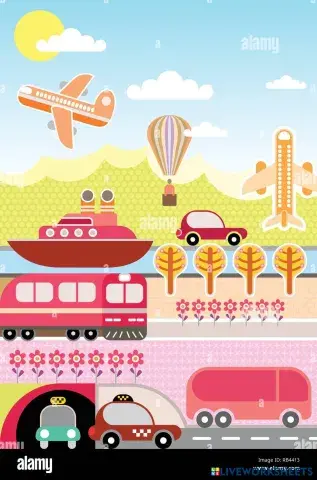
“Travel has always been important for people. In the past, people traveled by horse, on foot, or by simple boats. Today, we can travel by car, train, plane, or even by underground metro. Modern transport is faster and more comfortable, but it also causes traffic jams and pollution. Many people now think about eco-friendly travel, such as cycling, walking, or using electric vehicles.”


Text Analysis Tasks
    1.    Comprehension Questions
    •    How did people travel in the past?
    •    What are the advantages of modern transport?
    •    What problems does modern transport create?
    •    What are some eco-friendly ways to travel?
    2.    True or False
    •    In the past, people traveled by airplane.
    •    Modern transport is faster and more comfortable.
    •    Transport does not cause any problems.
    •    Cycling is an eco-friendly way to travel.
    3.    Vocabulary Work
    •    Find words in the text that mean:
a) very old ( → past )
b) not harmful to the environment ( → eco-friendly )
c) faster and easier to use ( → comfortable )
d) situation when many cars stop moving ( → traffic jam )
    4.    Discussion / Critical Thinking
    •    Which transport do you use most often and why?
    •    What are the advantages and disadvantages of cars?
    •    How can we make transport more eco-friendly in the future?
    5.    Writing Extension
    •    Write a short paragraph about your last trip. Which transport did you use? Was it comfortable or difficult?

Crea y personaliza fichas interactivas para cada aula

LiveWorksheets facilita a profesorado, familias y personas que educan en casa el diseño y la entrega de materiales de aprendizaje atractivos. Solo tienes que subir un PDF o empezar desde cero para crear lo que necesites: desde fichas interactivas de matemáticas hasta ejercicios de comprensión lectora, fichas de multiplicación o actividades para infantil, todo en unos pocos clics. Nuestro editor de arrastrar y soltar funciona en todos los cursos y asignaturas, lo que te permite adaptar el contenido a tus programaciones, deberes o evaluaciones. Quienes enseñan inglés como segunda lengua (ESL) también pueden crear sus propias fichas, añadir cuadros de sonidos comunes o integrar actividades de ESL para hacer cada clase más participativa. Además, podrás diseñar fácilmente tareas diferenciadas y autocorregidas que ahorran tiempo y apoyan un mejor aprendizaje del alumnado.

Una biblioteca completa de recursos para K-12 y ESL

Accede a miles de fichas listas para usar en todas las asignaturas de K-12, incluidas actividades para infantil, matemáticas, práctica de multiplicación, comprensión lectora y recursos de ESL. Filtra por curso, materia o nivel de competencia para encontrar exactamente lo que necesitas, ya sea para un aula de primaria, una revisión en secundaria o actividades de práctica en bachillerato. El profesorado de ESL puede explorar nuestra colección en constante crecimiento de fichas y actividades de inglés como segunda lengua, diseñadas para apoyar a estudiantes de todos los niveles. Con nuevo contenido añadido de forma regular, LiveWorksheets es un recurso flexible que ayuda a lograr aprendizajes duraderos.