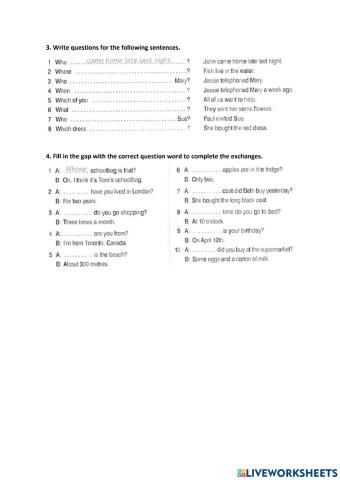
Exercise: Forming Questions about Clothes
Part 1: Yes/No Questions
Rewrite the sentences below as yes/no questions using "do" or "does".
- You need a new shirt.
- Question: Do you need a new shirt?
- She wants a pair of jeans.
- Question: Does she want a pair of jeans?
- They like the red dress.
- Question: Do they like the red dress?
- He has a blue jacket.
- Question: Does he have a blue jacket?
- We need some new shoes.
- Question: Do we need some new shoes?
Part 2: Information Questions
Rewrite the statements below as information questions using "do" or "does" and the question words (what, which, why, when, where, who).
- You need a new shirt.
- Question: What do you need?
- She wants a pair of jeans.
- Question: What does she want?
- They like the red dress.
- Question: Which dress do they like?
- He has a blue jacket.
- Question: What color jacket does he have?
- We need some new shoes.
- Question: What do we need?
Part 3: Create Your Own Questions
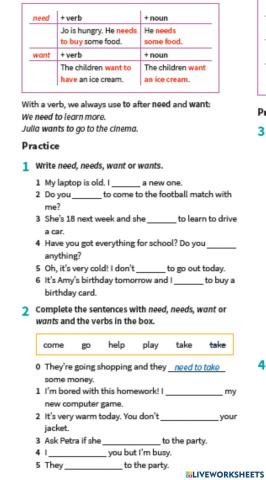
Now, create your own yes/no and information questions about clothes using the verbs need, want, like, and have.
- (Yes/No Question)
- Statement: I need a warm sweater.
- Question:
- Why do you want to buy a new jacket?
- (Information Question)
- Statement: She likes the black boots.
- Question: What color shoes does she like?
- (Yes/No Question)
- Statement: They have a lot of scarves.
- Question: ____Do they have a lot of scarves_________________________________?
- (Information Question)
- Statement: He wants a new belt.
- Question: ______What does he want___________________________?
Part 1: Yes/No Questions
Rewrite the sentences below as yes/no questions using "do" or "does".
- You need a new shirt.
- Question: Do you need a new shirt?
- She wants a pair of jeans.
- Question: Does she want a pair of jeans?
- They like the red dress.
- Question: Do they like the red dress?
- He has a blue jacket.
- Question: Does he have a blue jacket?
- We need some new shoes.
- Question: Do we need some new shoes?
Part 2: Information Questions
Rewrite the statements below as information questions using "do" or "does" and the question words (what, which, why, when, where, who).
- You need a new shirt.
- Question: What do you need?
- She wants a pair of jeans.
- Question: What does she want?
- They like the red dress.
- Question: Which dress do they like?
- He has a blue jacket.
- Question: What color jacket does he have?
- We need some new shoes.
- Question: What do we need?
Part 3: Create Your Own Questions
Now, create your own yes/no and information questions about clothes using the verbs need, want, like, and have.
- (Yes/No Question)
- Statement: I need a warm sweater.
- Question: ________Do you need a sweater__________________?
- (Yes/No Question)
- Statement: They have a lot of scarves.
- Question: ______________Do they have a scarf_____________?
Exercise: Forming Questions with Why, What, Which, and One/Ones
Part 1: Complete the Questions
Complete the questions using "why," "what," "which," "one," or "ones."
- ____Why____ do you want to buy a new jacket?
- ___What_____ color shoes do you need?
- ___Which_____ dress do you like, the red one or the blue one?
- ___What_____ do you have in your shopping bag?
- _____Which___ do you prefer, the striped shirt or the plain one?
- _____Why___ did you choose the black boots?
- ___Which_____ jeans are more comfortable, the skinny ones or the regular ones?
- ____What____ accessories do you want to wear with your outfit?
- ____Which____ of these hats is your favorite?
- _____Why__ does he need a new suit?


 Switch to New Search Page
 ¿Quieres miles de fichas gratuitas (y cero distracciones)?
Here’s how
¿Quieres miles de fichas gratuitas (y cero distracciones)?
Here’s how