B2 - Grammar

English Language

Past tenses

B2 Narrative tenses, used to, would


Future

B2 Future forms – expressing future time

B2 Other ways to express future – be about to, be due to, etc.

B2 Future in the past


Modals, the imperative, etc .

B2 Modal verbs – permission, obligation, prohibition, necessity

B2 Speculation and deduction – modal verbs and expressions

B2 Verbs of the senses

B2 Get – different meanings


Conditionals, if, wish, etc.

B2 All conditionals – mixed conditionals, alternatives to if, inversion

B2 Mixed conditionals – If I were you, I wouldn’t have done it

B2 Wish, rather, if only, it’s time – unreal uses of past tenses

B2 Unless, even if, provided, as long as, etc. – other expressions in conditionals


Passive

B2 Distancing – expressions and passive of reporting verbs

B2 Passive verbs with two objects


-ing and the infinitive

B2 Verb + object + infinitive/gerund – verb patterns

B2 Gerunds and infinitives – complex forms


Articles, nouns, pronouns, and determiners.

B2 Reflexive and reciprocal pronouns

B2 Generic pronouns – common-gender pronouns

B2 Compound nouns and possessive forms

B2 Possessive ’s with time expressions – Two hours’ walk


Relative clauses, relative pronouns and adverbs

B2 Relative clauses – defining and non-defining


there and it

B2 There and it – preparatory subjects


Auxiliary verbs

B2 Have – auxiliary or main verb

B2 Ellipsis and substitution


Adjectives and adverbs

B2 Inversion with negative adverbials – adding emphasis


Conjunctions and clauses

B2 Clauses of contrast, purpose, reason and result

B2 Discourse markers – linking words

B2 Participle claus

es


Word order


B2 Cleft sentences – adding emphasis


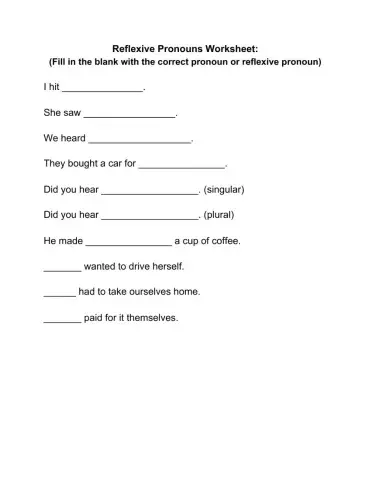
Reflexive pronoun

English Grammar

Reflective Pronouns Worksheet for Grade 5

Section 1: Theory and Rules with Example Sentences

Suggested Time: 10 minutes

What Are Reflexive Pronouns?
Reflexive pronouns are pronouns that end in “-self” or “-selves” and are used when the subject and the object of a sentence are the same person or thing. They are used to reflect the action back onto the subject.

Reflexive Pronouns:

  • Singular: myself, yourself, himself, herself, itself
  • Plural: ourselves, yourselves, themselves

When Do We Use Reflexive Pronouns?

  1. When the subject and object are the same:
    • Example: "I taught myself to play the piano."
    • Explanation: The subject "I" is the same person who is the object "myself."
  2. For emphasis (to emphasize that the subject did the action alone):
    • Example: "She cooked the entire meal herself."
    • Explanation: This emphasizes that "she" did the cooking without help.

Common Errors:

  • Incorrect: "Please give it to myself."
  • Correct: "Please give it to me."
  • Incorrect: "Himself went to the store."
  • Correct: "He went to the store by himself."

Section 2: Challenging NAPLAN-Style Questions

Suggested Time: 10 minutes

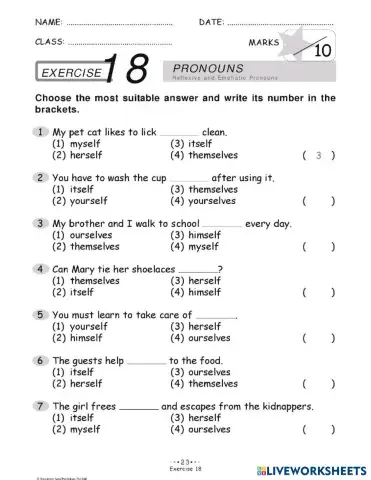
Instructions: Choose the correct reflexive pronoun to complete each sentence. Pay close attention to context and ensure the pronoun agrees with the subject.

  1. "After making the cake, Julia decorated it ______."

    • a) herself
    • b) himself
    • c) itself
    • d) themselves
  2. "The committee members decided to handle the problem ______."

    • a) themselves
    • b) itself
    • c) ourselves
    • d) himself
  3. "The robot fixed ______ after the malfunction."

    • a) himself
    • b) itself
    • c) themselves
    • d) ourselves
  4. "You must learn to rely on ______ if you want to be independent."

    • a) myself
    • b) yourselves
    • c) himself
    • d) yourself
  5. "The magician performed all the tricks ______, without any help."

    • a) itself
    • b) themselves
    • c) himself
    • d) herself

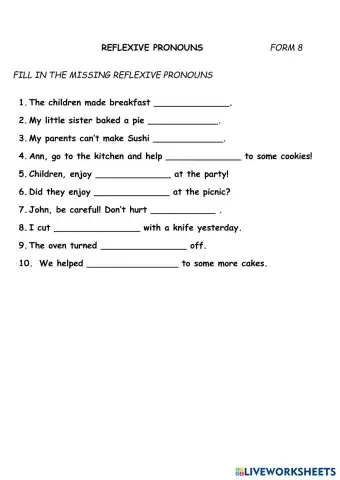
Short Answer Section: Instructions: Fill in the blank with the correct reflexive pronoun.

  1. "The cat saw ______ in the mirror and jumped back."
  2. "I taught ______ how to play the guitar by watching videos online."
  3. "The children built the treehouse all by ______."
  4. "During the test, remember to pace ______."
  5. "We enjoyed ______ at the amusement park yesterday."

Section 3: Writing Task to Practice Errors

Suggested Time: 15 minutes

Instructions: Write a short paragraph (4-5 sentences) about a time when you learned to do something by yourself. Use at least two reflexive pronouns in your paragraph.

Example Prompt: "Write about a time you learned a new skill or completed a task by yourself, such as riding a bike, cooking, or doing a school project. Describe what you did and how you felt."

Example Response: "I remember when I learned to bake cookies by myself. I followed the recipe carefully and didn’t ask for any help. I felt proud of myself when the cookies came out delicious. It was fun to bake all by myself!"

Create and Customize Worksheets for Every Classroom

LiveWorksheets makes it easy for teachers, parents and homeschool educators to design and deliver engaging learning materials. Upload a PDF or start from scratch to create what you need: anything from interactive math worksheets to reading comprehension worksheets, multiplication worksheets, and kindergarten worksheets in just a few clicks. Our drag-and-drop editor works across all grade levels and subjects, so you can tailor content to your lesson plans, homework, or assessments. ESL teachers can also build custom ESL worksheets, add a common sound chart, or integrate ESL activities to make each class more engaging. Easily create differentiated, auto-graded activities that save valuable time and support better student learning.

A Complete Library of Learning Resources for K-12 and ESL

Access thousands of ready-to-use worksheets across K-12 subjects, including kindergarten worksheets, math worksheets, multiplication practice, reading comprehension exercises, and ESL resources. Filter by grade, subject, or skill level to find exactly what you need, whether it’s for an elementary classroom, middle school review, or high school practice. ESL teachers can explore our growing collection of ESL worksheets and English as a Second Language activities designed to support all levels of learners. With new content added regularly, LiveWorksheets is a flexible resource that helps build lasting learning outcomes.