Narrative Text

Vocabulary - Language Arts

The Day the Pizza Flew

One Sunny Tuesday, Tommy decided to 1. [A) cook / B) cooked / C) cooking] a giant pizza for his family. He went into the 2. [A) kitchen / B) bathroom / C) garden] and put on a ridiculous chef’s hat. First, he mixed the flour, water, and yeast to make the 3. [A) soup / B) dough / C) juice]. Everything was going smoothly until he decided to toss the pizza base high into the 4. [A) water / B) ground / C) air] like a real Italian chef. Unfortunately, Tommy tossed it a little too 5. [A) hard / B) soft / C) slowly], and the dough stuck firmly to the high ceiling!

Tommy’s little sister, Lily, walked in and started to 6. [A) cry / B) laugh / C) sleep] uncontrollably. "Look! It's an 7. [A) Unidentified Flying Object / B) Unidentified Flying Doughnut / C) Unidentified Flying Pizza]!" she shouted. Tommy took a long wooden 8. [A) broom / B) pencil / C) spoon] and tried to poke the dough down. Instead of falling down, the heavy dough 9. [A) dropped / B) slipped / C) flew] off the stick and landed right on his dog’s 10. [A) tail / B) head / C) paw]. The dog, named Buster, looked like a silly wizard wearing a floppy white 11. [A) shoe / B) shirt / C) hat]. Buster sneezed loudly and ran across the living 12. [A) room / B) yard / C) roof]!

Suddenly, the family cat jumped off the 13. [A) tree / B) sofa / C) fridge] to chase the running dog. The cat tripped over a basket of 14. [A) toys / B) stones / C) books], which hit a heavy bottle of red tomato sauce. The sauce bottle opened and 15. [A) splashed / B) jumped / C) walked] all over Tommy’s white shirt! Tommy looked like he had just 16. [A) won / B) lost / C) started] a very messy ketchup war. Lily was so amused that she 17. [A) dropped / B) threw / C) caught] her glass of milk onto the rug, making an even bigger 18. [A) clean / B) mess / C) art].

At that exact moment, their mother opened the front 19. [A) window / B) door / C) gate] after a long day at work. She stopped, looked at the red sauce on the wall, the dough on the dog, and the milk on the floor. Tommy smiled 20. [A) nervously / B) angrily / C) proudly] and said, "Welcome home! Dinner is... almost 21. [A) raw / B) ready / C) cold]!" His mother could not stay angry for long; she began to 22. [A) scream / B) giggle / C) run] at the chaotic scene. In the end, they decided to 23. [A) order / B) cook / C) buy] a warm pizza from the nearby restaurant. It was definitely the most 24. [A) boring / B) memorable / C) scary] Tuesday night they ever 25. [A) had / B) have / C) having]!


Reading Worksheet - PFlores

English as a Second Language (ESL)

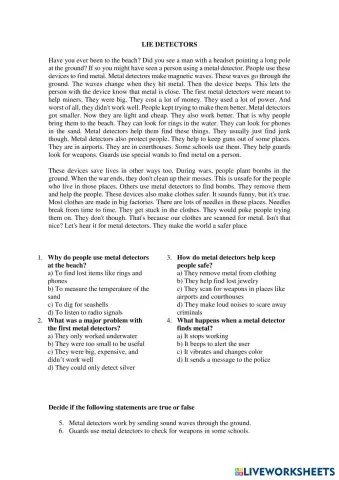
Have you ever been to the beach? Did you see a man with a headset pointing a long pole at the ground? If so you might have seen a person using a metal detector. People use these devices to find metal. Metal detectors make magnetic waves. These waves go through the ground. The waves change when they hit metal. Then the device beeps. This lets the person with the device know that metal is close. The first metal detectors were meant to help miners. They were big. They cost a lot of money. They used a lot of power. And worst of all, they didn't work well. People kept trying to make them better. Metal detectors got smaller. Now they are light and cheap. They also work better. That is why people bring them to the beach. They can look for rings in the water. They can look for phones in the sand. Metal detectors help them find these things. They usually just find junk though. Metal detectors also protect people. They help to keep guns out of some places. They are in airports. They are in courthouses. Some schools use them. They help guards look for weapons. Guards use special wands to find metal on a person.

These devices save lives in other ways too. During wars, people plant bombs in the ground. When the war ends, they don't clean up their messes. This is unsafe for the people who live in those places. Others use metal detectors to find bombs. They remove them and help the people. These devices also make clothes safer. It sounds funny, but it's true. Most clothes are made in big factories. There are lots of needles in these places. Needles break from time to time. They get stuck in the clothes. They would poke people trying them on. They don't though. That's because our clothes are scanned for metal. Isn't that nice? Let's hear it for metal detectors. They make the world a safer place

TRAVELLING

ENGLISH

Exploring Natural Wonders


Read the following passage and fill in the gaps with the correct form of the adjectives (irregular comparatives and superlatives) 


Last summer, I went on a trip to explore some of the most beautiful geographical features in the country. The journey started at the (beautiful) __________ coast I've ever seen. The cliffs there are much (high) __________ than the ones near my hometown.

Next, we visited a beach that was even (nice) __________ than the coast. The sand was softer, and the waves were gentler. After spending a day at the beach, we hiked to a (steep) __________ hill that gave us a panoramic view of the countryside.

Our next stop was a hidden cave, which was definitely (dark) __________ and (cool) __________ than the beach. We had to use flashlights to see the stunning formations inside.

We also saw a majestic waterfall that was the (powerful) __________ I've ever encountered. The sound of the water crashing down was much (loud) __________ than anything I've heard before.

The countryside was our next destination, and it was far (peaceful) __________ than the bustling city. We walked through a valley that seemed (green) __________ and (fertile) __________ than anywhere else on our journey.

One of the most memorable moments was when we followed a stream that led us to a winding river. The river was (wide) __________ and (clear) __________ than the stream, providing a perfect spot for a refreshing swim.

Towards the end of our trip, we ventured into a dense rainforest. It was (humid) __________ and (lush) __________ than any forest I've ever been to. The variety of plants and animals there was simply (astonishing) __________.

Finally, we ended our adventure in the desert. The landscape was (dry) __________ and (hot) __________ than any other place we visited. Despite the harsh conditions, the desert had its own unique beauty.

Create and Customize Worksheets for Every Classroom

LiveWorksheets makes it easy for teachers, parents and homeschool educators to design and deliver engaging learning materials. Upload a PDF or start from scratch to create what you need: anything from interactive math worksheets to reading comprehension worksheets, multiplication worksheets, and kindergarten worksheets in just a few clicks. Our drag-and-drop editor works across all grade levels and subjects, so you can tailor content to your lesson plans, homework, or assessments. ESL teachers can also build custom ESL worksheets, add a common sound chart, or integrate ESL activities to make each class more engaging. Easily create differentiated, auto-graded activities that save valuable time and support better student learning.

A Complete Library of Learning Resources for K-12 and ESL

Access thousands of ready-to-use worksheets across K-12 subjects, including kindergarten worksheets, math worksheets, multiplication practice, reading comprehension exercises, and ESL resources. Filter by grade, subject, or skill level to find exactly what you need, whether it’s for an elementary classroom, middle school review, or high school practice. ESL teachers can explore our growing collection of ESL worksheets and English as a Second Language activities designed to support all levels of learners. With new content added regularly, LiveWorksheets is a flexible resource that helps build lasting learning outcomes.