Shapes Matching Activity

English


Shapes Matching Activity


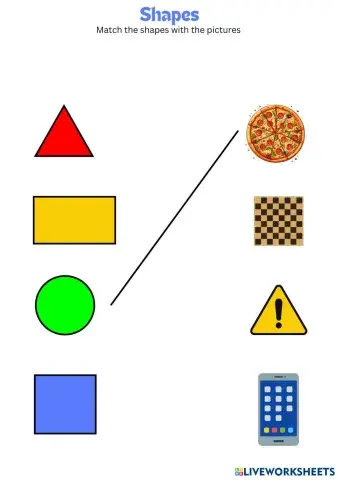
This worksheet is designed to introduce and reinforce the recognition of basic geometric shapes through real-life object associations. It supports early learners in building foundational geometry knowledge by identifying shapes and connecting them with familiar items. This is particularly useful for preschool, kindergarten, and early elementary students.


Objective:

Students will:

  • Identify and name basic geometric shapes: triangle, rectangle, circle, and square.
  • Match each shape with a real-world object that has the same shape.
  • Develop visual recognition skills, shape vocabulary, and critical thinking.


Instructions:

  • On the left side, there are four basic shapes:

    1. Triangle (red)
    2. Rectangle (yellow)
    3. Circle (green)
    4. Square (blue)
  • On the right side, there are four real-world images:

    1. A pizza (round shape)
    2. A chessboard (square shape)
    3. A warning sign (triangle shape)
    4. A smartphone (rectangular shape)
  •  
  • Students are instructed to match each shape on the left with the corresponding object on the right. This can be done by drawing lines.


Example:

  1. CirclePizza

    • The pizza is circular in shape.


Skills Developed:

  • Shape recognition: Identify and name common geometric shapes.
  • Real-world application: Understand how shapes appear in everyday life.
  • Vocabulary enhancement: Learn and use shape-related terminology.
  • Fine motor skills: Practice drawing lines or interacting with digital tools.
  • Cognitive skills: Strengthen observation and logical matching abilities.


Educational Use:

  • Can be used in classroom settings, homeschooling, or online learning platforms.
  • Suitable for individual practice, group activities, or teacher-led instruction.
  • Can serve as an assessment tool for understanding shape recognition.
  • Useful as a warm-up activity, part of a geometry lesson, or during math centers.

Digital Life & Social Media Awareness

Vocabulary - English Language

Digital Literacy: Navigating Social Media

Тема: Digital Life & Social Media Awareness

NAME: _________________________

Pre-Class Study (Домашняя подготовка до урока):

Перед выполнением этого рабочего листа, пожалуйста:

1.     Посмотрите короткое видео: "5 Ways Social Media Affects Your Brain" (ссылку можно найти в описании к уроку или использовать следующую: https://www.youtube.com/watch?v=HffWFd_6bJ0).

2.     Прочитайте текст-памятку ниже.

Netiquette: Rules for Online Interaction

Netiquette is a set of rules for polite behaviour online. Remember: THINK before you post. Is it True, Helpful, Inspiring, Necessary, Kind? Don't share private information (oversharing). Respect other people's opinions, even in a heated debate. Avoid writing in all CAPS – it looks like SHOUTING. Be careful with sarcasm and humour as it can be misunderstood without tone of voice.

Part 1: Vocabulary Check (Сопоставление)

Match the word with its definition.

1.     Netiquette

2.     Oversharing

3.     Heated debate

4.     FOMO (Fear Of Missing Out)

a) A public argument or disagreement, often online.
b) The feeling of anxiety from seeing others' perfect lives online.
c) Rules for polite and respectful behaviour on the internet.
d) Sharing too much personal information publicly.

Part 2: Comprehension – Multiple Choice (Множественный выбор)

Based on the Pre-Class Study video and text, choose the correct answer(s). There can be one or more right answers.

1.     What is the main purpose of the "THINK" rule?

o    a) To make your posts more interesting.

o    b) To help you decide if you should post something.

o    c) To improve your spelling.

2.     Which of the following are examples of good netiquette? (Choose all that apply)

o    a) Using capital letters for an entire post to express excitement.

o    b) Respecting someone's opinion even if you disagree.

o    c) Posting a friend's personal news without asking.

o    d) Being cautious with sarcasm in text messages.

Part 3: Language in Use (Перетаскивание / Заполнение пропусков)

Drag and drop the words into the correct gaps in the text: influencers, algorithms, tailored, content.

Social media platforms use complex (1) ______ to decide what you see. They analyse your likes and shares to create a (2) ______ feed. This means you mostly see (3) ______ that confirms your existing beliefs. Popular (4) ______ can shape trends and opinions.

Part 4: Critical Thinking (Короткий ответ / Открытый вопрос)

Answer in 2-3 sentences.

What is one POSITIVE and one NEGATIVE effect of social media on your personal life or society?

Positive: _________________________________________________________

Negative: ________________________________________________________


Types of Institutions

Belizean Studies

Name: ________________

Class: ________________

Date: _________________


Instructions: Select one type of institution that best describes the case scenario. 


Recreational                                  Economic                                      Religious 

Educational                                     Political 


  1. Electoral Commissions: Electoral commissions are responsible for organizing and conducting elections. They ensure the fairness, transparency, and integrity of the electoral process__________________
  2. Sports Clubs: A local sports club organizes various sports activities such as soccer, basketball, and tennis. It provides opportunities for individuals to engage in physical exercise, develop teamwork skills, and compete in friendly matches.__________
  3. Businesses: Businesses range from small enterprises to multinational corporations. They produce goods or provide services, create employment opportunities, and contribute to economic growth _________________.
  4. Gyms and Fitness Centers: These institutions provide fitness equipment, exercise classes, and personal training services to help individuals maintain their physical fitness and improve their overall well-being._____________________
  5. Religious Organizations: Religious organizations, such as religious orders, missionary groups, and interfaith organizations, engage in various religious and social activities. They promote religious teachings, charitable work, and community service _____________________
  6. Public and Private Schools: These institutions offer formal education to students from kindergarten to high school. They follow a structured curriculum and provide a learning environment for academic and personal growth ______________________.
  7. Colleges and Universities: Colleges and universities provide higher education and offer a wide range of academic programs and degrees. They promote research, critical thinking, and professional development.________________________
  8. Local Government: Local government institutions, such as city councils or town boards, are responsible for making decisions and implementing policies at the local level. They address issues related to public services, infrastructure development, and community welfare ______________________.
  9. Political Parties: Political parties are organizations that represent different ideologies and compete for political power. They play a vital role in shaping public opinion, mobilizing voters, and influencing policy agendas ___________________________
  10. Adult Education Programs: Adult education programs cater to the learning needs of adults, including vocational training, language courses, and continuing education. They support lifelong learning and skill enhancement __________________.
  11. Financial Institutions: Financial institutions, such as banks, credit unions, and investment firms, facilitate the flow of capital, provide financial services, and support economic transactions _____________________.
  12. Trade Associations: Trade associations represent specific industries or sectors and work to promote the interests of their members. They provide a platform for collaboration, advocacy, and knowledge sharing _________________________.
  13. Places of Worship: Churches, mosques, temples, and synagogues are places of worship where individuals gather for religious ceremonies, prayers, and community activities____________.
  14. Religious Education Institutions: These institutions provide religious education and training to individuals, such as Sunday schools, seminaries, and religious colleges ______________.
  15. Town or County Recreation Departments: These departments offer a wide range of recreational programs and facilities for community members. They may organize events like summer camps, swimming lessons, and fitness classes to promote an active and healthy lifestyle.____________________________


Create and Customize Worksheets for Every Classroom

LiveWorksheets makes it easy for teachers, parents and homeschool educators to design and deliver engaging learning materials. Upload a PDF or start from scratch to create what you need: anything from interactive math worksheets to reading comprehension worksheets, multiplication worksheets, and kindergarten worksheets in just a few clicks. Our drag-and-drop editor works across all grade levels and subjects, so you can tailor content to your lesson plans, homework, or assessments. ESL teachers can also build custom ESL worksheets, add a common sound chart, or integrate ESL activities to make each class more engaging. Easily create differentiated, auto-graded activities that save valuable time and support better student learning.

A Complete Library of Learning Resources for K-12 and ESL

Access thousands of ready-to-use worksheets across K-12 subjects, including kindergarten worksheets, math worksheets, multiplication practice, reading comprehension exercises, and ESL resources. Filter by grade, subject, or skill level to find exactly what you need, whether it’s for an elementary classroom, middle school review, or high school practice. ESL teachers can explore our growing collection of ESL worksheets and English as a Second Language activities designed to support all levels of learners. With new content added regularly, LiveWorksheets is a flexible resource that helps build lasting learning outcomes.