11 gk2- 4

11- 2ND MID TERM REVISION Exercise 4 R

11- 2ND MID TERM REVISION

Exercise 4
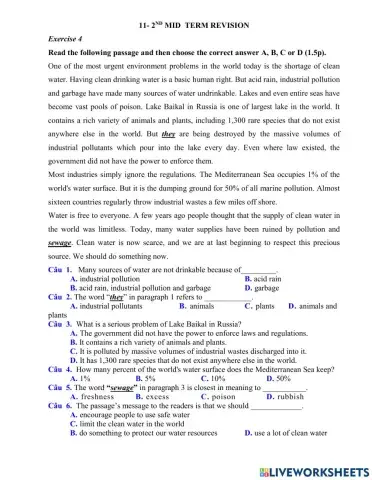
Read the following passage and then choose the correct answer A, B, C or D (1.5p).
One of the most urgent environment problems in the world today is the shortage of clean water. Having clean drinking water is a basic human right. But acid rain, industrial pollution and garbage have made many sources of water undrinkable. Lakes and even entire seas have become vast pools of poison. Lake Baikal in Russia is one of largest lake in the world. It contains a rich variety of animals and plants, including 1,300 rare species that do not exist anywhere else in the world. But they are being destroyed by the massive volumes of industrial pollutants which pour into the lake every day. Even where law existed, the government did not have the power to enforce them.
Most industries simply ignore the regulations. The Mediterranean Sea occupies 1% of the world's water surface. But it is the dumping ground for 50% of all marine pollution. Almost sixteen countries regularly throw industrial wastes a few miles off shore.
Water is free to everyone. A few years ago people thought that the supply of clean water in the world was limitless. Today, many water supplies have been ruined by pollution and sewage. Clean water is now scarce, and we are at last beginning to respect this precious source. We should do something now.
Câu 1. Many sources of water are not drinkable because of_________.
A. industrial pollution B. acid rain
B. acid rain, industrial pollution and garbage D. garbage
Câu 2. The word “they” in paragraph 1 refers to ____________.
A. industrial pollutants B. animals C. plants D. animals and plants
Câu 3. What is a serious problem of Lake Baikal in Russia?
A. The government did not have the power to enforce laws and regulations.
B. It contains a rich variety of animals and plants.
C. It is polluted by massive volumes of industrial wastes discharged into it.
D. It has 1,300 rare species that do not exist anywhere else in the world.
Câu 4. How many percent of the world's water surface does the Mediterranean Sea keep?
A. 1% B. 5% C. 10% D. 50%
Câu 5. The word “sewage” in paragraph 3 is closest in meaning to ___________.
A. freshness B. excess C. poison D. rubbish
Câu 6. The passage’s message to the readers is that we should _____________.
A. encourage people to use safe water
C. limit the clean water in the world
B. do something to protect our water resources D. use a lot of clean water
Circle the letter A, B, C, or D to indicate the word that differs from the other three in the position of primary stress in each of the following Câu s.
Câu 7: A. awareness B. billion C. protection D. society
Câu 8: A. apply B. differ C. decide D. protect
Circle the letter A, B, C, or D to indicate the answer that best completes sentence in each of the following Câu s.
Câu 9: Academic courses should teach practical skills ___________addition to critical thinking.
A. into B. to C. from D. in
Câu 10: Tree plantation helps to reduce global warming since trees ________ CO2 in the air.
A. absorb B. emit C. release D. pollute
Câu 11: The heavy rain has caused ________ in many parts of the country.
A. food B. drought C. famine D. floods
Câu 12: . Hunting for meat and burning forests for soils wildlife
A. protect B. conserve C. destroy D. survive
decreased
Câu 13: . Because of people’s _____with the environment, many kinds of plants and animals are becoming rare.
A. supply B. survival C. influence D. interference
Câu 14: Garbage is considered to be some kind of ______.
A. pollute B. pollutants C. pollution D. polluting
Câu 15: The ____ is the air, water and land in or on which people, animals and plants live.
A. consequence B. environment C. planet D. resource
Câu 16: . The knife ________ we are cutting bread is very sharp.
A. with that B. which C. with which D. that
Câu 17: Cathy is trustworthy. She’s a person upon _________ you can always depend.
A. who B. whom C. that D. X
Câu 18: The man ____ I introduced you to last night may be the next president of the university.
A. whom B. that C. X D. all are correct.
Câu 19: Your career should focus on a field _________ you are generally interested.
A. on which B. in which C. which D. that
Câu 20: . One of the people _________ I admire most in the history of the world is Gandhi.
A. that B. which C. whose D. of them

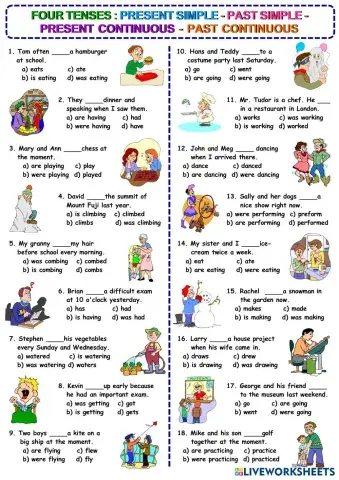
Understanding Tenses: Crucial for Effective Communication

English as a Second Language (ESL)

Tenses are an integral part of the English language, as they allow us to express actions and situations in different time frames. Understanding tenses is, as it ensures clarity and accuracy in conveying our thoughts.


Firstly, understanding tenses helps us to accurately describe past events. By using the past tense, we can indicate that an action or event has already occurred. This allows listeners or readers to have a clear timeline of events and prevents any confusion that may arise from incorrect verb usage. Secondly, tenses enable us to discuss present situations with precision. The present tense allows us to express ongoing actions or habits. For example, saying "I am studying" indicates that the action is currently taking place. This helps in providing accurate information about our current state or activities. Lastly, tenses allow us to talk about future events confidently. By using future tenses such as "will" or "going to," we can express intentions or predictions about what will happen later on. This is especially important when making plans or discussing future arrangements.

In conclusion, understanding tenses is essential for effective communication in English. It enables us to accurately describe past events, discuss present situations with precision, and confidently talk about future events. By mastering tenses, we can ensure clarity and accuracy in our language use and enhance our overall communication skills.


Tenses worksheets serve a crucial purpose in language learning, as they help students understand and practice the various tenses used in English grammar. The main goal of these worksheets is to provide learners with a structured approach to mastering verb tenses.

Firstly, these worksheets introduce students to the different tenses, such as present simple, past continuous, future perfect, and more. By providing clear explanations and examples, learners can grasp the concept of each tense and its specific usage. This foundational knowledge is essential for effective communication in English. Secondly, tense worksheets offer ample practice opportunities. Through exercises that involve filling in the blanks or transforming sentences from one tense to another, students can reinforce their understanding of how verbs change according to time and context. This repetitive practice helps solidify their grasp of verb conjugation and sentence structure. Furthermore, these worksheets encourage critical thinking skills by challenging students to identify which tense is appropriate in different situations. This not only enhances their grammatical knowledge but also improves their overall language proficiency.

In conclusion, tenses worksheets play a vital role in language learning by providing learners with a systematic approach to understanding and practicing verb tenses. Their purpose is to equip students with the necessary skills to communicate effectively in English by using appropriate verb forms according to time and context. With regular use of these worksheets, learners can confidently navigate through various tenses and enhance their overall language proficiency.


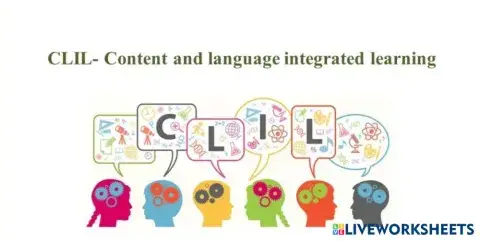
CLIL

English as a Foreign Language (EFL)

CLIL (Content and Language Integrated Learning), students learn various subjects like history, art, science and math in a foreign language. Rather than being a stand-alone subject, language becomes a skill acquired in the classroom while mastering other types of content.

Tips for Planning and Teaching CLIL Lessons 

As you can see from the lesson plans above, you can get creative with CLIL lessons and include diverse themes! Whether you want to make your own lesson plan or you’ll be working off these examples, here are some ways to make your CLIL lessons even more effective:  

Teach vocabulary separately 

Pick the important concepts and words and teach them in isolation from the main lesson. I usually prep students by doing this beforehand, but you can also choose to wait until after the class.

During the class, assume your students are native speakers of the target language and just teach the subject. For example, when the lesson is about math, teach actual addition and subtraction, not the translation of the word “addition” in German. Teach the math and be a math teacher for the duration of the activity.

In the course of the lesson, kids will be compelled to use their critical thinking skills to figure out the meanings of any unknown words. 

Include authentic materials

Aside from CLIL materials on the subject you want, look for authentic materials too about the subject at hand. For example, on top of CLIL-specific materials about philosophy in German, I’d look for native German discussions, blogs, websites, forums and book excerpts about philosophy too

There are three particular sites that I often check because they’re loaded with authentic materials and educational links:

  • Government sites and ministries. One of the aims of national leadership, for all states, is the education of their populace. So you can be sure that their websites have links to resources that can help you find material for CLIL. For example, the site for France’s Ministry of National Educationhas links to academic sites and even its own search engine.
  • Websites for the top universities in the country. Naturally, these sites are replete with links to the latest research, publications, lessons and journals. You may also find online libraries, databases and even e-books you could use. Take the example of Technische Universität München, one of the top universities in Germany.
  • Forums for native speakers. When you join these forums, you’ll have reached the inner sanctum of the country—at least online. Read the posts and discussion and you’ll have an insider’s look not only at their relationship problems, you’ll find in their postings, links to sites that native speakers actually use and recommend to each other. This one’s big in China.

Give simple worksheets

Keep any CLIL worksheets visually appealing and user-friendly. Avoid overcrowding it or making it too “busy.”

Use a consistent font and style throughout—ideally a basic font that won’t be distracting. Include lots of pictures and graphs to enhance the visual appearance. 

These are my favorite resource websites for worksheets:

  • One Stop English — This site provides unique English CLIL resources that can be adapted to any language. You’ll find puzzles, crosswords, vocabulary worksheets and more catering to a range of ages.
  • Teachers Pay Teachers — As the name suggests, this is a platform where teachers can sell resources that they’ve created to other teachers. Just look up “CLIL Teaching Resources,” and you can even filter for worksheets and select them by subject and grade. 
  • Scholastic’s Teacher Resources — This is a great place to find worksheet ideas to fit any subject you’re teaching through CLIL. You can get grade-appropriate lesson plans here on everything from literature to basic science to economics.
  • Instant Online Crossword Puzzle Maker— This non-traditional worksheet option is great for teaching vocabulary in any subject or language in an engaging way. You can use this instant crossword maker to easily produce fun worksheets targeting any vocabulary set you’re working on. 
  • Pinterest — Mostly known for craft and home decor inspiration, this popular platform is now also a go-to source for great lesson plan ideas, especially for elementary school children. Just type “CLIL” into the search bar plus the name of the target language (e.g. “CLIL italiano”). 

Do scaffolding

Give the students the temporary support they need to reach higher levels of comprehension and mastery, in terms of both the language and the content.

Begin with simple tasks and work your way up to those that are more complex. Give clear directions and explain concepts in multiple ways to ensure understanding.

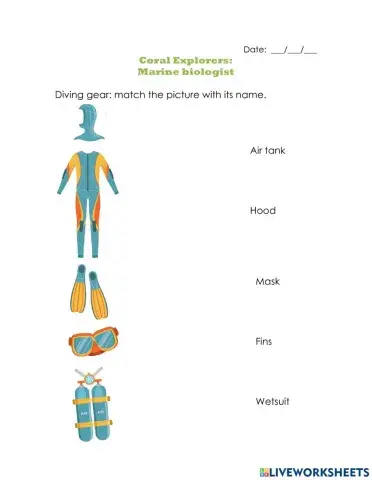
I sometimes start with intro exercises where students match vocabulary with images, followed by guided readings where key vocabulary is highlighted. After that, students can do more involved discussions and activities that involve problem-solving and research.

Use gestures, visual aids and props. 

You used to just stand there and talk. With CLIL, not anymore. Illustrate what you’re speaking about, and you’ll see that students are better able to grasp your message.

Break up presentations with videos and images that students will find interesting. You can show mind maps or flowcharts to explain more complicated processes. 

I also try to bring props whenever I can. I’ve used 3D models of different shapes in math when explaining concepts like area or volume and even puppets for storytelling. If the subject is history or geography, these might be objects related to what the students are learning.


Create and Customize Worksheets for Every Classroom

LiveWorksheets makes it easy for teachers, parents and homeschool educators to design and deliver engaging learning materials. Upload a PDF or start from scratch to create what you need: anything from interactive math worksheets to reading comprehension worksheets, multiplication worksheets, and kindergarten worksheets in just a few clicks. Our drag-and-drop editor works across all grade levels and subjects, so you can tailor content to your lesson plans, homework, or assessments. ESL teachers can also build custom ESL worksheets, add a common sound chart, or integrate ESL activities to make each class more engaging. Easily create differentiated, auto-graded activities that save valuable time and support better student learning.

A Complete Library of Learning Resources for K-12 and ESL

Access thousands of ready-to-use worksheets across K-12 subjects, including kindergarten worksheets, math worksheets, multiplication practice, reading comprehension exercises, and ESL resources. Filter by grade, subject, or skill level to find exactly what you need, whether it’s for an elementary classroom, middle school review, or high school practice. ESL teachers can explore our growing collection of ESL worksheets and English as a Second Language activities designed to support all levels of learners. With new content added regularly, LiveWorksheets is a flexible resource that helps build lasting learning outcomes.