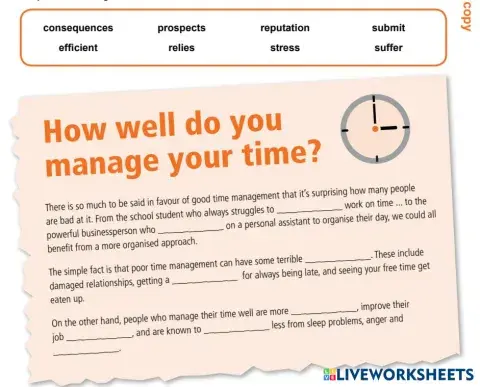
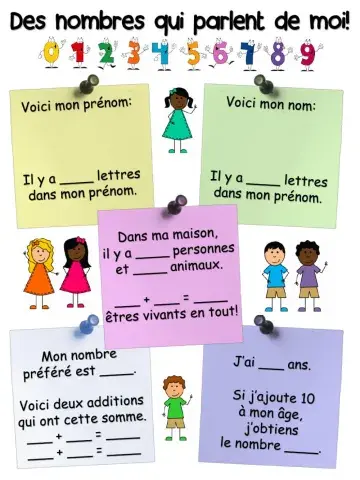
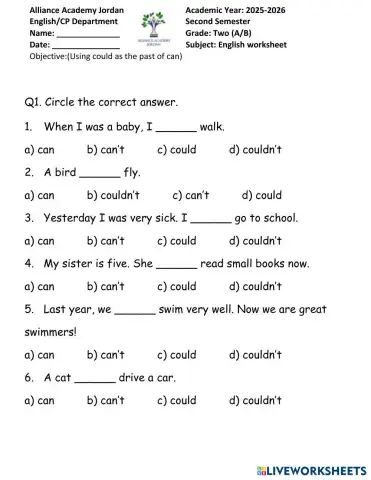
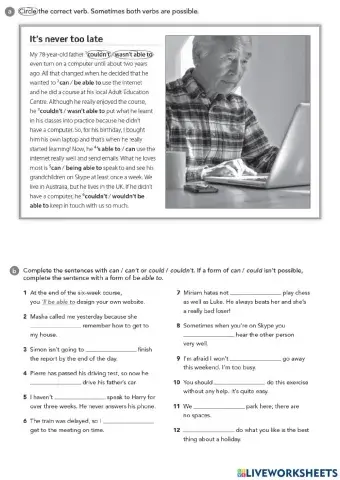
Fill in the gaps

English as a Second Language (ESL)

  1. Where is your school?
    My school is in the ________ ________, which makes it very easy to get to. Since it’s in such a ________ ________, I can also visit ________, cafes, and other places nearby that help me with my studies.
  2. Do you like your school?
    Yes, I really ________ my school because it’s a place where I can ________ a lot and meet people who are ________ to do well. Moreover, the teachers are also very ________, which makes learning enjoyable.
  3. Do you think your school is a good place to study?
    Yes, my school is a ________ place to study because it has everything we need, like a good ________ and well-equipped ________ labs. In addition, the teachers are always ready to ________, which makes it easier to focus on learning.
  4. What is the environment like at your school?
    The environment at my school is very ________ and encouraging. For example, students often ________ together on projects, and there are many ________ to keep us involved. Well, frankly speaking, it’s a place where everyone tries to do their ________.
  5. What do you think could be improved in your school?
    Although my school is great, I think it could have more ________ ________ where students can choose to study ________ or in groups. This would make it easier for everyone to learn in the way that ________ them best.
  6.  How important is interest in study?
    Interest in study is extremely ________ because it keeps you ________ despite challenges. When you’re ________ about what you’re learning, even ________ the midnight oil feels like an ________ in your future.
    Interest in study is very ________ because it helps you stay ________ and work hard, even when things get ________. When you like what you’re ________, it feels easier and more ________.
  7.  Which subject do you find challenging?
    ________ is quite challenging for me because it requires sharp ________ skills and meeting tight ________ for assignments. However, I see it as an ________ to sharpen my ________ abilities.
    I find ________ a bit difficult because it needs a lot of ________ thinking and ________-solving. Even though it’s hard, I try to see it as a way to ________ my skills.
  8. How do you go to school?
    I usually go to school by ________, which allows me to manage my ________ effectively. During the commute, I often ________ my notes or listen to educational ________ to make the most of my day.
    I usually take the ________ to school. It’s ________, and I use the time to ________ my notes or listen to ________, so the journey feels ________.
  9. What are you studying?
    I’m currently ________ a degree in computer science, which I find both ________ and rewarding. It offers opportunities to explore ________-edge technologies and prepare for a ________ career in IT.
    I’m studying ________ ________. It’s a bit ________, but I enjoy it because it prepares me for a career in ________, which is something I’m ________.
  10. Why did you choose this subject?
    I chose computer science because I’m ________ by how ________ is shaping our future. I aim to gain ________ in this field and use it to climb the ________ ladder.
    Well, I chose computer science because I’m really ________ in ________ and how it is ________ the world. I want to learn more about it and use this ________ to build my ________ career.

11.            What do you like most about your studies?

……………..is the balance between theoretical knowledge and practical application. For instance, during lab sessions, I gain hands-on …………………..which helps me sharpen my skills and stay ………………..

I like that my studies include both …………. and practice. For example, we have lab sessions where I can ………………. what I’ve learned. This makes studying more interesting and ……………….

     12.            Are you more interested in theoretical or practical subjects? Why?

I prefer …………… subjects because they allow me to gain hands-on experience and ………………….. real-world scenarios. This approach not only sharpens my skills but also builds my …………………. for future challenges.

I prefer practical subjects because I like to apply what I’ve learned in real situations. It makes learning more fun and gives me …………………… I can use in the future.

     13.            Do you find your studies difficult? Why or why not?

Sometimes, the workload can be…………………., especially when I have to meet tight deadlines. However, I stay motivated by setting ……………….. and managing my schedule effectively.

Sometimes my studies are a bit hard, especially when I have a lot of assignments or……………….. But I try to manage my time well and stay ………………….. which helps me deal with the workload.

14.  How do you usually prepare for exams?

I prepare for exams by ………………..a study schedule that helps me balance my workload. I also collaborate with classmates for group discussions and …………………. past papers to improve my understanding.

I prepare for exams by making a study plan so I can manage my time well. I also study with my classmates and practice past papers to …………………. my understanding of the topics.

15.  Do you prefer studying alone or with others? Why?

I prefer a mix of both. Studying alone helps me focus and ……………… my time effectively, while group study sessions are engaging and help me explore ………………….. perspectives.

I like both. When I study alone, I can ………………. better, but studying with others helps me learn from different ………………… and understand things more clearly

16.  What are your future plans after finishing your studies?

After completing my studies, I plan to ……………….. a career in software engineering. My ultimate goal is to climb the career ladder by gaining expertise in my field and making a meaningful impact in a reputable company.

After I …………….. my studies, I plan to work as a software engineer. I want to keep learning and improving my skills so I can build a ……………..career and contribute to interesting projects

  1.  
  2.  
  3.  


CLIL

English as a Foreign Language (EFL)

CLIL (Content and Language Integrated Learning), students learn various subjects like history, art, science and math in a foreign language. Rather than being a stand-alone subject, language becomes a skill acquired in the classroom while mastering other types of content.

Tips for Planning and Teaching CLIL Lessons 

As you can see from the lesson plans above, you can get creative with CLIL lessons and include diverse themes! Whether you want to make your own lesson plan or you’ll be working off these examples, here are some ways to make your CLIL lessons even more effective:  

Teach vocabulary separately 

Pick the important concepts and words and teach them in isolation from the main lesson. I usually prep students by doing this beforehand, but you can also choose to wait until after the class.

During the class, assume your students are native speakers of the target language and just teach the subject. For example, when the lesson is about math, teach actual addition and subtraction, not the translation of the word “addition” in German. Teach the math and be a math teacher for the duration of the activity.

In the course of the lesson, kids will be compelled to use their critical thinking skills to figure out the meanings of any unknown words. 

Include authentic materials

Aside from CLIL materials on the subject you want, look for authentic materials too about the subject at hand. For example, on top of CLIL-specific materials about philosophy in German, I’d look for native German discussions, blogs, websites, forums and book excerpts about philosophy too

There are three particular sites that I often check because they’re loaded with authentic materials and educational links:

  • Government sites and ministries. One of the aims of national leadership, for all states, is the education of their populace. So you can be sure that their websites have links to resources that can help you find material for CLIL. For example, the site for France’s Ministry of National Educationhas links to academic sites and even its own search engine.
  • Websites for the top universities in the country. Naturally, these sites are replete with links to the latest research, publications, lessons and journals. You may also find online libraries, databases and even e-books you could use. Take the example of Technische Universität München, one of the top universities in Germany.
  • Forums for native speakers. When you join these forums, you’ll have reached the inner sanctum of the country—at least online. Read the posts and discussion and you’ll have an insider’s look not only at their relationship problems, you’ll find in their postings, links to sites that native speakers actually use and recommend to each other. This one’s big in China.

Give simple worksheets

Keep any CLIL worksheets visually appealing and user-friendly. Avoid overcrowding it or making it too “busy.”

Use a consistent font and style throughout—ideally a basic font that won’t be distracting. Include lots of pictures and graphs to enhance the visual appearance. 

These are my favorite resource websites for worksheets:

  • One Stop English — This site provides unique English CLIL resources that can be adapted to any language. You’ll find puzzles, crosswords, vocabulary worksheets and more catering to a range of ages.
  • Teachers Pay Teachers — As the name suggests, this is a platform where teachers can sell resources that they’ve created to other teachers. Just look up “CLIL Teaching Resources,” and you can even filter for worksheets and select them by subject and grade. 
  • Scholastic’s Teacher Resources — This is a great place to find worksheet ideas to fit any subject you’re teaching through CLIL. You can get grade-appropriate lesson plans here on everything from literature to basic science to economics.
  • Instant Online Crossword Puzzle Maker— This non-traditional worksheet option is great for teaching vocabulary in any subject or language in an engaging way. You can use this instant crossword maker to easily produce fun worksheets targeting any vocabulary set you’re working on. 
  • Pinterest — Mostly known for craft and home decor inspiration, this popular platform is now also a go-to source for great lesson plan ideas, especially for elementary school children. Just type “CLIL” into the search bar plus the name of the target language (e.g. “CLIL italiano”). 

Do scaffolding

Give the students the temporary support they need to reach higher levels of comprehension and mastery, in terms of both the language and the content.

Begin with simple tasks and work your way up to those that are more complex. Give clear directions and explain concepts in multiple ways to ensure understanding.

I sometimes start with intro exercises where students match vocabulary with images, followed by guided readings where key vocabulary is highlighted. After that, students can do more involved discussions and activities that involve problem-solving and research.

Use gestures, visual aids and props. 

You used to just stand there and talk. With CLIL, not anymore. Illustrate what you’re speaking about, and you’ll see that students are better able to grasp your message.

Break up presentations with videos and images that students will find interesting. You can show mind maps or flowcharts to explain more complicated processes. 

I also try to bring props whenever I can. I’ve used 3D models of different shapes in math when explaining concepts like area or volume and even puppets for storytelling. If the subject is history or geography, these might be objects related to what the students are learning.


Create and Customize Worksheets for Every Classroom

LiveWorksheets makes it easy for teachers, parents and homeschool educators to design and deliver engaging learning materials. Upload a PDF or start from scratch to create what you need: anything from interactive math worksheets to reading comprehension worksheets, multiplication worksheets, and kindergarten worksheets in just a few clicks. Our drag-and-drop editor works across all grade levels and subjects, so you can tailor content to your lesson plans, homework, or assessments. ESL teachers can also build custom ESL worksheets, add a common sound chart, or integrate ESL activities to make each class more engaging. Easily create differentiated, auto-graded activities that save valuable time and support better student learning.

A Complete Library of Learning Resources for K-12 and ESL

Access thousands of ready-to-use worksheets across K-12 subjects, including kindergarten worksheets, math worksheets, multiplication practice, reading comprehension exercises, and ESL resources. Filter by grade, subject, or skill level to find exactly what you need, whether it’s for an elementary classroom, middle school review, or high school practice. ESL teachers can explore our growing collection of ESL worksheets and English as a Second Language activities designed to support all levels of learners. With new content added regularly, LiveWorksheets is a flexible resource that helps build lasting learning outcomes.