Reading Test: Black Friday

English as a Foreign Language

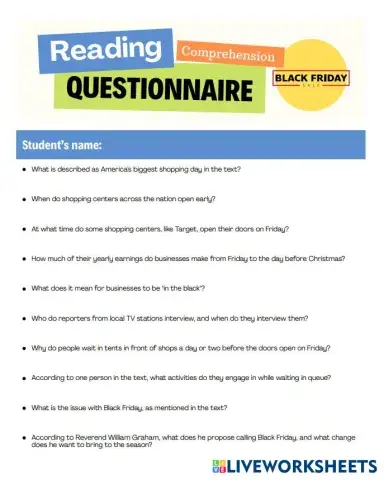
The day after Thanksgiving has become America’s biggest shopping day. Closed all day on Thursday, shopping centres all across the nation open early on Friday. Some of them open at 12:01 Friday morning, while others open at 4 a.m. Some “sleepyhead“ shopping centres, like Target this year, don’t open their doors on Friday until 6 a.m. From Friday to the day before Christmas, this is the season when businesses make nearly 25 per cent of what they earn in a year. This season puts many businesses “in the black”, that is, they make the money they need for the year.

Reporters from local TV stations interview people who sleep in tents in front of the shops a day or two before the doors open on Friday. These people patiently wait in queue to get products that are 50 per cent cheaper or more.

“Oh, we have fun,” said one of the persons queuing. “We sometimes bring games to play, we watch TV and order lots of pizza, and we often meet interesting people. And, most important of all, we save a lot!” The problem, of course, is that only a very small number of products have big reductions in their prices. Apart from a few big discounts, each shop has other things that are reduced from 10 to 50 per cent, saving shoppers from $10 to $400 per item, and so Americans want to go shopping.

Not all Americans enjoy shopping. Reverend William Graham wants to change Black Friday’s name. “We want to call it Remember Jesus Friday. People should start the season with the right attitude. Christmas has become a Season of Shopping. We want to make it a Season of Giving. And we don’t mean giving material things. We mean giving your back, your mind, and your hands. Help an old lady clean up her house. Teach a kid how to read. Visit sick people in the hospital or in nursing homes. Give food to the Red Cross. Celebrate Christmas by remembering Jesus and forgetting Santa Claus.”

The last Sunday

English

The Last Saturday


Last Saturday, Emily and her friends went to the amusement park. They arrived early in the morning because they wanted to enjoy the whole day there. Emily tried the big roller coaster, and it was very exciting, but also a little scary. Her friend, Jake, didn't like the roller coaster, so he waited for her near the food stalls. After the ride, they all ate hot dogs and drank lemonade. Later, they played games to win prizes, but only Emily won a small teddy bear. At the end of the day, they watched a firework show. They were very tired but happy. It was a fun day.


Vocabulario

  1. Amusement park – parque de diversiones
  2. Roller coaster – montaña rusa
  3. Exciting – emocionante
  4. Scary – aterrador/a
  5. Food stalls – puestos de comida
  6. Hot dog – perro caliente
  7. Lemonade – limonada
  8. Teddy bear – oso de peluche
  9. Firework show – espectáculo de fuegos artificiales

Preguntas de Comprensión

  1. 1. Where did Emily and her friends go last Saturday?
  2. 2. What time of day did they arrive at the amusement park?
  3. 3. What ride did Emily try?
  4. 4. Who didn’t like the roller coaster?
  5. 5. What did they eat after the ride?
  6. 6. What did they drink with their hot dogs?
  7. 7. Who won a prize at the amusement park games?
  8. 8. What kind of prize did Emily win?
  9. 9. What did they watch at the end of the day?
  10. 10. How did Emily and her friends feel at the end of the day?


Complete the sentences using verbs into brackets (simple past tense):


  1. 1. Emily and her friends _____ (go) to the amusement park last Saturday.
  2. 2. They _____ (arrive) early in the morning.
  3. 3. Emily _____ (try) the big roller coaster.
  4. 4. Her friend Jake _____ (not like) the roller coaster.
  5. 5. At the end of the day, they _____ (watch) a firework show.

Create and Customize Worksheets for Every Classroom

LiveWorksheets makes it easy for teachers, parents and homeschool educators to design and deliver engaging learning materials. Upload a PDF or start from scratch to create what you need: anything from interactive math worksheets to reading comprehension worksheets, multiplication worksheets, and kindergarten worksheets in just a few clicks. Our drag-and-drop editor works across all grade levels and subjects, so you can tailor content to your lesson plans, homework, or assessments. ESL teachers can also build custom ESL worksheets, add a common sound chart, or integrate ESL activities to make each class more engaging. Easily create differentiated, auto-graded activities that save valuable time and support better student learning.

A Complete Library of Learning Resources for K-12 and ESL

Access thousands of ready-to-use worksheets across K-12 subjects, including kindergarten worksheets, math worksheets, multiplication practice, reading comprehension exercises, and ESL resources. Filter by grade, subject, or skill level to find exactly what you need, whether it’s for an elementary classroom, middle school review, or high school practice. ESL teachers can explore our growing collection of ESL worksheets and English as a Second Language activities designed to support all levels of learners. With new content added regularly, LiveWorksheets is a flexible resource that helps build lasting learning outcomes.