Death's Lines

Reading Comprehension - English Language

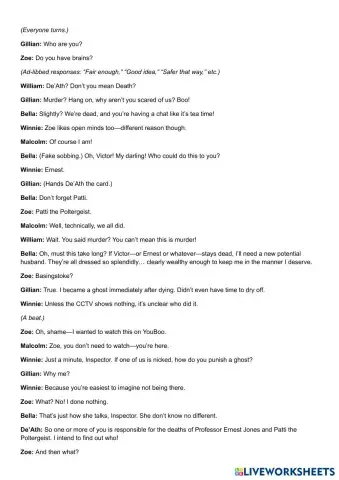
(Everyone turns.)

Gillian: Who are you?

Zoe: Do you have brains?

(Ad-libbed responses: “Fair enough,” “Good idea,” “Safer that way,” etc.)

William: De’Ath? Don’t you mean Death?

Gillian: Murder? Hang on, why aren’t you scared of us? Boo!

Bella: Slightly? We’re dead, and you’re having a chat like it’s tea time!

Winnie: Zoe likes open minds too—different reason though.

Malcolm: Of course I am!

Bella: (Fake sobbing.) Oh, Victor! My darling! Who could do this to you?

Winnie: Ernest.

Gillian: (Hands De’Ath the card.)

Bella: Don’t forget Patti.

Zoe: Patti the Poltergeist.

Malcolm: Well, technically, we all did.

William: Wait. You said murder? You can’t mean this is murder!

Bella: Oh, must this take long? If Victor—or Ernest or whatever—stays dead, I’ll need a new potential husband. They’re all dressed so splendidly… clearly wealthy enough to keep me in the manner I deserve.

Zoe: Basingstoke?

Gillian: True. I became a ghost immediately after dying. Didn’t even have time to dry off.

Winnie: Unless the CCTV shows nothing, it’s unclear who did it.

(A beat.)

Zoe: Oh, shame—I wanted to watch this on YouBoo.

Malcolm: Zoe, you don’t need to watch—you’re here.

Winnie: Just a minute, Inspector. If one of us is nicked, how do you punish a ghost?

Gillian: Why me?

Winnie: Because you’re easiest to imagine not being there.

Zoe: What? No! I done nothing.

Bella: That’s just how she talks, Inspector. She don’t know no different.

De’Ath: So one or more of you is responsible for the deaths of Professor Ernest Jones and Patti the Poltergeist. I intend to find out who!

Zoe: And then what?

De’Ath: Then the guilty will face consequences.

Malcolm: Consequences! Missed that one.

Zoe: (To Gillian) What did he say?

Gillian: You’ll be nicked.

Zoe: But I didn’t do nothing!

(All groan.)

Gillian: Life? Are you sure?

Zoe: We’re already dead… haha.

Malcolm: A week in Basingstoke?

Gillian: (To audience.) We have a murder to solve. So, ladies and gentlemen, let us see if we can, between us, solve these crimes, as we open up the floor to questions from the audience.

(Audience questions – see production notes.)

Scene 2 – The Reveal

Winnie: Her real name was Sharon.

Zoe: Sharon?

Winnie: Yes, she told me while I was doing her hair before we came out tonight.

William: She didn’t have any ingredients for potions.

Bella: Oh, well surmised, Inspector! Bravo!

Malcolm: (To Gillian) So we can go?

Zoe: What? Me? No! I liked Patti. She was my friend.

Malcolm: That doesn’t sound like Zoe. She only pulls hair off if she’s going to eat their… B-R-A-I-N-S.

William: Real wine!

Winnie: What? Me? No, don’t be silly. Why would I want to kill Victor? And why would I want to kill Patti? I helped her get ready for tonight, for goodness’ sake. I helped her with her hair!

William: So that’s why you wanted me to spend time with Patti! You wanted her sneezes to use in your spells! She and Gillian are the only ones who are officially spooks!

Winnie: Yes, yes, OK. I stabbed him, but I didn’t know then he wasn’t a vampire. He accused me of shoddy spells.

Zoe: Is that near Cognito?

Bella: Yes Zoe, yes, it is. Just down the road.

Gillian: Look, Inspector – Victor, or Ernest, whoever he was, must have known the risks when he came to live with us. Anyone could have found out at any time he wasn’t a vampire. It wouldn’t have taken a genius.

William: Keeping up standards, Winnie, good girl.

Malcolm: Zoe, I’m sorry to say, the house belonged to Victor, I think we’re all going to have to move to… (braces himself) Basingstoke!

(All except De’Ath.) Nooooooo!

(Curtain.)

Death's Lines

Reading Comprehension - English Language

(Everyone turns.)

Gillian: Who are you?

Zoe: Do you have brains?

(Ad-libbed responses: “Fair enough,” “Good idea,” “Safer that way,” etc.)

William: De’Ath? Don’t you mean Death?

Gillian: Murder? Hang on, why aren’t you scared of us? Boo!

Bella: Slightly? We’re dead, and you’re having a chat like it’s tea time!

Winnie: Zoe likes open minds too—different reason though.

Malcolm: Of course I am!

Bella: (Fake sobbing.) Oh, Victor! My darling! Who could do this to you?

Winnie: Ernest.

Gillian: (Hands De’Ath the card.)

Bella: Don’t forget Patti.

Zoe: Patti the Poltergeist.

Malcolm: Well, technically, we all did.

William: Wait. You said murder? You can’t mean this is murder!

Bella: Oh, must this take long? If Victor—or Ernest or whatever—stays dead, I’ll need a new potential husband. They’re all dressed so splendidly… clearly wealthy enough to keep me in the manner I deserve.

Zoe: Basingstoke?

Gillian: True. I became a ghost immediately after dying. Didn’t even have time to dry off.

Winnie: Unless the CCTV shows nothing, it’s unclear who did it.

(A beat.)

Zoe: Oh, shame—I wanted to watch this on YouBoo.

Malcolm: Zoe, you don’t need to watch—you’re here.

Winnie: Just a minute, Inspector. If one of us is nicked, how do you punish a ghost?

Gillian: Why me?

Winnie: Because you’re easiest to imagine not being there.

Zoe: What? No! I done nothing.

Bella: That’s just how she talks, Inspector. She don’t know no different.

De’Ath: So one or more of you is responsible for the deaths of Professor Ernest Jones and Patti the Poltergeist. I intend to find out who!

Zoe: And then what?

De’Ath: Then the guilty will face consequences.

Malcolm: Consequences! Missed that one.

Zoe: (To Gillian) What did he say?

Gillian: You’ll be nicked.

Zoe: But I didn’t do nothing!

(All groan.)

Gillian: Life? Are you sure?

Zoe: We’re already dead… haha.

Malcolm: A week in Basingstoke?

Gillian: (To audience.) We have a murder to solve. So, ladies and gentlemen, let us see if we can, between us, solve these crimes, as we open up the floor to questions from the audience.

(Audience questions – see production notes.)

Scene 2 – The Reveal

Winnie: Her real name was Sharon.

Zoe: Sharon?

Winnie: Yes, she told me while I was doing her hair before we came out tonight.

William: She didn’t have any ingredients for potions.

Bella: Oh, well surmised, Inspector! Bravo!

Malcolm: (To Gillian) So we can go?

Zoe: What? Me? No! I liked Patti. She was my friend.

Malcolm: That doesn’t sound like Zoe. She only pulls hair off if she’s going to eat their… B-R-A-I-N-S.

William: Real wine!

Winnie: What? Me? No, don’t be silly. Why would I want to kill Victor? And why would I want to kill Patti? I helped her get ready for tonight, for goodness’ sake. I helped her with her hair!

William: So that’s why you wanted me to spend time with Patti! You wanted her sneezes to use in your spells! She and Gillian are the only ones who are officially spooks!

Winnie: Yes, yes, OK. I stabbed him, but I didn’t know then he wasn’t a vampire. He accused me of shoddy spells.

Zoe: Is that near Cognito?

Bella: Yes Zoe, yes, it is. Just down the road.

Gillian: Look, Inspector – Victor, or Ernest, whoever he was, must have known the risks when he came to live with us. Anyone could have found out at any time he wasn’t a vampire. It wouldn’t have taken a genius.

William: Keeping up standards, Winnie, good girl.

Malcolm: Zoe, I’m sorry to say, the house belonged to Victor, I think we’re all going to have to move to… (braces himself) Basingstoke!

(All except De’Ath.) Nooooooo!

(Curtain.)

Road not Taken

English

1. Describe how the poet/speaker acts at the end and explain why you think he acts that way.

The speaker acts with a sense of acceptance at the end, saying that his choice "has made all the difference." He reflects on his decision calmly, knowing it shaped his life. This shows he understands that life choices have lasting effects. I think he acts this way because he realizes his journey is unique to him.


2. How do the poet's thoughts affect him?

The poet’s thoughts make him reflect deeply about his life and the choices he made. He wonders how different life might have been if he had chosen the other road. This thinking brings some regret but also pride. His thoughts show he values his journey.


3. Explain why you think the poet does not choose the road that many people trod by.

The poet avoids the common path because he wants a unique experience. By choosing the less-traveled road, he believes he can have a life that stands out. This choice shows his desire to explore and be different. It also suggests he values making his own path.


 4. Explain the poet's thinking pattern throughout the poem. Does it change at the end? Explain why or why not.

The poet’s thinking is reflective and hesitant at first, as he wonders which path to take. He carefully considers each road, not wanting to miss an opportunity. At the end, he accepts his choice with some mixed feelings, showing that he’s at peace with his decision. His thinking pattern does change from uncertainty to acceptance.


5. Is the setting important to the story? How?

Yes, the setting is very important because the two roads symbolize choices in life. The fork in the woods represents a moment when the poet must make a decision. This setting highlights the theme of life’s different paths. Without this setting, the poem would lose its central meaning.


 6. What is the turning point of the story? Who/What changes as a result? How? Why?

The turning point is when the poet finally chooses one road over the other. This decision shapes his life, making him realize that choices define our journey. The poet changes by accepting his choice, understanding it’s a part of who he is now. He realizes that he cannot go back.


7. What problem does the speaker in the poem face? How does he/she solve it?

The speaker faces the problem of choosing between two paths, each leading to different futures. He solves it by picking the road less traveled, accepting that it’s his personal choice. By doing this, he takes responsibility for his life path. This decision helps him feel unique.


 8. Analyzing the poet's thinking pattern and choices, explain why you would/would not like to have him/her as a friend.

I would like to have the poet as a friend because he is thoughtful and reflective. He considers his choices deeply, which shows he values life and decisions. This quality would make him a supportive and understanding friend. I think he could give good advice.


 9. Write about what would happen if you brought the poet to school or home for a day.

If I brought the poet home, he might observe everything closely and think deeply about ordinary things. He would likely enjoy nature and quiet spaces to reflect. I think he would be a calm guest, talking about how every choice has meaning. His thoughts would make simple things feel special.


 10. Pick a stanza in which you disagreed with how the poet handled a situation and rewrite it in the way you think it should have happened.

In the second stanza, instead of hesitating, I would write, "Without a doubt, I chose the path ahead / With courage, I walked and never looked back." This version shows more confidence in choosing. It shows the poet embracing life boldly, without second thoughts.


11. What quality of the poet strikes you as a good characteristic to develop within yourself over the years? Why? Describe how the poet demonstrates this quality.

The poet’s courage to take a different path is a quality worth developing. This shows bravery in facing unknown challenges, which is important for a meaningful life. He demonstrates this quality by choosing the less-traveled road, even though it’s uncertain. This makes him unique.


 12. How would the poem be different if told through another speaker's eyes?

If another speaker told the poem, they might see the two paths differently, maybe without hesitation. They might describe the paths with different emotions, like excitement or fear. This would change the poem’s tone. The story might feel less reflective and more practical.


 13. What is the main conflict for the speaker in the poem? How does he resolve it? Do you think he resolved the conflict well or not? Explain.

The main conflict is choosing between two paths, representing different life choices. He resolves it by choosing the less-traveled road and accepting his choice. I think he resolves it well because he finds meaning in his decision. He doesn’t seem unhappy, showing he made peace with his choice.


7 Deadly Sins of Presentations

English as a Second Language (ESL)


The 7 Deadly Sins of Presentations


I've been to a lot of presentations. Some have been good, but many have been bad. Very bad. So I thought it might be helpful to put together a list of the seven deadly sins of presentations.1. Lack of preparation: This is the most common sin. There's no _____(1) for not preparing. You should know your script and your slides inside out. If you don't, then your audience will know you're not prepared and they'll _____(2) interest.2. Too much information: Many presenters try to include too much information in their talks. They think that if they say everything about their subject, then people will be impressed. But actually, people get _____(3) very quickly. Your presentation should be simple and clear.3. Reading from the slides: This is another very common mistake. You should never read directly from your slides. People can read for themselves. Instead, you should use your slides to help explain what you're saying. For example, you could use photos or diagrams.4. No structure: A good presentation needs a clear structure. Your audience wants to know where you're going. You should start by telling them what you're going to talk about, then go into more _____(4), and finally summarise what you've said.5. Not making eye contact: This is a big problem for many presenters. They look at their notes or at the screen, but they don't look at the audience. Eye contact is very important. It helps you connect with your audience and makes them feel involved.6. Speaking too quickly: When you're nervous, it's easy to speak too quickly. But if you speak too fast, people won't understand you. You need to slow down and give people time to think.7. No enthusiasm: Finally, the most serious sin of all is not being enthusiastic about your subject. If you're not interested, then your audience certainly won't be. You need to show how much you care about what you're saying.So those are the seven deadly sins of presentations. Make sure you _____(5) them!


Create and Customize Worksheets for Every Classroom

LiveWorksheets makes it easy for teachers, parents and homeschool educators to design and deliver engaging learning materials. Upload a PDF or start from scratch to create what you need: anything from interactive math worksheets to reading comprehension worksheets, multiplication worksheets, and kindergarten worksheets in just a few clicks. Our drag-and-drop editor works across all grade levels and subjects, so you can tailor content to your lesson plans, homework, or assessments. ESL teachers can also build custom ESL worksheets, add a common sound chart, or integrate ESL activities to make each class more engaging. Easily create differentiated, auto-graded activities that save valuable time and support better student learning.

A Complete Library of Learning Resources for K-12 and ESL

Access thousands of ready-to-use worksheets across K-12 subjects, including kindergarten worksheets, math worksheets, multiplication practice, reading comprehension exercises, and ESL resources. Filter by grade, subject, or skill level to find exactly what you need, whether it’s for an elementary classroom, middle school review, or high school practice. ESL teachers can explore our growing collection of ESL worksheets and English as a Second Language activities designed to support all levels of learners. With new content added regularly, LiveWorksheets is a flexible resource that helps build lasting learning outcomes.