U8 - WEATHER VOCABULARY & GRAMMAR WORKSHEET

Grammar - Language Arts

🔗 Activity 1: Matching

🧩 Instructions: You need to match each weather word (like “hot” or “windy”) with the correct meaning from the right column.

🧠 How to Solve It:

•             Read the weather word on the left carefully. Think about what that kind of weather looks or feels like.

•             Then read through all the definitions (A–J) on the right side.

•             Choose the letter that best explains the meaning of the word.

•             Write that letter next to the number of the word.

📌 Tip: Think about real-life examples — like how it feels when it's foggy or snowy.

________________________________________

📖 Activity 2: Reading Comprehension

📚 Instructions: Read the short story about the weather and then answer the questions.

🧠 How to Solve It:

•             Start by reading the passage slowly and carefully.

•             Underline or remember key weather words (e.g., “snowy,” “windy”).

•             Look at each question. Go back to the passage to find the part that answers it.

•             Answer using complete sentences or key words.

📌 Tip: Try reading each question before re-reading the passage so you know what to look for.

________________________________________

✏️ Activity 3: Fill in the Blanks

🖊️ Instructions: Fill in each sentence with the correct weather vocabulary word.

🧠 How to Solve It:

•             Read the full sentence to understand the meaning.

•             Think about what word fits the best: Does it describe sun, rain, cold, fog, etc.?

•             Choose the most suitable weather word from the list you learned.

📌 Tip: Think about the clue in the sentence — like “wore sunglasses” might go with “sunny.”

________________________________________

🧠 Activity 4: Multiple Choice

✅ Instructions: Choose the best answer from the options (A–D).

🧠 How to Solve It:

•             Read the question carefully.

•             Look at all the options before picking one.

•             Eliminate the ones that don’t make sense.

•             Pick the best-fitting and grammatically correct answer.

📌 Tip: Read the question and options aloud to check if they sound right.

________________________________________

🔤 Activity 5: Sentence Ordering

🧩 Instructions: Rearrange the mixed-up words to form a correct sentence.

🧠 How to Solve It:

•             Look for clues like question words (what, was) or starting words (It, The).

•             Remember how sentences are usually ordered in English:

Subject → Verb → Details (e.g., “It was sunny yesterday.”)

•             Rearrange the words until it makes a complete sentence.

📌 Tip: Say the words out loud in different orders until it sounds right.

________________________________________

🧑‍🏫 Final Tips:

•             Take your time — it’s okay to re-read or double-check your work.

•             Use your class vocabulary list or weather flashcards if you get stuck.

•             Ask yourself, “Does this make sense?” after every answer.

11 gk2- 4

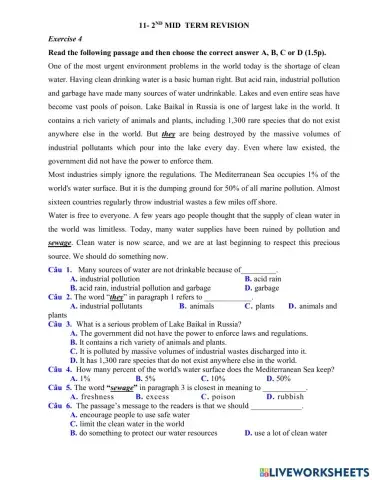
11- 2ND MID TERM REVISION Exercise 4 R

11- 2ND MID TERM REVISION

Exercise 4
Read the following passage and then choose the correct answer A, B, C or D (1.5p).
One of the most urgent environment problems in the world today is the shortage of clean water. Having clean drinking water is a basic human right. But acid rain, industrial pollution and garbage have made many sources of water undrinkable. Lakes and even entire seas have become vast pools of poison. Lake Baikal in Russia is one of largest lake in the world. It contains a rich variety of animals and plants, including 1,300 rare species that do not exist anywhere else in the world. But they are being destroyed by the massive volumes of industrial pollutants which pour into the lake every day. Even where law existed, the government did not have the power to enforce them.
Most industries simply ignore the regulations. The Mediterranean Sea occupies 1% of the world's water surface. But it is the dumping ground for 50% of all marine pollution. Almost sixteen countries regularly throw industrial wastes a few miles off shore.
Water is free to everyone. A few years ago people thought that the supply of clean water in the world was limitless. Today, many water supplies have been ruined by pollution and sewage. Clean water is now scarce, and we are at last beginning to respect this precious source. We should do something now.
Câu 1. Many sources of water are not drinkable because of_________.
A. industrial pollution B. acid rain
B. acid rain, industrial pollution and garbage D. garbage
Câu 2. The word “they” in paragraph 1 refers to ____________.
A. industrial pollutants B. animals C. plants D. animals and plants
Câu 3. What is a serious problem of Lake Baikal in Russia?
A. The government did not have the power to enforce laws and regulations.
B. It contains a rich variety of animals and plants.
C. It is polluted by massive volumes of industrial wastes discharged into it.
D. It has 1,300 rare species that do not exist anywhere else in the world.
Câu 4. How many percent of the world's water surface does the Mediterranean Sea keep?
A. 1% B. 5% C. 10% D. 50%
Câu 5. The word “sewage” in paragraph 3 is closest in meaning to ___________.
A. freshness B. excess C. poison D. rubbish
Câu 6. The passage’s message to the readers is that we should _____________.
A. encourage people to use safe water
C. limit the clean water in the world
B. do something to protect our water resources D. use a lot of clean water
Circle the letter A, B, C, or D to indicate the word that differs from the other three in the position of primary stress in each of the following Câu s.
Câu 7: A. awareness B. billion C. protection D. society
Câu 8: A. apply B. differ C. decide D. protect
Circle the letter A, B, C, or D to indicate the answer that best completes sentence in each of the following Câu s.
Câu 9: Academic courses should teach practical skills ___________addition to critical thinking.
A. into B. to C. from D. in
Câu 10: Tree plantation helps to reduce global warming since trees ________ CO2 in the air.
A. absorb B. emit C. release D. pollute
Câu 11: The heavy rain has caused ________ in many parts of the country.
A. food B. drought C. famine D. floods
Câu 12: . Hunting for meat and burning forests for soils wildlife
A. protect B. conserve C. destroy D. survive
decreased
Câu 13: . Because of people’s _____with the environment, many kinds of plants and animals are becoming rare.
A. supply B. survival C. influence D. interference
Câu 14: Garbage is considered to be some kind of ______.
A. pollute B. pollutants C. pollution D. polluting
Câu 15: The ____ is the air, water and land in or on which people, animals and plants live.
A. consequence B. environment C. planet D. resource
Câu 16: . The knife ________ we are cutting bread is very sharp.
A. with that B. which C. with which D. that
Câu 17: Cathy is trustworthy. She’s a person upon _________ you can always depend.
A. who B. whom C. that D. X
Câu 18: The man ____ I introduced you to last night may be the next president of the university.
A. whom B. that C. X D. all are correct.
Câu 19: Your career should focus on a field _________ you are generally interested.
A. on which B. in which C. which D. that
Câu 20: . One of the people _________ I admire most in the history of the world is Gandhi.
A. that B. which C. whose D. of them

Create and Customize Worksheets for Every Classroom

LiveWorksheets makes it easy for teachers, parents and homeschool educators to design and deliver engaging learning materials. Upload a PDF or start from scratch to create what you need: anything from interactive math worksheets to reading comprehension worksheets, multiplication worksheets, and kindergarten worksheets in just a few clicks. Our drag-and-drop editor works across all grade levels and subjects, so you can tailor content to your lesson plans, homework, or assessments. ESL teachers can also build custom ESL worksheets, add a common sound chart, or integrate ESL activities to make each class more engaging. Easily create differentiated, auto-graded activities that save valuable time and support better student learning.

A Complete Library of Learning Resources for K-12 and ESL

Access thousands of ready-to-use worksheets across K-12 subjects, including kindergarten worksheets, math worksheets, multiplication practice, reading comprehension exercises, and ESL resources. Filter by grade, subject, or skill level to find exactly what you need, whether it’s for an elementary classroom, middle school review, or high school practice. ESL teachers can explore our growing collection of ESL worksheets and English as a Second Language activities designed to support all levels of learners. With new content added regularly, LiveWorksheets is a flexible resource that helps build lasting learning outcomes.