Rifqi

  • English Language
  • 7th grade

Rifqi

Literary Devices and Text Structure - English Language

🎧 Listening Activity: Daily Routine


🔹 Pre-Listening Activity


1. Look at these pictures:

🛏️ wake up 🍚 eat breakfast 🚿 take a shower 🎒 go to school


2. Discuss with your friend:


What time do you wake up every day?


What do you eat for breakfast?


3. Listen to the dialogue and find out what Rani and Dika do in the morning.


---


🔹 Listening Dialogue


Rani: Good morning, Dika!

Dika: Morning, Rani! You came early today.

Rani: Yes, I woke up at five o’clock.

Dika: Wow! What did you do after that?

Rani: I took a shower and had breakfast with my family.

Dika: What did you eat?

Rani: I ate rice and egg. What about you?

Dika: I just drank milk because I was late!

Rani: Haha, you should wake up earlier next time.


---


🔹 Listening Comprehension Questions


1. What time did Rani wake up?

a. Four o’clock

b. Five o’clock

c. Six o’clock

d. Seven o’clock


2. What did Rani do after waking up?

a. She cleaned her room

b. She took a shower

c. She went to school

d. She watched TV


3. What did Rani eat for breakfast?

a. Bread and jam

b. Rice and egg

c. Fried rice

d. Noodles


4. Why did Dika only drink milk?

a. He was late

b. He wasn’t hungry

c. He was sick

d. He didn’t like rice


5. What does Rani tell Dika to do next time?

a

🎧 Listening Activity: Daily Routine

🔹 Pre-Listening Activity

1. Look at these pictures:
🛏️ wake up 🍚 eat breakfast 🚿 take a shower 🎒 go to school

2. Discuss with your friend:

What time do you wake up every day?

What do you eat for breakfast?


3. Listen to the dialogue and find out what Rani and Dika do in the morning.


---

🔹 Listening Dialogue

Rani: Good morning, Dika!
Dika: Morning, Rani! You came early today.
Rani: Yes, I woke up at five o’clock.
Dika: Wow! What did you do after that?
Rani: I took a shower and had breakfast with my family.
Dika: What did you eat?
Rani: I ate rice and egg. What about you?
Dika: I just drank milk because I was late!
Rani: Haha, you should wake up earlier next time.

---

🔹 Listening Comprehension Questions

1. What time did Rani wake up?
a. Four o’clock
b. Five o’clock
c. Six o’clock
d. Seven o’clock

2. What did Rani do after waking up?
a. She cleaned her room
b. She took a shower
c. She went to school
d. She watched TV

3. What did Rani eat for breakfast?
a. Bread and jam
b. Rice and egg
c. Fried rice
d. Noodles

4. Why did Dika only drink milk?
a. He was late
b. He wasn’t hungry
c. He was sick
d. He didn’t like rice

5. What does Rani tell Dika to do next time?
a. Sleep late
b. Wake up earlier
c. Bring food to school
d. Study more

. Sleep late

b. Wake up earlier

c. Bring food to school

d. Study more

29.1 homework

Grammar - English Language

Câu 1. She ___ to school every day.
A. go
B. goes
C. is going
D. went

Câu 2. They ___ TV when I came home.
A. watch
B. watched
C. were watching
D. are watching

Câu 3. We ___ this movie before.
A. see
B. saw
C. have seen
D. will see

Câu 4. He ___ English for 5 years.
A. learns
B. learned
C. has learned
D. is learning

Câu 5. She is ___ than her sister.
A. tall
B. taller
C. tallest
D. more tall

Câu 6. This is the ___ book I’ve ever read.
A. interesting
B. more interesting
C. most interesting
D. interest

Câu 7. They ___ to Hanoi tomorrow.
A. go
B. went
C. will go
D. have gone

Câu 8. My father usually ___ up at 6 a.m.
A. get
B. gets
C. got
D. is getting

Câu 9. While she ___, the phone rang.
A. sleeps
B. slept
C. was sleeping
D. is sleeping

Câu 10. I ___ my homework yet.
A. don’t finish
B. didn’t finish
C. haven’t finished
D. won’t finish

Câu 11. This exercise is ___ than the last one.
A. easy
B. easier
C. easiest
D. more easy

Câu 12. He ___ football yesterday.
A. plays
B. played
C. is playing
D. has played

Câu 13. She ___ a letter right now.
A. writes
B. wrote
C. is writing
D. has written

Câu 14. They ___ each other since 2020.
A. know
B. knew
C. have known
D. are knowing

Câu 15. This is the ___ day of my life.
A. happy
B. happier
C. happiest
D. more happy

Câu 16. We ___ lunch when it started to rain.
A. have
B. had
C. were having
D. are having

Câu 17. She ___ speak English very well.
A. can
B. must
C. should
D. need

Câu 18. I ___ him tomorrow.
A. meet
B. met
C. will meet
D. have met

Câu 19. This house is ___ than that one.
A. big
B. bigger
C. biggest
D. more bigger

Câu 20. He ___ to music at the moment.
A. listens
B. listened
C. is listening
D. has listened

simple past tense

Writing - English Language

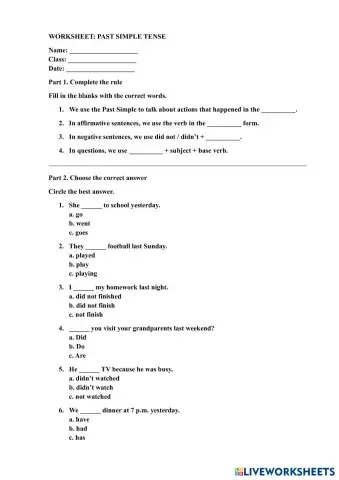
WORKSHEET: PAST SIMPLE TENSE  

Name: ____________________  
Class: ____________________  
Date: ____________________  

Part 1. Complete the rule  

Fill in the blanks with the correct words.  

     1.   We use the Past Simple to talk about actions that happened in the __________.  

    2.   In affirmative sentences, we use the verb in the __________ form.  

    3.   In negative sentences, we use did not / didn’t + __________.  

    4.   In questions, we use __________ + subject + base verb.  


Part 2. Choose the correct answer  

Circle the best answer.  

     1.   She ______ to school yesterday.  
         a. go  
         b. went  
         c. goes  

    2.   They ______ football last Sunday.  
         a. played  
         b. play  
         c. playing  

    3.   I ______ my homework last night.  
         a. did not finished  
         b. did not finish  
         c. not finish  

    4.   ______ you visit your grandparents last weekend?  
         a. Did  
         b. Do  
         c. Are  

    5.   He ______ TV because he was busy.  
         a. didn’t watched  
         b. didn’t watch  
         c. not watched  

    6.   We ______ dinner at 7 p.m. yesterday.  
         a. have  
         b. had  
         c. has  

----------------------- Page 2-----------------------

    7.   My teacher ______ me a very interesting question.  
         a. ask  
         b. asked  
         c. asking  

    8.   ______ they go to the library yesterday?  
         a. Were  
         b. Did  
         c. Do  


Part 3. Put the verbs in brackets into the Past Simple  

     1.   I __________ (watch) a movie last night.  

    2.   She __________ (go) to the supermarket yesterday.  

    3.   We __________ (study) English for the test.  

    4.   He __________ (not / come) to class last Monday.  

    5.   __________ you __________ (finish) your project yesterday?  

    6.   They __________ (see) their teacher in the hallway.  

    7.   My friends __________ (play) badminton after school.  

    8.   I __________ (not / understand) the question.  

    9.   __________ she __________ (call) you last night?  

     10. We __________ (eat) breakfast very early yesterday.  


Part 4. Change the sentences  

Rewrite the sentences into negative or question form.  

     1.   She visited her aunt last weekend.  
         → Negative: ______________________________________  

    2.   They studied in the library yesterday.  
         → Question: ______________________________________  

    3.   He cleaned his room yesterday afternoon.  
         → Negative: ______________________________________  

    4.   You watched the football match last night.  
         → Question: ______________________________________  

    5.   I finished my homework before dinner.  
         → Negative: ______________________________________  

----------------------- Page 3-----------------------

    6.   Lan went to school by bus yesterday.  
         → Question: ______________________________________  


Part 5. Find and correct the mistakes  

     1.   She didn’t went to school yesterday.  
         → ______________________________________  

    2.   Did he studied for the exam?  
         → ______________________________________  

    3.   We was very tired after class.  
         → ______________________________________  

    4.   They not play basketball last Sunday.  
         → ______________________________________  

    5.   I eated lunch at 12 o’clock.  
         → ______________________________________  

    6.   Did you went to the bookshop yesterday?  
         → ______________________________________  


Part 6. Unscramble the words  

Put the words in the correct order.  

     1.   yesterday / to / went / I / school  
         → ______________________________________  

    2.   not / she / did / coffee / drink  
         → ______________________________________  

    3.   last night / did / what / do / you / ?  
         → ______________________________________  

    4.   watched / we / a film / yesterday evening  
         → ______________________________________  

    5.   they / the test / did / pass / ?  
         → ______________________________________  


Part 7. Reading and gap-fill  

Read the passage and fill in the blanks with the correct Past Simple form of the verbs in  
brackets.  

Yesterday, Mai __________ (wake) up at 6:00 a.m. She __________ (have) breakfast with  
her family and then __________ (go) to university. In the morning, she __________  

----------------------- Page 4-----------------------

(attend) two classes. After lunch, she __________ (meet) her friends in the library. They  
__________ (study) together for two hours. In the evening, Mai __________ (return)  
home, __________ (eat) dinner, and __________ (do) her homework. She __________  
(sleep) at 10:30 p.m.  


Part 8. Speaking / Writing  

Answer the questions in full sentences.  

     1.   What did you do yesterday morning?  
         → ______________________________________  

    2.   Did you study English last night?  
         → ______________________________________  

    3.   Where did you go last weekend?  
         → ______________________________________  

    4.   What did you eat for dinner yesterday?  
         → ______________________________________  

    5.   Did you watch TV yesterday? Why / Why not?  
         → ______________________________________  
 

fiction

Reading Comprehension - English Language

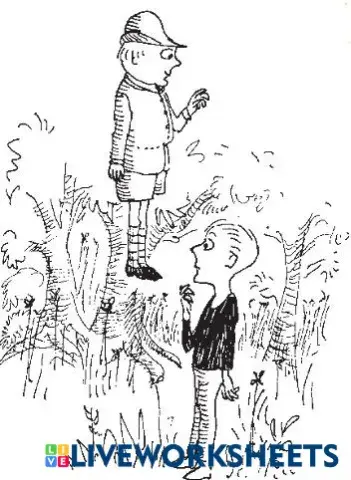
Fiction “It seems to me that almost everything is a waste of time,” Milo remarks as he walks dejectedly home from school. Until for no logical or predictable reason he is transported to a strange world of words, numbers and confusion. ‘Isn’t it beautiful?’ gasped Milo. ‘Oh, I don’t know,’ answered a strange voice. ‘It all depends on how you look at things.’ ‘I beg your pardon?’ said Milo, for he didn’t see who had spoken. ‘I said it depends how you look at things,’ repeated the voice. Milo turned around and found himself staring at two very neatly polished brown shoes, for standing directly in front of him (if you can use the word ‘standing’ for someone suspended in mid-air) was another boy just about his age, whose feet were easily three feet off the ground. ‘For instance,’ continued the boy, ‘if you happen to like deserts, you might not think this was beautiful at all.’ ‘For instance,’ said the boy again, ‘if Christmas trees were people and people were Christmas trees, we’d all be chopped down, put up in the living room, and covered with tinsel, while the trees opened our presents.’ ‘What does that have to do with it?’ asked Milo. 83 Year 6, Sequence 11 ‘Nothing at all,’ he answered, ‘but it’s an interesting possibility, don’t you think?’ ‘How do you manage to stand up there?’ for this was the subject that most interested him. ‘I was about to ask you a similar question,’ answered the boy, ‘for you must be much older than you look to be standing on the ground.’ ‘What do you mean?’ Milo asked. ‘Well,’ said the boy, ‘in my family everyone is born in the air, with his head at exactly the height it’s going to be when he’s an adult, and then we all grow towards the ground. When we’re fully grown up, or as you can see, grown down, our feet finally touch. Of course, there are a few of us whose feet never reach the ground, no matter how old we get, but I suppose it is the same in every family.’ He hopped a few steps in the air, skipped back to where he started, and then began again. ‘You certainly must be very old to have reached the ground already.’ ‘Oh no,’ said Milo seriously, ‘in my family we all start on the ground and grow up, and we never know how far until we actually get there.’ ‘What a silly system,’ the boy laughed. ‘Then your head keeps changing its height and you always see things in a different way? Why, when you’re fifteen things won’t look at all the way they did when you were ten, and at twenty everything will change again.’ ‘I suppose so,’ said Milo, for he had never really thought about the matter. ‘We always see things from the same angle,’ the boy continued. ‘It’s much less trouble that way. Besides it makes more sense to grow down and not up. When you’re very young, you can never hurt yourself from falling down if you’re in mid-air, and you certainly can’t get into trouble for scuffing your shoes or marking the floor if there’s nothing to scuff them on and the floor is three feet away

Media

English language

STUDENTS THINK FAKE NEWS IS FACT AND ARE USING IT IN THEIR SCHOOLWORK, SAY TEACHERS

Teachers are frustrated that students can’t accept that some stories on social networks are false, while experts suggest that students need better education about online dangers. Students believe that fake news is a fact, and are repeating it in lessons and using it in written work, teachers have warned. More than a third of teachers say their students have used false information that they found online, according to a survey by a teacher’s union.

The union’s general secretary Chris Keates said that the information was "worrying" and it showed that internet companies have a lot of power to influence people’s opinions, especially young people. International education experts are becoming more worried about the situation and say that teachers will need to teach children how to spot fake news. Others were frustrated that students didn’t believe that news they had seen on Facebook and other social media sites was not true, even when the problem was explained to them. One teacher said that students often thought that fake news sites were real, and also that anything that President Donald Trump said was a fact. Last week, German officials said they would give fines of up to 50 million euro to social networks if they didn’t take down illegal fake news posts. The new law would give social networks 24 hours to delete or block the content and seven days to concentrate on more complicated cases. Commenting on the results of the survey, Ms. Keates said that she was worried about the trend, particularly because many young people have never known a world without internet, and are less able to judge whether information that they read online is real or fake. She added that: "It is important for children and young people to be made aware that not everything they see and read online is real."

She said that teachers are trying to help educate students about using false information, but added that it was important for internet providers and websites to take responsibility for any material that is available, and also to deal with people who misuse their services. Last month, Andreas Schleicher, the director of education and skills at OECD (The Organization of Economic co-operation and Development) said that in the modern age, being able to tell the difference between what is real and what is fake is a critical skill. He added that: "This is something that we believe schools can do something about."

Adapted from the Independent by Rachel Pells, April 12th, 2017

Student Worksheet Leaflet : Marc Chagall – From Goal to Success

Reading Comprehension - English Language

Name: ____________________ 

SUCCESS

to set a goal 


to work hard


to face obstacles


to acquire new skills


to stay humble and hungry


Before Reading – Think & Discuss 

1. What do you think makes a person successful? 


2. Have you ever seen a painting with flying people, animals, or dream-like scenes? How did it make you feel? 


Reading Comprehension 

Read the biography of Marc Chagall . Then answer the questions.*


True (T) or False (F)? Correct the false sentences. 


1. Marc Chagall was born in Paris. 

   → Correction: _____________________________________ 


2. He came from a wealthy family. 

 → Correction: _____________________________________ 


3.  He stopped painting during World War II. 

 → Correction: _____________________________________ 


4.  His art often included memories of his childhood. 

 → Correction: _____________________________________ 


5. _ He only painted on canvas. 

 → Correction: _____________________________________ 


6. He painted his most famous works in Paris.

 → Correction: _____________________________________ 

7. Unfortunately, Chagall`s paintings didn`t see many exhibitions during his lifetime.

 → Correction: _____________________________________ 


Find the evidence of his success in the text. Give the details from the text 


to set a goal 

________________________________________________

to work hard

________________________________________________

to face obstacles

________________________________________________

to acquire new skills

________________________________________________

to stay humble and hungry

________________________________________________


A picture description

  • Useful vocabulary

a flying couple, a violinist, a vibrant colour palette, floating figures, distorted perspective, symbols of childhood / love / hometown, euphoria of love, soaring happiness, nostalgia for the goal, connection to roots, the artist at work, between his homeland and new life


Topics to highlight while describing

  • How does this picture reflect Chagall`s goals, dreams, obstacles etc
  • What do main figures symbolize in the picture?


Reflection 

  • Marc Chagall never gave up on his dream, even when life was hard. 
  • What is your dream or big goal? What will help you achieve it? 

Create and Customize Worksheets for Every Classroom

LiveWorksheets makes it easy for teachers, parents and homeschool educators to design and deliver engaging learning materials. Upload a PDF or start from scratch to create what you need: anything from interactive math worksheets to reading comprehension worksheets, multiplication worksheets, and kindergarten worksheets in just a few clicks. Our drag-and-drop editor works across all grade levels and subjects, so you can tailor content to your lesson plans, homework, or assessments. ESL teachers can also build custom ESL worksheets, add a common sound chart, or integrate ESL activities to make each class more engaging. Easily create differentiated, auto-graded activities that save valuable time and support better student learning.

A Complete Library of Learning Resources for K-12 and ESL

Access thousands of ready-to-use worksheets across K-12 subjects, including kindergarten worksheets, math worksheets, multiplication practice, reading comprehension exercises, and ESL resources. Filter by grade, subject, or skill level to find exactly what you need, whether it’s for an elementary classroom, middle school review, or high school practice. ESL teachers can explore our growing collection of ESL worksheets and English as a Second Language activities designed to support all levels of learners. With new content added regularly, LiveWorksheets is a flexible resource that helps build lasting learning outcomes.