Colors Matching Activity

English


Colors Matching Activity


This interactive worksheet is designed to help young learners recognize and match colors to commonly known objects or items based on their real-world colors. It is ideal for early learners, particularly preschoolers, kindergarten students, or early elementary students, as part of a color recognition and visual association lesson.


Objective:

Students will:

  • Identify and name basic colors.
  • Match each color to the corresponding object that naturally represents that color.
  • Enhance visual perception, color vocabulary, and fine motor skills through drag-and-drop or line drawing activities.


Instructions:

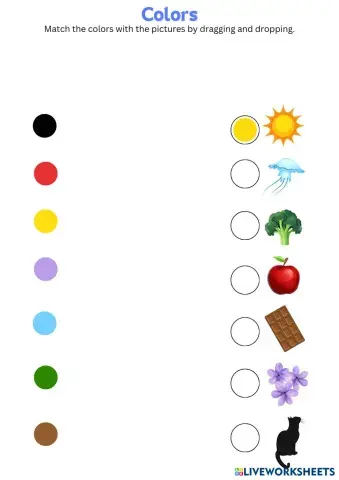
  • On the left side, there are seven color circles (Black, Red, Yellow, Purple, Light Blue, Green, Brown).
  • On the right side, there are seven images of familiar objects and creatures.
  • Each object is associated with one of the colors provided.
  • Students are instructed to match the colors with the pictures by either dragging and dropping the color circles to the corresponding image or by drawing a line from the color to the picture.


Example:

  1. YellowSun

    • Yellow is represented by the bright yellow sun.


Skills Developed:

  • Color recognition: Learn and identify primary and secondary colors.
  • Visual discrimination: Understand the association between objects and their typical colors.
  • Vocabulary building: Reinforce color and object names.
  • Motor skills: Practice coordination by drawing lines or dragging/dropping.
  • Critical thinking: Make connections between abstract colors and real-life objects.


Educational Use:

  • Can be used for individual practice, group work, or teacher-guided activities.
  • Excellent for review sessions, color-themed lessons, or as a diagnostic tool to assess color knowledge.
  • Can be printed for hands-on activities or used in digital formats for interactive learning.

U.S. Supreme Court Justices

Civics and Government - Social Studies

Part 1: Meet the Justices (10–12 minutes)

Directions: Use your notes, textbook, or prior knowledge to complete the chart.

Justice NameAppointed By (President)Year AppointedConsidered Liberal, Conservative, or ModerateOne Interesting Fact

John Roberts

Clarence Thomas

Samuel Alito

Sonia Sotomayor

Elena Kagan

Neil Gorsuch

Brett Kavanaugh

Amy Coney Barrett

Ketanji Brown Jackson

Part 2: Quick Understanding (5–7 minutes)

Directions: Answer in complete sentences.

  1. What is the role of the Supreme Court in the U.S. government?
  2. What does it mean when a justice is described as “liberal” or “conservative”?
  3. Who is the Chief Justice, and how is that role different from the other justices?
  4. Why do Supreme Court justices serve for life?

Part 3: Patterns & Observations (5–6 minutes)

Directions: Look at your completed chart and answer the questions.

  1. Which presidents appointed the most current justices?
  2. Do most justices lean liberal, conservative, or is the Court balanced? Explain.
  3. What trend do you notice about when most justices were appointed (recent vs. long ago)?
  4. Why might the timing of appointments matter for the country?

Part 4: Critical Thinking (8–10 minutes)

Directions: Answer each question in 2–4 sentences. Support your ideas.

  1. Why is it important that Supreme Court justices are independent from elections and political pressure?
  2. Do you think the Supreme Court should reflect the political views of the country? Why or why not?
  3. Should there be term limits for Supreme Court justices instead of lifetime appointments? Explain your reasoning.
  4. Imagine you are the president—what qualities would you look for when choosing a Supreme Court justice?
  5. Which do you think matters more: a justice’s personal beliefs or their interpretation of the Constitution? Defend your answer.

Extension (Optional / Early Finishers)

Option A: Rank the Importance
Rank the following from most important to least important when selecting a justice and explain your top choice:

  • Experience
  • Political beliefs
  • Age
  • Background/diversity
  • Judicial philosophy

Option B: Real-World Connection
Write 3–4 sentences explaining how Supreme Court decisions affect everyday life (school, rights, laws, etc.).

Create and Customize Worksheets for Every Classroom

LiveWorksheets makes it easy for teachers, parents and homeschool educators to design and deliver engaging learning materials. Upload a PDF or start from scratch to create what you need: anything from interactive math worksheets to reading comprehension worksheets, multiplication worksheets, and kindergarten worksheets in just a few clicks. Our drag-and-drop editor works across all grade levels and subjects, so you can tailor content to your lesson plans, homework, or assessments. ESL teachers can also build custom ESL worksheets, add a common sound chart, or integrate ESL activities to make each class more engaging. Easily create differentiated, auto-graded activities that save valuable time and support better student learning.

A Complete Library of Learning Resources for K-12 and ESL

Access thousands of ready-to-use worksheets across K-12 subjects, including kindergarten worksheets, math worksheets, multiplication practice, reading comprehension exercises, and ESL resources. Filter by grade, subject, or skill level to find exactly what you need, whether it’s for an elementary classroom, middle school review, or high school practice. ESL teachers can explore our growing collection of ESL worksheets and English as a Second Language activities designed to support all levels of learners. With new content added regularly, LiveWorksheets is a flexible resource that helps build lasting learning outcomes.