Vocab - A long and healthy life

Vocabulary - Language Arts

Create a basic English vocabulary worksheet for Grade 11 Vietnamese students.

Topic:
UNIT 1 – A LONG AND HEALTHY LIFE

Target level:
A2 – basic Grade 11 level.

Learning objectives:
- Help students memorize and recognize the 22 target vocabulary items.
- Focus on basic meaning, word recognition, spelling, part of speech, and simple usage.
- Use short, clear sentences suitable for Vietnamese Grade 11 students.
- Avoid difficult grammar and complicated contexts.

TARGET VOCABULARY:

1. fit /fɪt/ (adj) – cân đối
2. healthy /ˈhelθi/ (adj) – khỏe mạnh
3. work out /ˌwɜːk ˈaʊt/ (v.phr) – tập thể dục
4. fast food /ˈfɑːst fuːd/ (n) – đồ ăn nhanh
5. give up /ɡɪv ʌp/ (v.phr) – từ bỏ
6. bad habit /bæd ˈhæbɪt/ (n) – thói quen xấu
7. burger /ˈbɜːɡə(r)/ (n) – bánh mì kẹp thịt
8. chip /tʃɪp/ (n) – khoai tây chiên
9. full of /fʊl əv/ (adj.phr) – đầy
10. energy /ˈenədʒi/ (n) – năng lượng
11. active /ˈæktɪv/ (adj) – tích cực
12. life lesson /laɪf ˈlesən/ (n) – bài học cuộc sống
13. regular /ˈreɡjələ(r)/ (adj) – thường xuyên
15. physical /ˈfɪzɪkl/ (adj) – thuộc về thể chất
16. mental /ˈmentl/ (adj) – thuộc về tinh thần
17. treatment /ˈtriːtmənt/ (n) – điều trị
18. strength /streŋkθ/ (n) – sức mạnh
19. muscle /ˈmʌsl/ (n) – cơ bắp
20. suffer /ˈsʌfə(r)/ (v) – chịu đựng
21. examine /ɪɡˈzæmɪn/ (v) – kiểm tra
22. headache /ˈhedeɪk/ (n) – đau đầu

Create 4 sections:

PART 1 – MATCHING
- 10 questions.
- Match English words with Vietnamese meanings.
- Use simple, familiar definitions.

PART 2 – MULTIPLE CHOICE
- 15 questions.
- Four options A, B, C, D.
- Test basic meaning and simple context.
- Only ONE correct answer.
- Make distractors simple and reasonable.

PART 3 – FILL IN THE BLANKS
- 15 questions.
- Provide a vocabulary box containing the target words.
- Students choose the correct word to complete each sentence.
- Use very short and easy sentences.
- Do not require difficult word-form changes.

PART 4 – CHOOSE THE CORRECT WORD
- 10 questions.
- Give two similar or related vocabulary choices.
- Students choose the word that correctly completes the sentence.
- Focus on distinguishing meaning and basic usage.

IMPORTANT:
- Use all 22 vocabulary items across the worksheet.
- Do not introduce vocabulary outside the target list unless it is absolutely necessary.
- Keep sentences short and natural.
- Avoid advanced grammar.
- Avoid tricky questions.
- Do not make questions overly academic.
- Make the exercises suitable for students who are learning these words for the first time.
- Ensure spelling, IPA, part of speech, and Vietnamese meanings are accurate.
- Number questions continuously from 1 to 50.

At the end, provide:
ANSWER KEY
- Give the answers for questions 1–50.
- Do not provide explanations unless necessary.

Formatting:
- Clear worksheet layout.
- Bold section headings.
- English vocabulary should be easy to scan.
- Suitable for printing on A4 paper.
- Professional but student-friendly.

Our Senses

Psychology

Our five senses include __________, _____________, _______________, ______________,_____________

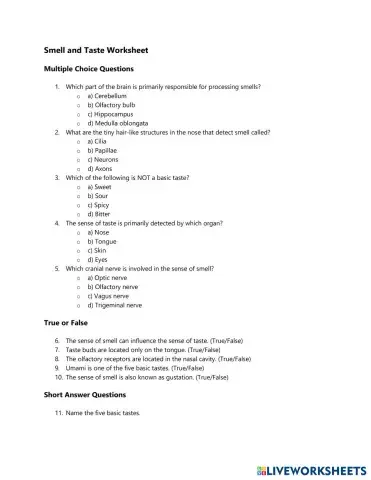
Sure! Here's a worksheet with 25 questions about the senses of smell and taste:

Smell and Taste Worksheet

Multiple Choice Questions

  1. Which part of the brain is primarily responsible for processing smells?

    • a) Cerebellum
    • b) Olfactory bulb
    • c) Hippocampus
    • d) Medulla oblongata
  2. What are the tiny hair-like structures in the nose that detect smell called?

    • a) Cilia
    • b) Papillae
    • c) Neurons
    • d) Axons
  3. Which of the following is NOT a basic taste?

    • a) Sweet
    • b) Sour
    • c) Spicy
    • d) Bitter
  4. The sense of taste is primarily detected by which organ?

    • a) Nose
    • b) Tongue
    • c) Skin
    • d) Eyes
  5. Which cranial nerve is involved in the sense of smell?

    • a) Optic nerve
    • b) Olfactory nerve
    • c) Vagus nerve
    • d) Trigeminal nerve

True or False

  1. The sense of smell can influence the sense of taste. (True/False)

  2. Taste buds are located only on the tongue. (True/False)

  3. The olfactory receptors are located in the nasal cavity. (True/False)

  4. Umami is one of the five basic tastes. (True/False)

  5. The sense of smell is also known as gustation. (True/False)

Short Answer Questions

  1. Name the five basic tastes.
  2. Describe the role of the olfactory bulb in the sense of smell.
  3. How do taste buds detect different flavors?
  4. Explain how the sense of smell can affect the sense of taste.
  5. What is the function of cilia in the nasal cavity?

Fill in the Blanks

  1. The sense of taste is also known as __.
  2. __ are the sensory receptors for smell.
  3. The __ nerve carries signals from the taste buds to the brain.
  4. __ is the taste associated with savory flavors.
  5. The __ is the part of the brain that processes smell information.

Matching

  1. Match the taste with its description:

    • Sweet
    • Sour
    • Salty
    • Bitter
    • Umami

    a) Associated with amino acids and savory flavors b) Often found in citrus fruits c) Commonly found in sugary foods d) Typically found in salty snacks e) Often associated with bitter compounds like caffeine

  2. Match the term with its definition:

    • Olfactory bulb
    • Taste buds
    • Cilia
    • Papillae
    • Olfactory nerve

    a) Structures on the tongue that contain taste receptors

  3. b) Hair-like structures in the nasal cavity

  4. c) Nerve that transmits smell information to the brain

  5. d) Brain structure involved in processing smells e) Small bumps on the tongue that contain taste buds

Essay Questions

  1. Discuss the relationship between the senses of smell and taste and how they work together to create the perception of flavor.
  2. Explain the process of olfaction from the detection of odor molecules to the perception of smell in the brain.
  3. Describe how different factors, such as age and health, can affect the senses of smell and taste.

Feel free to adjust or add more questions as needed! If you need any further assistance, just let me know.

Create and Customize Worksheets for Every Classroom

LiveWorksheets makes it easy for teachers, parents and homeschool educators to design and deliver engaging learning materials. Upload a PDF or start from scratch to create what you need: anything from interactive math worksheets to reading comprehension worksheets, multiplication worksheets, and kindergarten worksheets in just a few clicks. Our drag-and-drop editor works across all grade levels and subjects, so you can tailor content to your lesson plans, homework, or assessments. ESL teachers can also build custom ESL worksheets, add a common sound chart, or integrate ESL activities to make each class more engaging. Easily create differentiated, auto-graded activities that save valuable time and support better student learning.

A Complete Library of Learning Resources for K-12 and ESL

Access thousands of ready-to-use worksheets across K-12 subjects, including kindergarten worksheets, math worksheets, multiplication practice, reading comprehension exercises, and ESL resources. Filter by grade, subject, or skill level to find exactly what you need, whether it’s for an elementary classroom, middle school review, or high school practice. ESL teachers can explore our growing collection of ESL worksheets and English as a Second Language activities designed to support all levels of learners. With new content added regularly, LiveWorksheets is a flexible resource that helps build lasting learning outcomes.