Exercise 1. Mark the letter A, B, C or D to indicate the word that differs from the rest in the position of the main stress in each of the following questions.
1. A. airplane B. motorbike C. airport D. delay
2. A. station B. subway C. shampoo D. transport
3. A. shower B. museum C. restaurant D. towel
4. A. biology B. college C. ruler D. supermarket
5. A. clinic B. doctor C. activity D. healthy
Exercise 2. Reorder the letters to make the correct words.
1. E-B-C-A-H _____________________
2. E-A-N-D-C _____________________
3. P-P-S-O-N-H-I-G _____________________
4. E-A-R-P-G _____________________
5. E-A-I-C-T-V _____________________
6. E-W-K-S-O-I-F-R-R _____________________
7. I-E-E-Y-S-L-F-T-L _____________________
8. D-E-E-I-T-X-C _____________________
9. D-A-P-O-G-A _____________________
10. D-I-C-O-U-E-L-I-S O-D-F-O _____________________
Exercise 3. Odd one out.
1. A. bike B. bus C. table D. car
2. A. dinner B. lunch C. breakfast D. dish
3. A. subway B. television C. fan D. clock
4. A. bed B. sleep C. pillow D. mirror
5. A. museum B. restaurant C. supermarket D. road
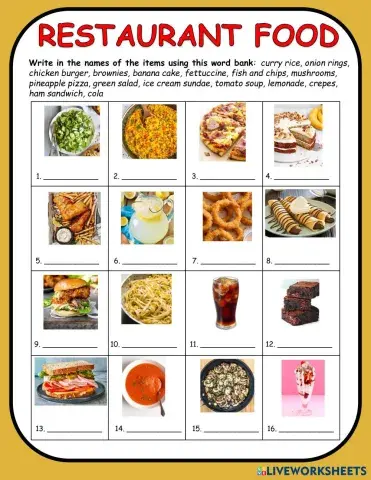
Exercise 4. Look at these pictures and complete the words with the clues given.
1. _ E _ C _
2. G _ _ _ _
3. S _ _ _ P _ _ _
4. M _ _ _ T _ _
5. F _ R _ W _ _ _ _
6. D _ _ _ _ _ T
7. T _ _ - T _ _ - T _ _
8. D _ L _ C _ _ _ _ F _ O _
9. P _ _ _ _
10. W _ _ _ _
Exercise 5. Look at these pictures, then match.
Exercise 6. Look at these pictures, then match.
Exercise 7. Fill in the blanks with suitable words in the box.
- She __________ on the beach with her family last weekend.
- We’ll __________ our house with flowers.
- They will play the guitar and __________ on Children’s Day.
- Peter will wear __________ and eat delicious food.
- Lily eats fish, __________, and fruit.
- She drinks fresh juice __________.
- Tonie feels tired. He has a __________.
- I’m not very well. I have a toothache. You should go to the __________.
- We’ll eat __________at Tet.
- Mai and her brother __________ for their friends.
Exercise 8. Match the questions with their corresponding answers.
1. Where did Tuan’s family go last weekend?
A. We took a boat trip around the bay.
2. What’s the matter?
B. We’ll sing, dance and have a party.
3. Where will she go at Tet?
C. Yes, I will. It will bring good luck to my family.
4. What drinks will you have at the party?
D. He does morning exercise every day.
5. What did your family do in Ha Long?
E. Tuan and his family went to Nha Trang last weekend.
6. How does he stay healthy?
F. Every day. Even at the weekend.
7. You should take some medicine.
G. OK, I will. Thanks for your advice.
8. Will you buy a branch of peach blossoms for Tet?
H. We’ll have fruit juice and milk tea.
9. What will you do on Teachers’ Day?
I. She’ll go to her grandparents’ house in the countryside.
10. How often does Tom swim?
J. Ouch! I have a stomach ache.
Your answer:
1. __ 2. __ 3. __ 4. __ 5. __ 6. __ 7. __ 8. __ 9. __ 10. __
Exercise 9. Circle the correct answers.
1. Where did your family go last Sunday? - We __________ to the beach.
A. go B. goes C. went D. do
2. What are you doing, Mai? – I __________ my house for Tet.
A. am decorating B. decorate C. decorates D. decorated
3. Do you have Children’s Day in your country? - Yes, __________. It’s coming soon.
A. we do B. we are C. we don’t D. we aren’t
4. __________ does she do yoga? - Once a week.
A. What B. How often C. When D. How
5. You should __________ to the dentist, Mai. - OK, I will. Thanks for your advice.
A. go B. going C. goes D. went
6. Shall I __________ some fruits? - Yes, please.
A. bringing B. brings C. bring D. brought
7. How does Nam __________ healthy? – He __________ sports every day.
A. stays - plays B. stay - play C. stay - plays D. stays - play
8. Will you buy roses for Tet? - No, I __________. I’ll buy a branch of peach blossoms.
A. will B. don’t C. am not D. won’t
9. __________ you OK, Hung? – I don’t feel well.
A. Am B. Is C. Does D. Are
10. __________ you swim? - Yes, I did. I swam with my mother.
A. Did B. Does C. Do D. Are
Exercise 10. Circle the correct answers.
1. Tonnie __________ dinner for his family yesterday.
A. cook B. cooked C. cooks D. cooking
2. What will you do at the Mid-Autumn Festival? - We’ll __________.
A. go swimming B. go home C. play badminton D. have a party
3. Next weekend, Linh __________ how to learn the guitar at 7 p.m.
A. study B. studied C. will study D. studying
4. How often does he play soccer? - __________ a week.
A. Once B. Every day C. Rarely D. Daily
5. __________ she play badminton with her friends this weekend?
A. How B. Will C. What D. Do
6. What food will we have at the party? - We’ll have __________.
A. pizza B. hot chocolate C. fresh juice D. milk tea
7. Does Lily do yoga once a week? - __________.
A. No, he doesn’t B. Yes, she does C. Yes, he does D. No, she does
8. They __________ to London last summer.
A. traveling B. travels C. traveled D. travel
9. How does she stay healthy? – She __________ vegetables.
A. eats B. eat C. eating D. ate
10. Do you have Children’s Day in your country? - __________.
A. Yes, they do B. No, we don’t C. Yes, we don’t D. No, they don’t
Exercise 11. Reorder the words / phrases to complete the sentences.
1. you / Did / to / last / Ha Long Bay / go / weekend?
______________________________________________________________________
2. took / We / a / trip / boat / the / around / bay.
______________________________________________________________________
3. Where / at / you / will / go / Tet?
______________________________________________________________________
4. will / We / go / a / to / fireworks / the / show / in / park.
______________________________________________________________________
5. We’ll / on / and / dance / sing / Children’s Day.
______________________________________________________________________
6. will / What / do / at / you / Mid - Autumn / Festival? / the
______________________________________________________________________
7. How / does / often / do / sister / your / yoga?
______________________________________________________________________
8. My / to / gets / up / brother / early / morning / do / exercise.
______________________________________________________________________
9. for / your / Thanks / advice.
______________________________________________________________________
10. should / You / some / take / medicine.
______________________________________________________________________
 Switch to New Search Page