B2 - Grammar

English Language

Past tenses

B2 Narrative tenses, used to, would


Future

B2 Future forms – expressing future time

B2 Other ways to express future – be about to, be due to, etc.

B2 Future in the past


Modals, the imperative, etc .

B2 Modal verbs – permission, obligation, prohibition, necessity

B2 Speculation and deduction – modal verbs and expressions

B2 Verbs of the senses

B2 Get – different meanings


Conditionals, if, wish, etc.

B2 All conditionals – mixed conditionals, alternatives to if, inversion

B2 Mixed conditionals – If I were you, I wouldn’t have done it

B2 Wish, rather, if only, it’s time – unreal uses of past tenses

B2 Unless, even if, provided, as long as, etc. – other expressions in conditionals


Passive

B2 Distancing – expressions and passive of reporting verbs

B2 Passive verbs with two objects


-ing and the infinitive

B2 Verb + object + infinitive/gerund – verb patterns

B2 Gerunds and infinitives – complex forms


Articles, nouns, pronouns, and determiners.

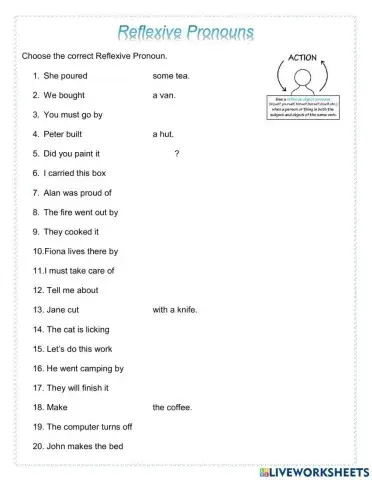
B2 Reflexive and reciprocal pronouns

B2 Generic pronouns – common-gender pronouns

B2 Compound nouns and possessive forms

B2 Possessive ’s with time expressions – Two hours’ walk


Relative clauses, relative pronouns and adverbs

B2 Relative clauses – defining and non-defining


there and it

B2 There and it – preparatory subjects


Auxiliary verbs

B2 Have – auxiliary or main verb

B2 Ellipsis and substitution


Adjectives and adverbs

B2 Inversion with negative adverbials – adding emphasis


Conjunctions and clauses

B2 Clauses of contrast, purpose, reason and result

B2 Discourse markers – linking words

B2 Participle claus

es


Word order


B2 Cleft sentences – adding emphasis


Reflexive pronoun

English Grammar

Reflective Pronouns Worksheet for Grade 5

Section 1: Theory and Rules with Example Sentences

Suggested Time: 10 minutes

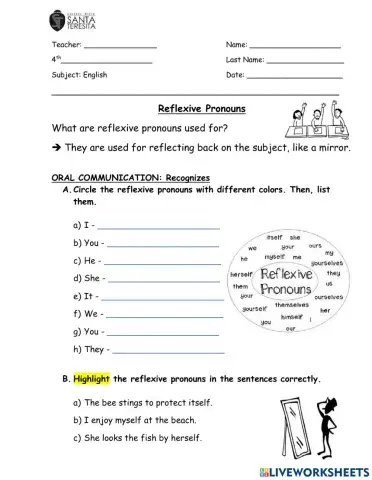
What Are Reflexive Pronouns?
Reflexive pronouns are pronouns that end in “-self” or “-selves” and are used when the subject and the object of a sentence are the same person or thing. They are used to reflect the action back onto the subject.

Reflexive Pronouns:

  • Singular: myself, yourself, himself, herself, itself
  • Plural: ourselves, yourselves, themselves

When Do We Use Reflexive Pronouns?

  1. When the subject and object are the same:
    • Example: "I taught myself to play the piano."
    • Explanation: The subject "I" is the same person who is the object "myself."
  2. For emphasis (to emphasize that the subject did the action alone):
    • Example: "She cooked the entire meal herself."
    • Explanation: This emphasizes that "she" did the cooking without help.

Common Errors:

  • Incorrect: "Please give it to myself."
  • Correct: "Please give it to me."
  • Incorrect: "Himself went to the store."
  • Correct: "He went to the store by himself."

Section 2: Challenging NAPLAN-Style Questions

Suggested Time: 10 minutes

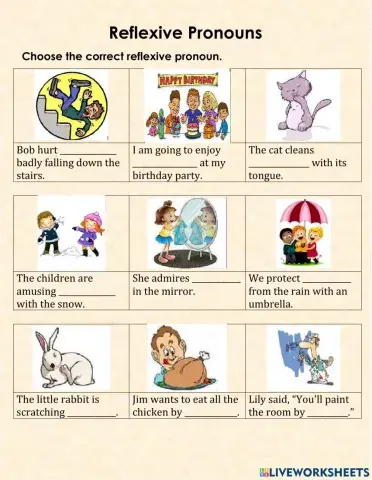
Instructions: Choose the correct reflexive pronoun to complete each sentence. Pay close attention to context and ensure the pronoun agrees with the subject.

  1. "After making the cake, Julia decorated it ______."

    • a) herself
    • b) himself
    • c) itself
    • d) themselves
  2. "The committee members decided to handle the problem ______."

    • a) themselves
    • b) itself
    • c) ourselves
    • d) himself
  3. "The robot fixed ______ after the malfunction."

    • a) himself
    • b) itself
    • c) themselves
    • d) ourselves
  4. "You must learn to rely on ______ if you want to be independent."

    • a) myself
    • b) yourselves
    • c) himself
    • d) yourself
  5. "The magician performed all the tricks ______, without any help."

    • a) itself
    • b) themselves
    • c) himself
    • d) herself

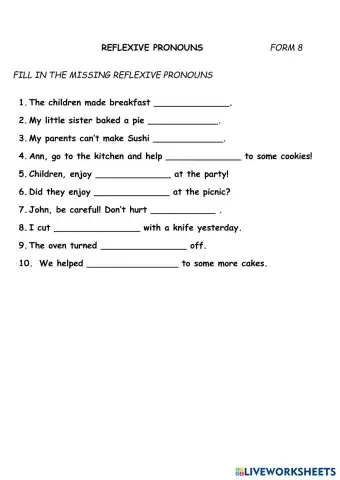
Short Answer Section: Instructions: Fill in the blank with the correct reflexive pronoun.

  1. "The cat saw ______ in the mirror and jumped back."
  2. "I taught ______ how to play the guitar by watching videos online."
  3. "The children built the treehouse all by ______."
  4. "During the test, remember to pace ______."
  5. "We enjoyed ______ at the amusement park yesterday."

Section 3: Writing Task to Practice Errors

Suggested Time: 15 minutes

Instructions: Write a short paragraph (4-5 sentences) about a time when you learned to do something by yourself. Use at least two reflexive pronouns in your paragraph.

Example Prompt: "Write about a time you learned a new skill or completed a task by yourself, such as riding a bike, cooking, or doing a school project. Describe what you did and how you felt."

Example Response: "I remember when I learned to bake cookies by myself. I followed the recipe carefully and didn’t ask for any help. I felt proud of myself when the cookies came out delicious. It was fun to bake all by myself!"

Crea y personaliza fichas interactivas para cada aula

LiveWorksheets facilita a profesorado, familias y personas que educan en casa el diseño y la entrega de materiales de aprendizaje atractivos. Solo tienes que subir un PDF o empezar desde cero para crear lo que necesites: desde fichas interactivas de matemáticas hasta ejercicios de comprensión lectora, fichas de multiplicación o actividades para infantil, todo en unos pocos clics. Nuestro editor de arrastrar y soltar funciona en todos los cursos y asignaturas, lo que te permite adaptar el contenido a tus programaciones, deberes o evaluaciones. Quienes enseñan inglés como segunda lengua (ESL) también pueden crear sus propias fichas, añadir cuadros de sonidos comunes o integrar actividades de ESL para hacer cada clase más participativa. Además, podrás diseñar fácilmente tareas diferenciadas y autocorregidas que ahorran tiempo y apoyan un mejor aprendizaje del alumnado.

Una biblioteca completa de recursos para K-12 y ESL

Accede a miles de fichas listas para usar en todas las asignaturas de K-12, incluidas actividades para infantil, matemáticas, práctica de multiplicación, comprensión lectora y recursos de ESL. Filtra por curso, materia o nivel de competencia para encontrar exactamente lo que necesitas, ya sea para un aula de primaria, una revisión en secundaria o actividades de práctica en bachillerato. El profesorado de ESL puede explorar nuestra colección en constante crecimiento de fichas y actividades de inglés como segunda lengua, diseñadas para apoyar a estudiantes de todos los niveles. Con nuevo contenido añadido de forma regular, LiveWorksheets es un recurso flexible que ayuda a lograr aprendizajes duraderos.