¿Quieres miles de fichas gratuitas (y cero distracciones)? Here’s how
Search
$1.99/mes con cuenta gratuita: regístrate en segundos.
Más popular
Newest
Oldest
A-Z
Z-A
English language
Past and Past Participle
English as a Second Language (ESL)
ESL for adults based on songs
Grammar. Verb (Tenses, Modals, Conditional, Infinitive, Participle, Reported Speech) , Noun, Article, Pronoun, Adjective, Adverb, Preposition.
A worksheet to describe experiences
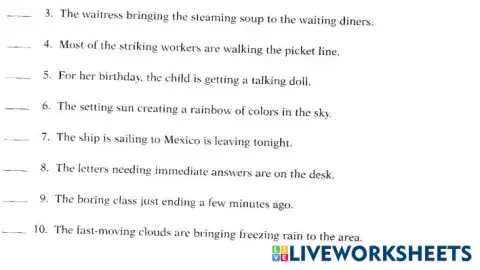
V. Combine the two sentences into one, using either an -ing or -ed participle.
like it says
matching,choosing the write answer
Grammar
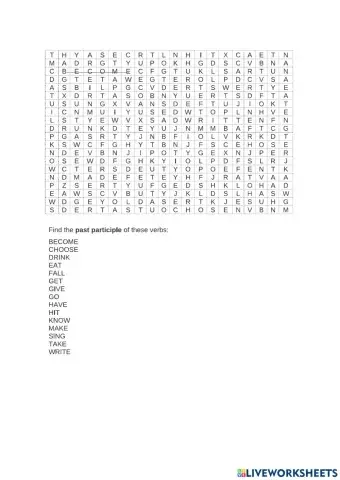
write the past and past participle of the verbs
VERBS PAST AND PAST PARTICIPLE
Vocabulary - Language Arts
Write the correct verb form to complete the chart with Irregulr verbs. Use the list of verbs provided.
Grammar - ESL
Complete
Writing - Language Arts
Read and answer
Read each sentence and complete the gaps below with a participle clause. Consider capitalization and/or punctuation marks if required.
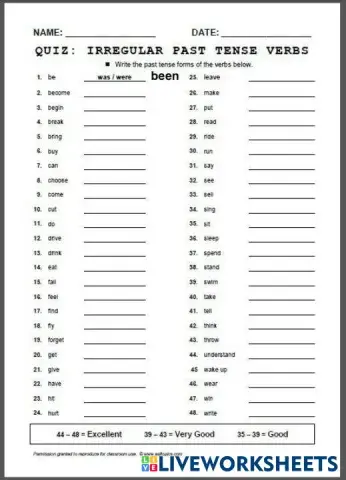
Complete the irregular verbs in past simple and past participle
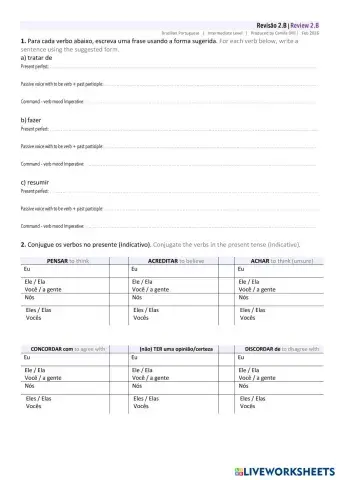
Review:
Present perfect
Passive voice with to be verb + past participle
Command – verb mood Imperative
Verbs to express opinion (present tense)
Choose the best choice.
Read the situations and write what the people should/shouldn't have done.
Use the past tense for all the sentences.
Complete the sentences using the verbs in the box. Use the present perfect tense in affirmative or negative form. Write the verbs in the correct past participle form.
Read the infinitive form of the verbs in the column on the left and match them with their corresponding past participle forms in the column on the right.
The passive voice shifts the focus from who performs the action to the object or result that receives it. To structure it, the original object moves to the front of the sentence, followed by the verb "to be" in the correct tense and the main verb in its past participle form. When completing the exercises, identify the original verb tense to maintain it in your transformation and decide if adding the agent at the end is necessary.
Vocabulary: Phrasal Verbs with "Get"
Get out: Escape or leave a dangerous enclosed space. (Pronunciation: /ge taʊt/)
Get through: Survive, endure, or make it safely to the end of a hard ordeal. (Pronunciation: /get ˈθruː/)
Get over: Recover, heal, or bounce back from shock, illness, or trauma. (Pronunciation: /ge ˈtəʊvə/)
Get rid of: Discard, throw away, or eliminate something useless or heavy. (Pronunciation: /get ˈrɪd əv/)
Get on with: Continue or resume an action or task after a pause or distraction. (Pronunciation: /ge ˈtɒn wɪð/)
Grammar: Perfect Forms Perfect tenses usually connect two time periods and describe completed actions or actions that started in the past and continue. They are formed using an auxiliary verb (have/has/had/will have) + the past participle (V3) of the main verb.
Present perfect: Connects the past to the present (e.g., The number of people has declined.).
Present perfect continuous: Focuses on the duration of an action started in the past and continuing up to now (e.g., They have been living off the sea.).
Past perfect: An action completed before another action in the past (e.g., They had realized the danger before others did.).
Future perfect: An action that will be completed before a specific time in the future (e.g., In ten years, they will have disappeared.).
Write the correct form of verb in the bracket
 Switch to New Search Page