Media

English language

STUDENTS THINK FAKE NEWS IS FACT AND ARE USING IT IN THEIR SCHOOLWORK, SAY TEACHERS

Teachers are frustrated that students can’t accept that some stories on social networks are false, while experts suggest that students need better education about online dangers. Students believe that fake news is a fact, and are repeating it in lessons and using it in written work, teachers have warned. More than a third of teachers say their students have used false information that they found online, according to a survey by a teacher’s union.

The union’s general secretary Chris Keates said that the information was "worrying" and it showed that internet companies have a lot of power to influence people’s opinions, especially young people. International education experts are becoming more worried about the situation and say that teachers will need to teach children how to spot fake news. Others were frustrated that students didn’t believe that news they had seen on Facebook and other social media sites was not true, even when the problem was explained to them. One teacher said that students often thought that fake news sites were real, and also that anything that President Donald Trump said was a fact. Last week, German officials said they would give fines of up to 50 million euro to social networks if they didn’t take down illegal fake news posts. The new law would give social networks 24 hours to delete or block the content and seven days to concentrate on more complicated cases. Commenting on the results of the survey, Ms. Keates said that she was worried about the trend, particularly because many young people have never known a world without internet, and are less able to judge whether information that they read online is real or fake. She added that: "It is important for children and young people to be made aware that not everything they see and read online is real."

She said that teachers are trying to help educate students about using false information, but added that it was important for internet providers and websites to take responsibility for any material that is available, and also to deal with people who misuse their services. Last month, Andreas Schleicher, the director of education and skills at OECD (The Organization of Economic co-operation and Development) said that in the modern age, being able to tell the difference between what is real and what is fake is a critical skill. He added that: "This is something that we believe schools can do something about."

Adapted from the Independent by Rachel Pells, April 12th, 2017

Betzabeth Aleixo

English

REVIEW WORKSHOP: PRONOUNS, RELATIVE CLAUSES AND MODAL VERBS


  1. Choose the right pronoun to correctly finish this sentence:

1._________ need to follow me closely.

A) You                   B) He                     C) She                                   D) It

2. Lewis, Luke and Thomas were mad because ________  waited ages for the bus.

A) them                 B) he                      C) they                                  D) it

3. Melanie and I are going soon so you can come with _________ .

A) we                    B) them                   C) our                                   D) us

4. Thank you for picking ______ up .

A) me                    B) he                       C) she                                  D) they

5. My boss told ____ that _____ had to finish the report today.

A) me/my             B) I /we                     C) we/us                               D) me/we

6. They took the money. Please run after ________.

A) they                   B) she                     C) we                                   D) them

7. What is wrong with ______?

A) he                     B) them                    C) she                                  D) they

8. Ali and Marcus would like to invite you to ______ party.

A) your                   B) they                    C) their                                 D) his

9. I couldn't find _____ book anywhere, but in the meantime, you can use ________.

A) its / its               B) mine / yours         C) your / mine                    D) my / your

10. There is a message for ______ boss on the notepad.

A) yours                    B) you                     C) your                              D) hers

11. My jumper has yellow stripes, but _______ is plain red.

A) yours                  B) him                     C) its                                  D) your

12. ____ house is in the northern part of the city.

A)John                       B) John’                   C) John’s                           D) Johns

13. I adopted a cute cat. _____ name is Larry.

A)it’s                       B) my                       C) its                                 D) our

14. Henry completed the report all by  _________.

A) himself               B) myself                C)herself                            D) themselves

15. Can you three finish the cleaning by __________?

A) themselves        B) yourself                 C) ourselves                   D) yourselves

16. The wife _________ killed the husband with a knife.

A) herself                B) himself                 C) herselves                    D) yourself

17. We should be proud of __________ for passing the test.

A) themselves        B) ours                     C) ourselves                   D) yourselves

18. The flashlight turned ______ on, I didn’t even touch the phone.

A) it                         B) itself                     C) itsself                          D) herself

19. My friend is mad at _______ for not going to the concert.

A) himself               B) hisself                  C) myself                        D) themselves


  1. Complete using relative pronouns: 

                                      which, where, that, who, whose, when. 

Examples:

 A laptop is a device which is used for work and entertainment. This device offers many tools that are considered essential nowadays.


A hotel is a place 1)  _______ people can stay for a period of time. Hotels offer many amenities and facilities 2) _______ are designed to make their experience more enjoyable. 

The hotel staff are the people 3)  ________ are in charge of helping guests with what they need. 

As part of the staff, you can find receptionists, doormen, bellboys, and more. 


Receptionists are the people 4) _______  work at the front desk and help people with the check-in and the check-out; and bellboys are the ones 5) _______ carry the luggage to their rooms.


There are many famous hotels, but one of the best is The Four Seasons Hotel, 6) ______ is in the top 50 highest ranked hotels in the world. Bogota is one of the cities 7) _______ you can find one of its branches. This hotel, 8) _________ location is very convenient, is considered one of the most luxurious in the city.


Student Worksheet Leaflet : Marc Chagall – From Goal to Success

Reading Comprehension - English Language

Name: ____________________ 

SUCCESS

to set a goal 


to work hard


to face obstacles


to acquire new skills


to stay humble and hungry


Before Reading – Think & Discuss 

1. What do you think makes a person successful? 


2. Have you ever seen a painting with flying people, animals, or dream-like scenes? How did it make you feel? 


Reading Comprehension 

Read the biography of Marc Chagall . Then answer the questions.*


True (T) or False (F)? Correct the false sentences. 


1. Marc Chagall was born in Paris. 

   → Correction: _____________________________________ 


2. He came from a wealthy family. 

 → Correction: _____________________________________ 


3.  He stopped painting during World War II. 

 → Correction: _____________________________________ 


4.  His art often included memories of his childhood. 

 → Correction: _____________________________________ 


5. _ He only painted on canvas. 

 → Correction: _____________________________________ 


6. He painted his most famous works in Paris.

 → Correction: _____________________________________ 

7. Unfortunately, Chagall`s paintings didn`t see many exhibitions during his lifetime.

 → Correction: _____________________________________ 


Find the evidence of his success in the text. Give the details from the text 


to set a goal 

________________________________________________

to work hard

________________________________________________

to face obstacles

________________________________________________

to acquire new skills

________________________________________________

to stay humble and hungry

________________________________________________


A picture description

  • Useful vocabulary

a flying couple, a violinist, a vibrant colour palette, floating figures, distorted perspective, symbols of childhood / love / hometown, euphoria of love, soaring happiness, nostalgia for the goal, connection to roots, the artist at work, between his homeland and new life


Topics to highlight while describing

  • How does this picture reflect Chagall`s goals, dreams, obstacles etc
  • What do main figures symbolize in the picture?


Reflection 

  • Marc Chagall never gave up on his dream, even when life was hard. 
  • What is your dream or big goal? What will help you achieve it? 

moral science revision

Senses and Body Parts - Science

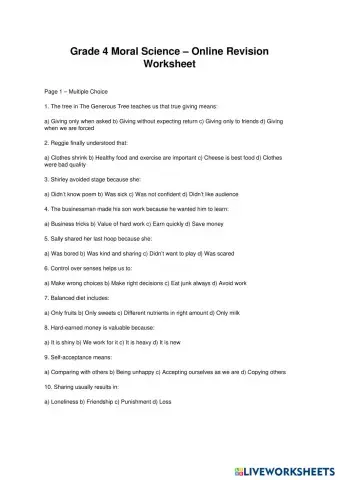
Grade 4 Moral Science – Online Revision Worksheet Page 1 – Multiple Choice 1. The tree in The Generous Tree teaches us that true giving means: a) Giving only when asked b) Giving without expecting return c) Giving only to friends d) Giving when we are forced 2. Reggie finally understood that: a) Clothes shrink b) Healthy food and exercise are important c) Cheese is best food d) Clothes were bad quality 3. Shirley avoided stage because she: a) Didn’t know poem b) Was sick c) Was not confident d) Didn’t like audience 4. The businessman made his son work because he wanted him to learn: a) Business tricks b) Value of hard work c) Earn quickly d) Save money 5. Sally shared her last hoop because she: a) Was bored b) Was kind and sharing c) Didn’t want to play d) Was scared 6. Control over senses helps us to: a) Make wrong choices b) Make right decisions c) Eat junk always d) Avoid work 7. Balanced diet includes: a) Only fruits b) Only sweets c) Different nutrients in right amount d) Only milk 8. Hard-earned money is valuable because: a) It is shiny b) We work for it c) It is heavy d) It is new 9. Self-acceptance means: a) Comparing with others b) Being unhappy c) Accepting ourselves as we are d) Copying others 10. Sharing usually results in: a) Loneliness b) Friendship c) Punishment d) Loss Page 2 – Fill in the blanks 11. Reggie became healthier by eating __________ food. 12. The tree never asked anything except __________ from Ruhi. 13. Shirley was talented in writing __________. 14. The son refused to throw the third coin because he had __________ for it. 15. Sharing shows we __________ for others. True or False 16. The generous tree only helped Ruhi sometimes. __________ 17. Reggie changed his habits after understanding his mistake. __________ 18. Shirley’s parents discouraged her. __________ 19. The son got first two coins by working. __________ 20. Sharing and kindness help build relationships. __________ Page 3 – Short / Long Answers 21. Why did Rita mouse worry about Reggie’s eating habits? 22. Why did Rita mouse worry about Reggie’s eating habits? 23. Why did Shirley think people would laugh at her? 24. How did the tree help Ruhi in different ways? 25. Why did Sally feel happy even after sharing her chance? 26. How does balanced diet help our body? 27. What change came in the son after working in the market? 28. How can you practice control over senses in daily life? Long Answers 29. Explain why generosity is important in society. 30. What would happen if Reggie continued eating only cheese? 31. How did Shirley’s parents help her become confident? 32. Why did the father make his son throw first two coins? 33. Explain how sharing creates strong friendships. 34. Why is it important to respect people who do physical work? 35. How can students show responsibility towards environment and trees? 36. Explain importance of self-control in studies and health. Very Long Answers 37. A girl found a new pencil box in class but returned it to teacher. a) Which value did she show? b) Why is this value important? c) What would you do? 38. Your friend is shy like Shirley. How will you help your friend become confident? 39. Make a 1■day healthy routine plan for Reggie (food + exercise). 40. You see food being wasted at a party. What will you do?

The last Sunday

English

The Last Saturday


Last Saturday, Emily and her friends went to the amusement park. They arrived early in the morning because they wanted to enjoy the whole day there. Emily tried the big roller coaster, and it was very exciting, but also a little scary. Her friend, Jake, didn't like the roller coaster, so he waited for her near the food stalls. After the ride, they all ate hot dogs and drank lemonade. Later, they played games to win prizes, but only Emily won a small teddy bear. At the end of the day, they watched a firework show. They were very tired but happy. It was a fun day.


Vocabulario

  1. Amusement park – parque de diversiones
  2. Roller coaster – montaña rusa
  3. Exciting – emocionante
  4. Scary – aterrador/a
  5. Food stalls – puestos de comida
  6. Hot dog – perro caliente
  7. Lemonade – limonada
  8. Teddy bear – oso de peluche
  9. Firework show – espectáculo de fuegos artificiales

Preguntas de Comprensión

  1. 1. Where did Emily and her friends go last Saturday?
  2. 2. What time of day did they arrive at the amusement park?
  3. 3. What ride did Emily try?
  4. 4. Who didn’t like the roller coaster?
  5. 5. What did they eat after the ride?
  6. 6. What did they drink with their hot dogs?
  7. 7. Who won a prize at the amusement park games?
  8. 8. What kind of prize did Emily win?
  9. 9. What did they watch at the end of the day?
  10. 10. How did Emily and her friends feel at the end of the day?


Complete the sentences using verbs into brackets (simple past tense):


  1. 1. Emily and her friends _____ (go) to the amusement park last Saturday.
  2. 2. They _____ (arrive) early in the morning.
  3. 3. Emily _____ (try) the big roller coaster.
  4. 4. Her friend Jake _____ (not like) the roller coaster.
  5. 5. At the end of the day, they _____ (watch) a firework show.

Crea y personaliza fichas interactivas para cada aula

LiveWorksheets facilita a profesorado, familias y personas que educan en casa el diseño y la entrega de materiales de aprendizaje atractivos. Solo tienes que subir un PDF o empezar desde cero para crear lo que necesites: desde fichas interactivas de matemáticas hasta ejercicios de comprensión lectora, fichas de multiplicación o actividades para infantil, todo en unos pocos clics. Nuestro editor de arrastrar y soltar funciona en todos los cursos y asignaturas, lo que te permite adaptar el contenido a tus programaciones, deberes o evaluaciones. Quienes enseñan inglés como segunda lengua (ESL) también pueden crear sus propias fichas, añadir cuadros de sonidos comunes o integrar actividades de ESL para hacer cada clase más participativa. Además, podrás diseñar fácilmente tareas diferenciadas y autocorregidas que ahorran tiempo y apoyan un mejor aprendizaje del alumnado.

Una biblioteca completa de recursos para K-12 y ESL

Accede a miles de fichas listas para usar en todas las asignaturas de K-12, incluidas actividades para infantil, matemáticas, práctica de multiplicación, comprensión lectora y recursos de ESL. Filtra por curso, materia o nivel de competencia para encontrar exactamente lo que necesitas, ya sea para un aula de primaria, una revisión en secundaria o actividades de práctica en bachillerato. El profesorado de ESL puede explorar nuestra colección en constante crecimiento de fichas y actividades de inglés como segunda lengua, diseñadas para apoyar a estudiantes de todos los niveles. Con nuevo contenido añadido de forma regular, LiveWorksheets es un recurso flexible que ayuda a lograr aprendizajes duraderos.