The Story of Coca-Cola

Reading - ESL

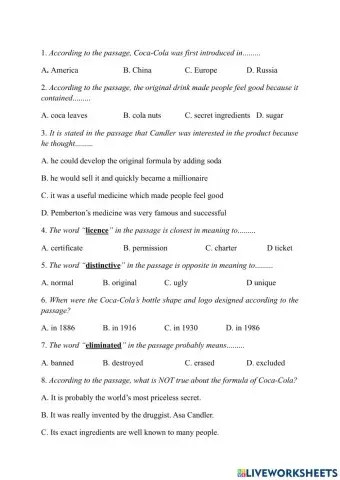
Coca-Cola was invented in 1886 by John Pemberton, a druggist living in Atlanta. The original drink was a type of syrup, using coca leaves, sugar and cola nuts, plus a few other secret ingredients! Pemberton sold it as a medicine; and with its coca (the source of cocaine), it must have made people feel good!
Nevertheless, Pemberton’s medicine was not very successful, so he sold his secret formula to another druggist, Asa Candler. Candler was interested, because he had another idea that Pemberton’s “medicine” would be much better if it was mixed with soda. Candler was thus the man who really invented the drink Coca-Cola. Candler also advertised his new drink, and soon people were going to drugstores just to get a drink of Coca-Cola.
Before long, other people became interested in the product, including a couple of businessmen who wanted to sell it in bottles. Candler sold them a licence to bottle the drink, and very quickly the men became millionaires. The famous bottle, with its very distinctive shape, was designed in 1916. And the famous Coca-Cola logo is the most famous logo in the world. Unlike any other famous commercial logos, it has not changed in 100 years!
During the First World War, American soldiers in Europe began asking for Coca-Cola, so the Coca-Cola company began to export to Europe. It was so popular with soldiers that they then had to start bottling the drink in Europe.
Today, Coca-Cola is made in countries all over the world, including Russia and China; it is the world’s most popular drink.
As for the famous formula, it is probably the world’s most valuable secret! The exact ingredients for making Coca-Cola are only known to a handful of people. And as for the “coca” that was in the original drink, that was eliminated in 1903. It was a drug, and too dangerous. Today’s Coca-Cola contains caffeine, but not cocaine!

Our Senses

Psychology

Our five senses include __________, _____________, _______________, ______________,_____________

Sure! Here's a worksheet with 25 questions about the senses of smell and taste:

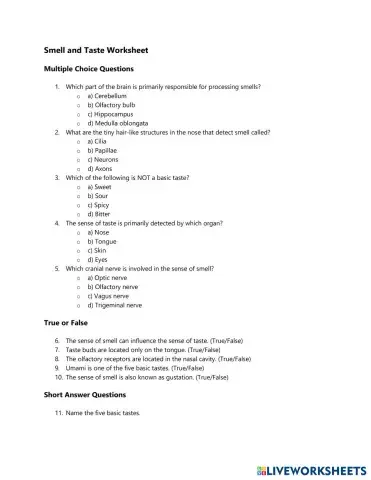
Smell and Taste Worksheet

Multiple Choice Questions

  1. Which part of the brain is primarily responsible for processing smells?

    • a) Cerebellum
    • b) Olfactory bulb
    • c) Hippocampus
    • d) Medulla oblongata
  2. What are the tiny hair-like structures in the nose that detect smell called?

    • a) Cilia
    • b) Papillae
    • c) Neurons
    • d) Axons
  3. Which of the following is NOT a basic taste?

    • a) Sweet
    • b) Sour
    • c) Spicy
    • d) Bitter
  4. The sense of taste is primarily detected by which organ?

    • a) Nose
    • b) Tongue
    • c) Skin
    • d) Eyes
  5. Which cranial nerve is involved in the sense of smell?

    • a) Optic nerve
    • b) Olfactory nerve
    • c) Vagus nerve
    • d) Trigeminal nerve

True or False

  1. The sense of smell can influence the sense of taste. (True/False)

  2. Taste buds are located only on the tongue. (True/False)

  3. The olfactory receptors are located in the nasal cavity. (True/False)

  4. Umami is one of the five basic tastes. (True/False)

  5. The sense of smell is also known as gustation. (True/False)

Short Answer Questions

  1. Name the five basic tastes.
  2. Describe the role of the olfactory bulb in the sense of smell.
  3. How do taste buds detect different flavors?
  4. Explain how the sense of smell can affect the sense of taste.
  5. What is the function of cilia in the nasal cavity?

Fill in the Blanks

  1. The sense of taste is also known as __.
  2. __ are the sensory receptors for smell.
  3. The __ nerve carries signals from the taste buds to the brain.
  4. __ is the taste associated with savory flavors.
  5. The __ is the part of the brain that processes smell information.

Matching

  1. Match the taste with its description:

    • Sweet
    • Sour
    • Salty
    • Bitter
    • Umami

    a) Associated with amino acids and savory flavors b) Often found in citrus fruits c) Commonly found in sugary foods d) Typically found in salty snacks e) Often associated with bitter compounds like caffeine

  2. Match the term with its definition:

    • Olfactory bulb
    • Taste buds
    • Cilia
    • Papillae
    • Olfactory nerve

    a) Structures on the tongue that contain taste receptors

  3. b) Hair-like structures in the nasal cavity

  4. c) Nerve that transmits smell information to the brain

  5. d) Brain structure involved in processing smells e) Small bumps on the tongue that contain taste buds

Essay Questions

  1. Discuss the relationship between the senses of smell and taste and how they work together to create the perception of flavor.
  2. Explain the process of olfaction from the detection of odor molecules to the perception of smell in the brain.
  3. Describe how different factors, such as age and health, can affect the senses of smell and taste.

Feel free to adjust or add more questions as needed! If you need any further assistance, just let me know.

Crea y personaliza fichas interactivas para cada aula

LiveWorksheets facilita a profesorado, familias y personas que educan en casa el diseño y la entrega de materiales de aprendizaje atractivos. Solo tienes que subir un PDF o empezar desde cero para crear lo que necesites: desde fichas interactivas de matemáticas hasta ejercicios de comprensión lectora, fichas de multiplicación o actividades para infantil, todo en unos pocos clics. Nuestro editor de arrastrar y soltar funciona en todos los cursos y asignaturas, lo que te permite adaptar el contenido a tus programaciones, deberes o evaluaciones. Quienes enseñan inglés como segunda lengua (ESL) también pueden crear sus propias fichas, añadir cuadros de sonidos comunes o integrar actividades de ESL para hacer cada clase más participativa. Además, podrás diseñar fácilmente tareas diferenciadas y autocorregidas que ahorran tiempo y apoyan un mejor aprendizaje del alumnado.

Una biblioteca completa de recursos para K-12 y ESL

Accede a miles de fichas listas para usar en todas las asignaturas de K-12, incluidas actividades para infantil, matemáticas, práctica de multiplicación, comprensión lectora y recursos de ESL. Filtra por curso, materia o nivel de competencia para encontrar exactamente lo que necesitas, ya sea para un aula de primaria, una revisión en secundaria o actividades de práctica en bachillerato. El profesorado de ESL puede explorar nuestra colección en constante crecimiento de fichas y actividades de inglés como segunda lengua, diseñadas para apoyar a estudiantes de todos los niveles. Con nuevo contenido añadido de forma regular, LiveWorksheets es un recurso flexible que ayuda a lograr aprendizajes duraderos.