Reading Worksheet - PFlores

English as a Second Language (ESL)

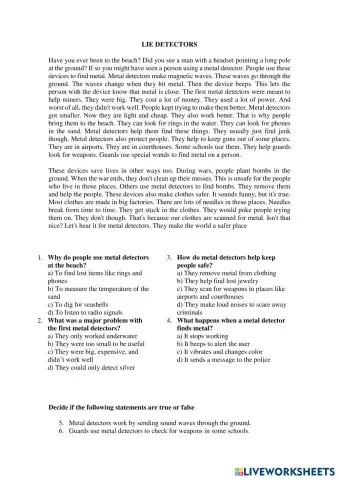
Have you ever been to the beach? Did you see a man with a headset pointing a long pole at the ground? If so you might have seen a person using a metal detector. People use these devices to find metal. Metal detectors make magnetic waves. These waves go through the ground. The waves change when they hit metal. Then the device beeps. This lets the person with the device know that metal is close. The first metal detectors were meant to help miners. They were big. They cost a lot of money. They used a lot of power. And worst of all, they didn't work well. People kept trying to make them better. Metal detectors got smaller. Now they are light and cheap. They also work better. That is why people bring them to the beach. They can look for rings in the water. They can look for phones in the sand. Metal detectors help them find these things. They usually just find junk though. Metal detectors also protect people. They help to keep guns out of some places. They are in airports. They are in courthouses. Some schools use them. They help guards look for weapons. Guards use special wands to find metal on a person.

These devices save lives in other ways too. During wars, people plant bombs in the ground. When the war ends, they don't clean up their messes. This is unsafe for the people who live in those places. Others use metal detectors to find bombs. They remove them and help the people. These devices also make clothes safer. It sounds funny, but it's true. Most clothes are made in big factories. There are lots of needles in these places. Needles break from time to time. They get stuck in the clothes. They would poke people trying them on. They don't though. That's because our clothes are scanned for metal. Isn't that nice? Let's hear it for metal detectors. They make the world a safer place

Sleep later! 2025

English as a Second Language (ESL)

The "Aludj máskor!" ("Sleep Later!") competition is an exciting 24-hour event held annually in Gyöngyös, Hungary. This year, it will take place on April 5th and 6th, 2025. The event brings together high school students from various schools to participate in a series of challenges that test their creativity, physical endurance, and teamwork.​

Event Organization and Programs

Teams, typically consisting of 25 to 40 students, gather at the Dr. Fejes András Sports Hall for the competition. The event kicks off with an opening ceremony, followed by a variety of activities designed to keep participants engaged and awake throughout the 24 hours. These activities include sports tournaments, such as basketball and soccer matches, creative workshops where teams design posters or perform skits, and quiz competitions that challenge their knowledge on various topics.​

Fair Play Cup

A highlight of the competition is the awarding of the Fair Play Cup, which recognizes the team that demonstrates the best sportsmanship and ethical behavior during the event. For example, in a previous competition, the team from Károly Róbert High School received the Fair Play Cup for their respectful conduct and willingness to assist other teams throughout the challenges.​

Participant Experience

We spoke with Anna Kovács, a student from Berze Nagy János High School, who participated in last year's event. She shared her experience: "The 'Aludj máskor!' competition was unforgettable. We faced various challenges that pushed our limits, but the camaraderie and support from teammates made it enjoyable. Winning wasn't our main goal; building friendships and creating memories were the best rewards."​

The "Aludj máskor!" competition continues to be a cherished event in Gyöngyös, promoting unity, resilience, and the spirit of fair play among students.

Crea y personaliza fichas interactivas para cada aula

LiveWorksheets facilita a profesorado, familias y personas que educan en casa el diseño y la entrega de materiales de aprendizaje atractivos. Solo tienes que subir un PDF o empezar desde cero para crear lo que necesites: desde fichas interactivas de matemáticas hasta ejercicios de comprensión lectora, fichas de multiplicación o actividades para infantil, todo en unos pocos clics. Nuestro editor de arrastrar y soltar funciona en todos los cursos y asignaturas, lo que te permite adaptar el contenido a tus programaciones, deberes o evaluaciones. Quienes enseñan inglés como segunda lengua (ESL) también pueden crear sus propias fichas, añadir cuadros de sonidos comunes o integrar actividades de ESL para hacer cada clase más participativa. Además, podrás diseñar fácilmente tareas diferenciadas y autocorregidas que ahorran tiempo y apoyan un mejor aprendizaje del alumnado.

Una biblioteca completa de recursos para K-12 y ESL

Accede a miles de fichas listas para usar en todas las asignaturas de K-12, incluidas actividades para infantil, matemáticas, práctica de multiplicación, comprensión lectora y recursos de ESL. Filtra por curso, materia o nivel de competencia para encontrar exactamente lo que necesitas, ya sea para un aula de primaria, una revisión en secundaria o actividades de práctica en bachillerato. El profesorado de ESL puede explorar nuestra colección en constante crecimiento de fichas y actividades de inglés como segunda lengua, diseñadas para apoyar a estudiantes de todos los niveles. Con nuevo contenido añadido de forma regular, LiveWorksheets es un recurso flexible que ayuda a lograr aprendizajes duraderos.