Rewrite the following sentences without changing their original meanings.

Writing - English Language

1. I am interested in learning English. 

=> I like _________________________________________________

2. Lan likes using the computer best in her free time

=> Lan's favorite

3. I am interested in going camping with my close friends.

=> I fancy

4. Mr. Pike is a big fan of water polo.

=> Mr. Pike is fond

5. It is not a problem to me whether I have to pick her up to the cinema or not.

=> I don’t mind

6. John cannot bear listening to such kind of noisy music.

=> John dislikes

7. Watching historical films is very interesting to my younger brother.

=> My younger brother enjoys

8. She cannot bear talking with him about what he likes.

=> She hates

9. The thing that I hate most is motor racing, and I will never do it in my life.

=> I detest

10. It is really interesting for him to talk with his music teacher about jazz.

=> He fancies

11. He uses all his free time to look after his garden.

=> He spends

12. Making crafts or collecting things like stamps and coins are very interesting.

=> It’s very

13. We usually visit museums when we have leisure time.

=> We enjoy

14. I don’t like to get up early and prepare breakfast in the cold winter days.

=> I hate

15. It took us 30 minutes to rehearse the song.

=> We spent

16. It took Tom one hour to travel to his hometown last week.

=> Tom spent

17. It took him 30 minutes to watch the play.

=> He spent

18. He likes swimming and sunbathing.

=> He is interested

19. It took her nearly an hour to do the crossword.

=> She spent

20. My teacher enjoys listening to folk songs in her free time as this helps her to reduce stress.

=> My teacher likes

21. Jane likes skateboarding although this has hurt her leg and arm some times.         

=> Jane fancies

22. My aunt really loves surfing the Internet. She can even do it all day without being tired at all.

=> My aunt adores

23. Ngoc dislikes doing any sports or exercises, so her health is not good enough to study.

=> Ngoc doesn’t like

24. Some of my friends fancy making crafts. They often save money for some craft kits.

=> Some of my friends enjoy

25. Cindy is extremely interested in taking care of her pets. She doesn’t mind doing it every day.

=> Cindy adores ______________________________________________________________________

Clothes and weather reading

English as a Second Language (ESL)

  1. My Clothes and the Weather


Hi! I am Jack. I am 8. I am happy today!

Today is a sunny day. I am wearing a T-shirt and shorts. I like sunny days because I can play football with my friends. When it is windy, I wear a jacket and a scarf. I don't like windy days because I can't fly my kite.

When it is snowy, I wear my coat, boots, and a sweater. I like snowy days because I can jump in the snow!

When it is cloudy, I wear jeans and a shirt. I don't like cloudy days because I can't swim in the pool.

When it is hot, I wear a dress or a skirt. I can dance and play volleyball with my friends.

When it is cold, I wear trousers and a hat. I can run outside and have fun!


No matter the weather, I love to play and have fun in my clothes!


Questions:

1. What do I wear on a sunny day?

   • a) A coat

   • b) A t-shirt and shorts

   • c) A sweater

2. Why don't I like windy days?

   • a) I can't play football

   • b) I can't fly a kite

   • c) I can't swim

3. What do I wear when it is snowy?

   • a) A dress

   • b) A coat, boots, and a sweater

   • c) Shorts and a t-shirt

4. What do I wear when it is cloudy?

   • a) A hat

   • b) Jeans and a shirt

   • c) A sweater and trousers

5. What do I do when it is hot?

   • a) I play in the snow

   • b) I dance and play volleyball

   • c) I play computer games


T/F Statements:

1. I wear a t-shirt and shorts on a sunny day. (T) (F)

2. I like windy days because I can fly a kite. (T) (F)

3. When it is snowy, I wear a coat and boots. (T) (F)

4. When it is cloudy, I wear a sweater. (T) (F)

5. When it's hot, I wear a dress or a skirt. (T) (F)


Physical Activity

Physical Education (PE)

5 Amazing facts about Women in Sports

1. Although women were technically permitted to participate in many sports, relatively few did until the late 19th century, when women's sport history is considered to start. Back then, although horseback riding, archery, golf, tennis, skiing and skating were practiced among women in the upper social class, there was often disapproval of women who played sport.

2. The first Olympic games in the modern era, in 1896, were not open to women. The first time for female athletes to participate in the Olympic games was in 1900. Only 12 female athletes participated out of the 1066 athletes from 19 countries. They competed in only golf and tennis. In the 3rd St. Louis Olympics, archery was the only women's event. In the 4th London Olympics, archery, figure skating and tennis became women's events, and diving, swimming and tennis in the 5th Stockholm Olympics.

 3. There are a few sports where men and women compete together: in mixed events or in truly mixed sports. Sports that operate in mixed events are badminton, luge, tennis and ice skating. In badminton, men and women compete as a male/female duo; in luge they compete by teams with equal numbers of men and women; in tennis, men and women compete as a male/female team in mixed doubles matches; and in ice skating male/female pairs compete together performing a dance on the ice.

 4. Sports where men and women compete against each other regardless of sex, as the physical differences between them are considered to not have any effect on the outcome of the competition, are equestrian, in which the attributes required to win are just to be an able rider, and sailing, but only in one particular class, the Nacre 17.

 5. Women that have broken boundaries in sports! African American sprinter Wilma Rudolph was the first  woman to win three gold medals in a single Olympics. Despite the loss of strength in her left leg, caused by polio, she became the fastest woman in the world at the 1960 Olympics. Former World No. 1 Billie Jean King is regarded as one of the greatest women's tennis players of all time. She won 39 Grand Slam titles, including 12 in singles, 16 in women's doubles, and 11 in mixed doubles. 


1. When did women's participation in sports significantly increase?

A) 18th century
B) Late 19th century
C) Early 20th century
D) Mid-20th century


2. In which year did female athletes first participate in the Olympic Games?

A) 1896
B) 1900
C) 1904
D) 1912


3. Which of the following sports allows men and women to compete against each other regardless of sex?

A) Badminton and Ice Skating
B) Equestrian and Sailing
C) Tennis and Luge
D) Golf and Archery


4. Who was the first woman to win three gold medals in a single Olympics?

A) Serena Williams
B) Billie Jean King
C) Wilma Rudolph
D) Nadia Comaneci


Choose the answer correct if TRUE or FALSE 


5. Women were allowed to compete in the first modern Olympic Games in 1896.


6. In mixed doubles tennis, men and women compete together as a team.


7. Wilma Rudolph won three gold medals at the 1964 Olympics.


Match the sport with how men and women compete:

  1. Badminton           Mixed-gender pairs compete in doubles matches
  2. Equestrian            Men and women compete directly against each other
  3. Tennis                    Men and women compete as a male/female team in mixed doubles

PRESENT SIMPLE

English as a Second Language (ESL)

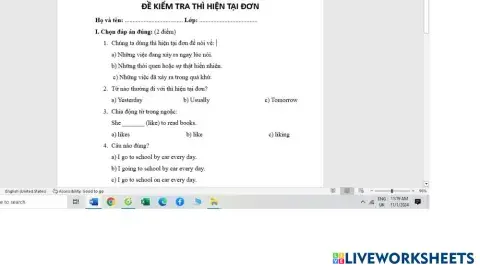
ĐỀ KIỂM TRA THÌ HIỆN TẠI ĐƠN

Họ và tên: ..................................... Lớp: .....................................

I. Chọn đáp án đúng: (2 điểm)

  1. Chúng ta dùng thì hiện tại đơn để nói về:

a) Những việc đang xảy ra ngay lúc nói.

b) Những thói quen hoặc sự thật hiển nhiên.

 c) Những việc đã xảy ra trong quá khứ.

  1. Từ nào thường đi với thì hiện tại đơn?

a) Yesterday                          b) Usually                                   c) Tomorrow

  1. Chia động từ trong ngoặc:

She _______ (like) to read books.

a) likes                                    b) like                                          c) liking

  1. Câu nào đúng?

a) I go to school by car every day.

b) I going to school by car every day.

c) I go to school on car every day.

II. Điền vào chỗ trống với dạng đúng của động từ trong ngoặc: (2.5 điểm)

  1. My father _______ (watch) TV every evening.
  2. We _______ (not play) football on Sundays.
  3. She _______ (get up) at 6 a.m every day.
  4. They _______ (live) in a big house.
  5. He _______ (like) to eat ice cream.

III. Viết lại các câu sau theo yêu cầu: (1.5 điểm)

  1. I play badminton every afternoon. (Viết thành câu phủ định) ................................................................................
  2. Does she like to swim? (Viết thành câu khẳng định) ................................................................................
  3. They go to school by bike. (Đặt câu hỏi) ................................................................................

IV. Sắp xếp các từ sau thành câu hoàn chỉnh: (1.0 điểm)

  1. every / I / day / school / go / to. ................................................................................
  2. likes / she / music / listen / to. ...............................................................................

V. Đọc đoạn văn sau và trả lời câu hỏi: (1.0 điểm)

My name is Hoa. I am 10 years old. I live in a small house with my family. Every day, I get up at 6 o’clock. I brush my teeth and then I have breakfast. I go to school at 7 o’clock. I like to play badminton after school.

  1. How old is Hoa? .......................................................................................
  2. Where does Hoa live? ................................................................................
  3. What does Hoa do after school?..................................................................

VI. Nói về một hoạt động hàng ngày của em bằng tiếng Anh. (2 điểm)

...............................................................................................................................................................................................................................................................................................................................................................................................................................................................................................................................................................................................................................................................................................................................................................................................................................................................................................................................................................................................................................................................................................................................................................................................................................................................................................................................................................................................................................................................................................................................................................................................................................................................................................................................................................................................................................................................................................................................................................................................................................................................................................................................................................................................................................................................................................................................................................................................................................................................................................................................................................................................................................................................................................................................................................................................................................................................................................................................................................................................................................................................................................................................................

ĐỀ KIỂM TRA THÌ HIỆN TẠI ĐƠN

Họ và tên: ..................................... Lớp: .....................................

I. Chọn đáp án đúng: (2 điểm)

  1. Chúng ta dùng thì hiện tại đơn để nói về:

a) Những việc đang xảy ra ngay lúc nói.

b) Những thói quen hoặc sự thật hiển nhiên.

 c) Những việc đã xảy ra trong quá khứ.

  1. Từ nào thường đi với thì hiện tại đơn?

a) Yesterday                          b) Usually                                   c) Tomorrow

  1. Chia động từ trong ngoặc:

She _______ (like) to read books.

a) likes                                    b) like                                          c) liking

  1. Câu nào đúng?

a) I go to school by car every day.

b) I going to school by car every day.

c) I go to school on car every day.

II. Điền vào chỗ trống với dạng đúng của động từ trong ngoặc: (2.5 điểm)

  1. My father _______ (watch) TV every evening.
  2. We _______ (not play) football on Sundays.
  3. She _______ (get up) at 6 a.m every day.
  4. They _______ (live) in a big house.
  5. He _______ (like) to eat ice cream.

III. Viết lại các câu sau theo yêu cầu: (1.5 điểm)

  1. I play badminton every afternoon. (Viết thành câu phủ định) ................................................................................
  2. Does she like to swim? (Viết thành câu khẳng định) ................................................................................
  3. They go to school by bike. (Đặt câu hỏi) ................................................................................

IV. Sắp xếp các từ sau thành câu hoàn chỉnh: (1.0 điểm)

  1. every / I / day / school / go / to. ................................................................................
  2. likes / she / music / listen / to. ...............................................................................

V. Đọc đoạn văn sau và trả lời câu hỏi: (1.0 điểm)

My name is Hoa. I am 10 years old. I live in a small house with my family. Every day, I get up at 6 o’clock. I brush my teeth and then I have breakfast. I go to school at 7 o’clock. I like to play badminton after school.

  1. How old is Hoa? .......................................................................................
  2. Where does Hoa live? ................................................................................
  3. What does Hoa do after school?..................................................................

VI. Nói về một hoạt động hàng ngày của em bằng tiếng Anh. (2 điểm)

...............................................................................................................................................................................................................................................................................................................................................................................................................................................................................................................................................................................................................................................................................................................................................................................................................................................................................................................................................................................................................................................................................................................................................................................................................................................................................................................................................................................................................................................................................................................................................................................................................................................................................................................................................................................................................................................................................................................................................................................................................................................................................................................................................................................................................................................................................................................................................................................................................................................................................................................................................................................................................................................................................................................................................................................................................................................................................................................................................................................................................................................................................................................................................


LISTENING SKILL

English as a Second Language (ESL)

Listening Question 1:


Which sport is commonly played in the spring in the US and Canada?


A) Baseball

B) Soccer

C) Ice hockey

D) Football


Correct Answer: B) Soccer


Listening Question 2:


which sport is NOT mentioned as being played in the spring season?


A) Golf

B) Soccer

C) Basketball

D) Ice skating


Correct Answer: D) Ice skating


Listening Question 3:


 what sports are typically played in the fall season in the US and Canada?


A) Golf, soccer, and basketball

B) Baseball, volleyball, and swimming

C) Football, bike riding, and hiking

D) Ice hockey, ice skating, and snowboarding


Correct Answer: C) Football, bike riding, and hiking


Listening Question 4:


what is a winter sport in the US and Canada?


A) Soccer

B) Baseball

C) Ice hockey

D) Volleyball


Correct Answer: C) Ice hockey


Listening Question 5:


During which season do people play both basketball and soccer?


A) Spring

B) Summer

C) Fall

D) Winter


Listening Question 6:

 it's mentioned that people go swimming in the summer season. Why do you think swimming is a popular activity during the summer, while ice hockey is played in the winter? Provide at least two reasons to support your answer.


Listening Question 7:

The audio highlights that people play football in the fall season. Imagine you are a coach planning a football season. What environmental factors might influence your decision when scheduling football games during the fall? Explain how these factors could impact the sport and the athletes.

Crea y personaliza fichas interactivas para cada aula

LiveWorksheets facilita a profesorado, familias y personas que educan en casa el diseño y la entrega de materiales de aprendizaje atractivos. Solo tienes que subir un PDF o empezar desde cero para crear lo que necesites: desde fichas interactivas de matemáticas hasta ejercicios de comprensión lectora, fichas de multiplicación o actividades para infantil, todo en unos pocos clics. Nuestro editor de arrastrar y soltar funciona en todos los cursos y asignaturas, lo que te permite adaptar el contenido a tus programaciones, deberes o evaluaciones. Quienes enseñan inglés como segunda lengua (ESL) también pueden crear sus propias fichas, añadir cuadros de sonidos comunes o integrar actividades de ESL para hacer cada clase más participativa. Además, podrás diseñar fácilmente tareas diferenciadas y autocorregidas que ahorran tiempo y apoyan un mejor aprendizaje del alumnado.

Una biblioteca completa de recursos para K-12 y ESL

Accede a miles de fichas listas para usar en todas las asignaturas de K-12, incluidas actividades para infantil, matemáticas, práctica de multiplicación, comprensión lectora y recursos de ESL. Filtra por curso, materia o nivel de competencia para encontrar exactamente lo que necesitas, ya sea para un aula de primaria, una revisión en secundaria o actividades de práctica en bachillerato. El profesorado de ESL puede explorar nuestra colección en constante crecimiento de fichas y actividades de inglés como segunda lengua, diseñadas para apoyar a estudiantes de todos los niveles. Con nuevo contenido añadido de forma regular, LiveWorksheets es un recurso flexible que ayuda a lograr aprendizajes duraderos.