Descriptive Text

English

Floating Market Lembang


Floating Market Lembang is a fun and unique tourist spot in Bandung, Indonesia. It is located in Lembang, a cool area with fresh air and green views. This place is like a big park with a beautiful lake. The special thing about the Floating Market is the food market on boats! Many small boats float on the lake, selling delicious snacks and drinks.


You can walk around the lake, take photos, or relax on the benches. There are also activities for kids, like feeding rabbits and riding small boats. Visitors can try local foods, like "batagor" (fried dumplings with peanut sauce) and "siomay" (steamed dumplings).


Floating Market Lembang is a great place to enjoy nature, eat tasty food, and have a nice time with friends and family. It is open every day, and you need to buy a ticket to enter.

Answer the questions based

  1. Where is Floating Market Lembang located?

A. Jakarta

B. Bali

C. Surabaya

D. Bandung

E. Yogyakarta


  1. What types of activities can children enjoy at the Floating Market?

A. Riding bicycles and playing basketball

B. Feeding rabbits and riding small boats

C. Swimming in the lake

D. Playing video games

E. Painting and drawing


  1. Why is the Floating Market called “unique”?

A. Because it has a large amusement park

B. Because the food is sold on floating boats

C. Because it is only open once a week

D. Because it offers helicopter rides

E. Because it has a zoo inside


  1. What makes Floating Market Lembang a good place to visit with friends and family?

A. It has many fast-food restaurants

B. It is a quiet place with no activities

C. It offers nature, food, and a relaxing environment

D. It has a large playground with slides

E. It is free to enter


  1. If you were to visit Floating Market Lembang, what activity would you enjoy the most, and why?

A. Walking around the lake and taking photos because it is peaceful

B. Shopping for souvenirs because they are cheap

C. Playing sports because there are courts available

D. Watching movies because it has a cinema

E. Riding bicycles because there are bike paths


Part 2

Match the vocabularies in column A with its description in column B


Column A

Column B

1. Floating Market

A market where food is sold on boats in a lake


2. Benches

Seats where people can sit and relax


3. Batagor

Fried dumplings with peanut sauce, a popular local food


4. Fresh air

Clean, cool air often found in nature


5. Activities

Fun things to do, such as feeding rabbits and riding boats


Activity 3

Put the correct word for the sentence

lake, ticket, boats, park, nature, batagor, benches, rabbits, food, Lembang


  1. Floating Market Lembang is a fun and unique ________ spot in Bandung, Indonesia.
  2. It is located in ________, a cool area with fresh air and green views.
  3. This place is like a big ________ with a beautiful lake.
  4. The special thing about the Floating Market is the ________ market on boats.
  5. Many small ________ float on the lake, selling delicious snacks and drinks.
  6. You can walk around the lake, take photos, or relax on the ________.
  7. There are also activities for kids, like feeding ________ and riding small boats.
  8. Visitors can try local foods, like "________" (fried dumplings with peanut sauce).
  9. Floating Market Lembang is a great place to enjoy ________, eat tasty food, and have a nice time with friends and family.
  10. The market is open every day, and you need to buy a ________ to enter.


Activity 4

True false question

  1. Floating Market Lembang is located in Jakarta, Indonesia.

True / False

  1. The Floating Market has a food market where vendors sell snacks from boats on the lake.

True / False

  1. Visitors can take photos, walk around, and sit on benches by the lake.

True / False

  1. Floating Market Lembang is only open on weekends.

True / False

  1. Kids can feed rabbits and ride small boats at Floating Market Lembang.

True / False


Activity 5

  1. The Floating Market in Lembang is described as having food sold from boats on a lake. Why might the market choose to use boats for selling food instead of regular stalls?

A. To offer an experience similar to a traditional Indonesian market

B. To make it harder for people to buy food

C. To prevent people from entering the lake area

D. To allow only small amounts of food to be sold


  1. Lembang is mentioned as a "cool area with fresh air and green views." Based on this information, which season or time of year would most likely make the Floating Market an attractive place to visit?

A. Winter, when temperatures are the lowest

B. Any season, because the area has a cool climate year-round

C. Summer, because people want to cool off

D. The rainy season, because it’s a lake area


  1. Imagine a family with young children is planning to visit Floating Market Lembang. Which of these activities would likely be most suitable for them, based on the description?

A. Hiking in the mountains nearby

B. Swimming in the lake

C. Feeding rabbits and riding small boats

D. Taking a tour of the city center of Bandung


  1. The Floating Market Lembang requires visitors to buy a ticket to enter. Why might this be necessary for a place like the Floating Market?

A. To control the number of visitors and maintain the area

B. To discourage tourists from visiting too often

C. To ensure that only local people can enter

D. To allow visitors to enter without waiting


  1. If Floating Market Lembang is a popular destination for nature and food, how might increased tourism impact the local environment in Lembang?

A. The area may become less crowded with tourists

B. The natural areas may require more upkeep and conservation

C. The fresh air will become cooler

D. The lake will expand

Clothes and weather reading

English as a Second Language (ESL)

  1. My Clothes and the Weather


Hi! I am Jack. I am 8. I am happy today!

Today is a sunny day. I am wearing a T-shirt and shorts. I like sunny days because I can play football with my friends. When it is windy, I wear a jacket and a scarf. I don't like windy days because I can't fly my kite.

When it is snowy, I wear my coat, boots, and a sweater. I like snowy days because I can jump in the snow!

When it is cloudy, I wear jeans and a shirt. I don't like cloudy days because I can't swim in the pool.

When it is hot, I wear a dress or a skirt. I can dance and play volleyball with my friends.

When it is cold, I wear trousers and a hat. I can run outside and have fun!


No matter the weather, I love to play and have fun in my clothes!


Questions:

1. What do I wear on a sunny day?

   • a) A coat

   • b) A t-shirt and shorts

   • c) A sweater

2. Why don't I like windy days?

   • a) I can't play football

   • b) I can't fly a kite

   • c) I can't swim

3. What do I wear when it is snowy?

   • a) A dress

   • b) A coat, boots, and a sweater

   • c) Shorts and a t-shirt

4. What do I wear when it is cloudy?

   • a) A hat

   • b) Jeans and a shirt

   • c) A sweater and trousers

5. What do I do when it is hot?

   • a) I play in the snow

   • b) I dance and play volleyball

   • c) I play computer games


T/F Statements:

1. I wear a t-shirt and shorts on a sunny day. (T) (F)

2. I like windy days because I can fly a kite. (T) (F)

3. When it is snowy, I wear a coat and boots. (T) (F)

4. When it is cloudy, I wear a sweater. (T) (F)

5. When it's hot, I wear a dress or a skirt. (T) (F)


Physical Activity

Physical Education (PE)

5 Amazing facts about Women in Sports

1. Although women were technically permitted to participate in many sports, relatively few did until the late 19th century, when women's sport history is considered to start. Back then, although horseback riding, archery, golf, tennis, skiing and skating were practiced among women in the upper social class, there was often disapproval of women who played sport.

2. The first Olympic games in the modern era, in 1896, were not open to women. The first time for female athletes to participate in the Olympic games was in 1900. Only 12 female athletes participated out of the 1066 athletes from 19 countries. They competed in only golf and tennis. In the 3rd St. Louis Olympics, archery was the only women's event. In the 4th London Olympics, archery, figure skating and tennis became women's events, and diving, swimming and tennis in the 5th Stockholm Olympics.

 3. There are a few sports where men and women compete together: in mixed events or in truly mixed sports. Sports that operate in mixed events are badminton, luge, tennis and ice skating. In badminton, men and women compete as a male/female duo; in luge they compete by teams with equal numbers of men and women; in tennis, men and women compete as a male/female team in mixed doubles matches; and in ice skating male/female pairs compete together performing a dance on the ice.

 4. Sports where men and women compete against each other regardless of sex, as the physical differences between them are considered to not have any effect on the outcome of the competition, are equestrian, in which the attributes required to win are just to be an able rider, and sailing, but only in one particular class, the Nacre 17.

 5. Women that have broken boundaries in sports! African American sprinter Wilma Rudolph was the first  woman to win three gold medals in a single Olympics. Despite the loss of strength in her left leg, caused by polio, she became the fastest woman in the world at the 1960 Olympics. Former World No. 1 Billie Jean King is regarded as one of the greatest women's tennis players of all time. She won 39 Grand Slam titles, including 12 in singles, 16 in women's doubles, and 11 in mixed doubles. 


1. When did women's participation in sports significantly increase?

A) 18th century
B) Late 19th century
C) Early 20th century
D) Mid-20th century


2. In which year did female athletes first participate in the Olympic Games?

A) 1896
B) 1900
C) 1904
D) 1912


3. Which of the following sports allows men and women to compete against each other regardless of sex?

A) Badminton and Ice Skating
B) Equestrian and Sailing
C) Tennis and Luge
D) Golf and Archery


4. Who was the first woman to win three gold medals in a single Olympics?

A) Serena Williams
B) Billie Jean King
C) Wilma Rudolph
D) Nadia Comaneci


Choose the answer correct if TRUE or FALSE 


5. Women were allowed to compete in the first modern Olympic Games in 1896.


6. In mixed doubles tennis, men and women compete together as a team.


7. Wilma Rudolph won three gold medals at the 1964 Olympics.


Match the sport with how men and women compete:

  1. Badminton           Mixed-gender pairs compete in doubles matches
  2. Equestrian            Men and women compete directly against each other
  3. Tennis                    Men and women compete as a male/female team in mixed doubles

PRESENT SIMPLE

English as a Second Language (ESL)

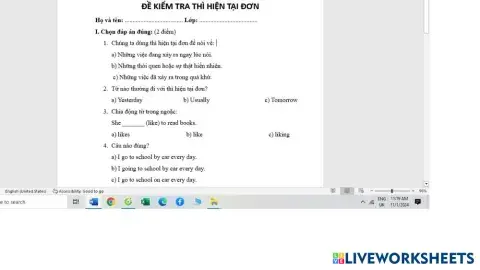
ĐỀ KIỂM TRA THÌ HIỆN TẠI ĐƠN

Họ và tên: ..................................... Lớp: .....................................

I. Chọn đáp án đúng: (2 điểm)

  1. Chúng ta dùng thì hiện tại đơn để nói về:

a) Những việc đang xảy ra ngay lúc nói.

b) Những thói quen hoặc sự thật hiển nhiên.

 c) Những việc đã xảy ra trong quá khứ.

  1. Từ nào thường đi với thì hiện tại đơn?

a) Yesterday                          b) Usually                                   c) Tomorrow

  1. Chia động từ trong ngoặc:

She _______ (like) to read books.

a) likes                                    b) like                                          c) liking

  1. Câu nào đúng?

a) I go to school by car every day.

b) I going to school by car every day.

c) I go to school on car every day.

II. Điền vào chỗ trống với dạng đúng của động từ trong ngoặc: (2.5 điểm)

  1. My father _______ (watch) TV every evening.
  2. We _______ (not play) football on Sundays.
  3. She _______ (get up) at 6 a.m every day.
  4. They _______ (live) in a big house.
  5. He _______ (like) to eat ice cream.

III. Viết lại các câu sau theo yêu cầu: (1.5 điểm)

  1. I play badminton every afternoon. (Viết thành câu phủ định) ................................................................................
  2. Does she like to swim? (Viết thành câu khẳng định) ................................................................................
  3. They go to school by bike. (Đặt câu hỏi) ................................................................................

IV. Sắp xếp các từ sau thành câu hoàn chỉnh: (1.0 điểm)

  1. every / I / day / school / go / to. ................................................................................
  2. likes / she / music / listen / to. ...............................................................................

V. Đọc đoạn văn sau và trả lời câu hỏi: (1.0 điểm)

My name is Hoa. I am 10 years old. I live in a small house with my family. Every day, I get up at 6 o’clock. I brush my teeth and then I have breakfast. I go to school at 7 o’clock. I like to play badminton after school.

  1. How old is Hoa? .......................................................................................
  2. Where does Hoa live? ................................................................................
  3. What does Hoa do after school?..................................................................

VI. Nói về một hoạt động hàng ngày của em bằng tiếng Anh. (2 điểm)

...............................................................................................................................................................................................................................................................................................................................................................................................................................................................................................................................................................................................................................................................................................................................................................................................................................................................................................................................................................................................................................................................................................................................................................................................................................................................................................................................................................................................................................................................................................................................................................................................................................................................................................................................................................................................................................................................................................................................................................................................................................................................................................................................................................................................................................................................................................................................................................................................................................................................................................................................................................................................................................................................................................................................................................................................................................................................................................................................................................................................................................................................................................................................................


Crea y personaliza fichas interactivas para cada aula

LiveWorksheets facilita a profesorado, familias y personas que educan en casa el diseño y la entrega de materiales de aprendizaje atractivos. Solo tienes que subir un PDF o empezar desde cero para crear lo que necesites: desde fichas interactivas de matemáticas hasta ejercicios de comprensión lectora, fichas de multiplicación o actividades para infantil, todo en unos pocos clics. Nuestro editor de arrastrar y soltar funciona en todos los cursos y asignaturas, lo que te permite adaptar el contenido a tus programaciones, deberes o evaluaciones. Quienes enseñan inglés como segunda lengua (ESL) también pueden crear sus propias fichas, añadir cuadros de sonidos comunes o integrar actividades de ESL para hacer cada clase más participativa. Además, podrás diseñar fácilmente tareas diferenciadas y autocorregidas que ahorran tiempo y apoyan un mejor aprendizaje del alumnado.

Una biblioteca completa de recursos para K-12 y ESL

Accede a miles de fichas listas para usar en todas las asignaturas de K-12, incluidas actividades para infantil, matemáticas, práctica de multiplicación, comprensión lectora y recursos de ESL. Filtra por curso, materia o nivel de competencia para encontrar exactamente lo que necesitas, ya sea para un aula de primaria, una revisión en secundaria o actividades de práctica en bachillerato. El profesorado de ESL puede explorar nuestra colección en constante crecimiento de fichas y actividades de inglés como segunda lengua, diseñadas para apoyar a estudiantes de todos los niveles. Con nuevo contenido añadido de forma regular, LiveWorksheets es un recurso flexible que ayuda a lograr aprendizajes duraderos.