The Lion an the mouse

English

1. Who was sleeping on a sunny afternoon?
   a) Tiger
   b) Lion
   c) Elephant
   d) Giraffe

2. What was the mouse doing when she found the lion?
   a) Eating cheese
   b) Running home
   c) Flying in the sky
   d) Swimming in the river

3. How did the lion react when he caught the mouse under his paw?
   a) He laughed
   b) He cried
   c) He roared loudly
   d) He danced happily

4. Why was the mouse scared when the lion picked her up?
   a) Because she wanted to play
   b) Because she was hungry
   c) Because the lion promised to eat her
   d) Because she was ticklish

5. How did the lion react when the mouse promised to help him someday?
   a) He laughed
   b) He got angry
   c) He believed the mouse
   d) He ignored the mouse

6. What happened to the lion one day when he went into a net?
   a) He found some food
   b) He got caught
   c) He met another lion
   d) He fell asleep

7. What did the other animals do when they heard the lion roaring?
   a) They laughed
   b) They came to help
   c) They ignored him
   d) They ran away

8. Who was brave enough to help the lion when he was caught in the net?
   a) Rabbit
   b) Hunter
   c) Mouse
   d) Another lion

9. How did the mouse help the lion get free from the net?
   a) By biting the net
   b) By asking for help
   c) By ignoring the lion
   d) By running away

10. How did the lion and the mouse feel about each other at the end of the story?
    a) Angry
    b) Indifferent
    c) Grateful
    d) Scared


Fill in with the missing word

1. Lion was __________ on a sunny afternoon.
2. Mouse promised to __________ the lion someday.
3. Lion got caught in a __________ that belonged to a hunter.
4. Many animals listened to the lion's roar, but __________ came to help.
5. Mouse used her sharp teeth to bite the __________ and set Lion free.
6. Lion roared in anger and then in __________.
7. His big noise went everywhere, but __________ came to help.
8. Mouse quickly went to Lion´s place when she saw him caught in the __________.
9. Mouse used her sharp teeth to bite the __________ and set Lion free.
10. Lion got rid of the __________ and looked into Mouse’s eyes.

Task 1 : Jumbled Paragraph

Narrative Text

Once upon a time, a mother duck sat on her eggs. She felt tired of sitting on them. She just wished the eggs would break out.


Several days later, she got her wish. The eggs cracked and some cute little ducklings appeared. “Peep, peep” the little ducklings cried. “Quack, quack” their mother greeted in return. However the largest egg had not cracked. The mother duck sat on it for several days.


Finally, it cracked and a huge ugly duckling waddled out. The mother duck looked at him in surprise. He was so big and very gray. He didn’t look like the others at all. He was like a turkey.
 

When the mother duck brought the children to the pond for their first swimming lesson. The huge grey duckling splashed and paddled about just as nicely as the other ducklings did. “That is not a turkey chick.


He is my very own son and quite handsome” the mother said proudly. However, the other animals didn’t agree. They hissed and made fun of him day by day.


Even his own sisters and brothers were very unkind. “You are very ugly” they quacked. The little poor duckling was very unhappy. “I wish I looked like them” he thought to himself.


One day, the ugly duckling run away and hid in the bushes. The sad duckling lived alone through the cold and snow winter.


Finally the spring flowers began to bloom. While he was swimming in the pond, he saw three large white swans swimming toward him. “Oh, dear. These beautiful birds will laugh and peck me too” he said to himself.


But the swans did not attack him. Instead, they swam around him and stroked him with their bills.


As the ugly duckling bent his neck to speak to them, he saw his reflection in the water. He could not believe his eyes. “I am not an ugly duckling but a beautiful swam” he exclaimed.
 

He was very happy. From that day on, he swam and played with his new friends and was happier than he had never been.

Grammar points

English Grammar

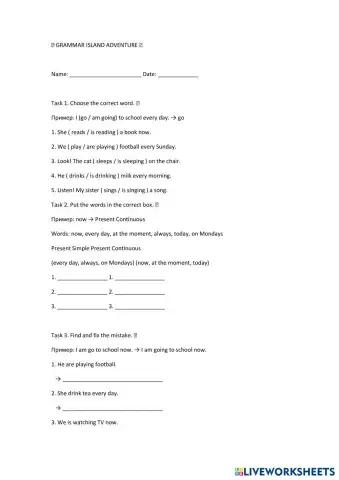
  • Present Simple Tense

    • Structure: Subject + base verb (s/es for he/she/it)
    • Example: "I work in an office." / "She goes to school every day."
  • Present Continuous Tense

    • Structure: Subject + am/are/is + verb-ing
    • Example: "I am studying right now." / "They are playing football."
  • Past Simple Tense

    • Structure: Subject + past form of verb
    • Example: "She visited the museum yesterday." / "I watched a movie last night."
  • Past Continuous Tense

    • Structure: Subject + was/were + verb-ing
    • Example: "I was reading when the phone rang." / "They were sleeping at 10 PM."
  • Future Simple Tense (will)

    • Structure: Subject + will + base verb
    • Example: "I will call you tomorrow." / "They will come to the party."
  • Future with "going to"

    • Structure: Subject + am/are/is + going to + base verb
    • Example: "I’m going to visit my grandparents." / "He is going to study abroad."
  • Present Perfect Simple

    • Structure: Subject + have/has + past participle
    • Example: "I have finished my homework." / "She has lived in this city for five years."
  • Comparatives and Superlatives

    • Comparatives: Subject + verb + adjective + -er / more + adjective (for longer adjectives)
      • Example: "This book is cheaper than that one." / "She is more intelligent than him."
    • Superlatives: The + adjective + -est / most + adjective (for longer adjectives)
      • Example: "This is the tallest building." / "He is the most hardworking person."
  • There is/There are

    • Structure: There + is/are + noun
    • Example: "There is a book on the table." / "There are many people in the park."
  • Can (ability and permission)

    • Structure: Subject + can + base verb
    • Example: "I can swim." / "Can I go to the bathroom?"
  • Some and Any

    • Some: Used in positive statements, offers, and requests.
      • Example: "I have some friends." / "Would you like some tea?"
    • Any: Used in negative statements and questions.
      • Example: "I don’t have any money." / "Do you have any pens?"
  • First Conditional

    • Structure: If + present simple, will + base verb
    • Example: "If it rains, I will stay at home." / "If I see her, I will say hello."
  • Second Conditional

    • Structure: If + past simple, would + base verb
    • Example: "If I were rich, I would travel the world." / "If she studied more, she would pass the exam."
  • Prepositions of Place and Time

    • Examples: "in," "on," "at"
    • "The book is on the table." / "We have a meeting at 3 PM." / "I live in New York."
  • Questions with Wh- words

    • Examples: "What," "Where," "When," "Why," "How"
    • "What is your name?" / "Where do you live?" / "How are you?"

Types of Institutions

Belizean Studies

Name: ________________

Class: ________________

Date: _________________


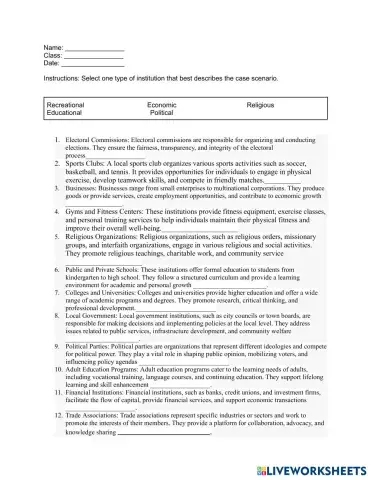
Instructions: Select one type of institution that best describes the case scenario. 


Recreational                                  Economic                                      Religious 

Educational                                     Political 


  1. Electoral Commissions: Electoral commissions are responsible for organizing and conducting elections. They ensure the fairness, transparency, and integrity of the electoral process__________________
  2. Sports Clubs: A local sports club organizes various sports activities such as soccer, basketball, and tennis. It provides opportunities for individuals to engage in physical exercise, develop teamwork skills, and compete in friendly matches.__________
  3. Businesses: Businesses range from small enterprises to multinational corporations. They produce goods or provide services, create employment opportunities, and contribute to economic growth _________________.
  4. Gyms and Fitness Centers: These institutions provide fitness equipment, exercise classes, and personal training services to help individuals maintain their physical fitness and improve their overall well-being._____________________
  5. Religious Organizations: Religious organizations, such as religious orders, missionary groups, and interfaith organizations, engage in various religious and social activities. They promote religious teachings, charitable work, and community service _____________________
  6. Public and Private Schools: These institutions offer formal education to students from kindergarten to high school. They follow a structured curriculum and provide a learning environment for academic and personal growth ______________________.
  7. Colleges and Universities: Colleges and universities provide higher education and offer a wide range of academic programs and degrees. They promote research, critical thinking, and professional development.________________________
  8. Local Government: Local government institutions, such as city councils or town boards, are responsible for making decisions and implementing policies at the local level. They address issues related to public services, infrastructure development, and community welfare ______________________.
  9. Political Parties: Political parties are organizations that represent different ideologies and compete for political power. They play a vital role in shaping public opinion, mobilizing voters, and influencing policy agendas ___________________________
  10. Adult Education Programs: Adult education programs cater to the learning needs of adults, including vocational training, language courses, and continuing education. They support lifelong learning and skill enhancement __________________.
  11. Financial Institutions: Financial institutions, such as banks, credit unions, and investment firms, facilitate the flow of capital, provide financial services, and support economic transactions _____________________.
  12. Trade Associations: Trade associations represent specific industries or sectors and work to promote the interests of their members. They provide a platform for collaboration, advocacy, and knowledge sharing _________________________.
  13. Places of Worship: Churches, mosques, temples, and synagogues are places of worship where individuals gather for religious ceremonies, prayers, and community activities____________.
  14. Religious Education Institutions: These institutions provide religious education and training to individuals, such as Sunday schools, seminaries, and religious colleges ______________.
  15. Town or County Recreation Departments: These departments offer a wide range of recreational programs and facilities for community members. They may organize events like summer camps, swimming lessons, and fitness classes to promote an active and healthy lifestyle.____________________________


Crea y personaliza fichas interactivas para cada aula

LiveWorksheets facilita a profesorado, familias y personas que educan en casa el diseño y la entrega de materiales de aprendizaje atractivos. Solo tienes que subir un PDF o empezar desde cero para crear lo que necesites: desde fichas interactivas de matemáticas hasta ejercicios de comprensión lectora, fichas de multiplicación o actividades para infantil, todo en unos pocos clics. Nuestro editor de arrastrar y soltar funciona en todos los cursos y asignaturas, lo que te permite adaptar el contenido a tus programaciones, deberes o evaluaciones. Quienes enseñan inglés como segunda lengua (ESL) también pueden crear sus propias fichas, añadir cuadros de sonidos comunes o integrar actividades de ESL para hacer cada clase más participativa. Además, podrás diseñar fácilmente tareas diferenciadas y autocorregidas que ahorran tiempo y apoyan un mejor aprendizaje del alumnado.

Una biblioteca completa de recursos para K-12 y ESL

Accede a miles de fichas listas para usar en todas las asignaturas de K-12, incluidas actividades para infantil, matemáticas, práctica de multiplicación, comprensión lectora y recursos de ESL. Filtra por curso, materia o nivel de competencia para encontrar exactamente lo que necesitas, ya sea para un aula de primaria, una revisión en secundaria o actividades de práctica en bachillerato. El profesorado de ESL puede explorar nuestra colección en constante crecimiento de fichas y actividades de inglés como segunda lengua, diseñadas para apoyar a estudiantes de todos los niveles. Con nuevo contenido añadido de forma regular, LiveWorksheets es un recurso flexible que ayuda a lograr aprendizajes duraderos.