Reading

English

                                                                                 The Earth

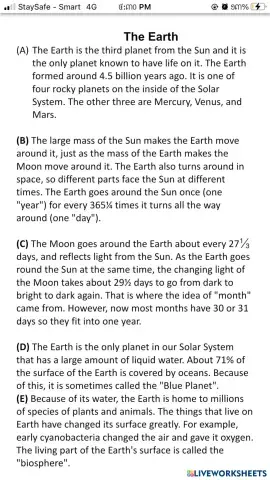
  1. The Earth is the third planet from the Sun and it is the only planet known to have life on it. The Earth formed around 4.5 billion years ago. It is one of four rocky planets on the inside of the Solar System. The other three are Mercury, Venus, and Mars.


(B) The large mass of the Sun makes the Earth move around it, just as the mass of the Earth makes the Moon move around it. The Earth also turns around in space, so different parts face the Sun at different times. The Earth goes around the Sun once (one "year") for every 365¼ times it turns all the way around (one "day").


(C) The Moon goes around the Earth about every 27⅓ days, and reflects light from the Sun. As the Earth goes round the Sun at the same time, the changing light of the Moon takes about 29½ days to go from dark to bright to dark again. That is where the idea of "month" came from. However, now most months have 30 or 31 days so they fit into one year.


(D) The Earth is the only planet in our Solar System that has a large amount of liquid water. About 71% of the surface of the Earth is covered by oceans. Because of this, it is sometimes called the "Blue Planet".

(E) Because of its water, the Earth is home to millions of species of plants and animals. The things that live on Earth have changed its surface greatly. For example, early cyanobacteria changed the air and gave it oxygen. The living part of the Earth's surface is called the "biosphere".


(F) The Earth is part of the eight planets and many thousands of small bodies that move around the Sun as its Solar System. The Solar System is moving through the Orion Arm of the Milky Way Galaxy now, and will be for about the next 10,000 years.

(G) The Earth is generally 150,000,000 kilometers or 93,000,000 miles away from the Sun (this distance is named an "Astronomical Unit"). The Earth moves along its way at an average speed of about 30 km or 19 mi a second. The Earth turns all the way around about 365¼ times in the time it takes for the Earth to go all the way around the Sun. To make up this extra bit of a day every year, an additional day is used every four years. This is named a "leap year".


(H) The Moon goes around the Earth at an average distance of 400,000 kilometers (250,000 mi). It is locked to Earth, so that it always has the same half facing the Earth; the other half is called the "dark side of the Moon". It takes about 27⅓ days for the Moon to go all the way around the Earth but, because the Earth is moving around the Sun at the same time, it takes about 29½ days for the Moon to go from dark to bright to dark again. This is where the word "month" came from, even though most months now have 30 or 31 days.


Questions 1–8

Reading Passage 1 has eight paragraphs A-H. Which paragraph contains the following information?  Write the correct letter, A–H, in boxes 1–8 on your answer sheet.

1. Earth’s natural satellite  ____
2. Distance between Earth and Sun  ____
3. General information about Earth  ____
4. The Solar System  ____
5. Length of most moths  ____
6. Another name for Earth  ____
7. The living part of the Earth's surface  ____
8. The movements of Earth around the Sun ____

Questions 9-13

Complete the sentences below.

Choose NO MORE THAN THREE WORDS from the text for each answer.

Write your answers in boxes 9-13 on your answer sheet.

9. Apart from Earth, other rocky planets in our Solar Systems are Venus, Mars and ____________ 

10. Moon ____________ from the Sun on Earth.

11. There are millions of ___________ of plants and animals that inhabit Earth.

12. Now the Solar System is travelling through ______________.

13. The dark side of the Moon is the side, which _____________ faces Earth.


What the future holds

Vocabulary - Language Arts

PART 1: VOCABULARY

Exercise 1. Match the words with their definitions.

WORDS:

prediction

gadget

underwater city

robotic housemaid

mini-submarine

glass dome

traffic jam

look forward to

DEFINITIONS:

a) a small vehicle that travels under water

b) a statement about what will happen in the future

c) a small useful machine or tool, often electronic

d) a city built below the surface of the ocean

e) a robot that does cleaning and other housework

f) a round transparent roof or cover

g) a situation when vehicles are stuck and cannot move

h) to feel excited about something that will happen

Exercise 2. Complete the sentences with words from the box.

Use each word only once.

WORD BOX:

prediction, fuel, exist, creature, online school, petrol, planet, look after

Scientists think that life might __________ on other planets.

My sister studies at an __________ — she has lessons from home.

We must take care of our __________ and protect the environment.

A robot pet can __________ you when you are lonely.

Electric cars don't use __________; they use electricity instead.

No one can make a 100% accurate __________ about the future.

In the future, we may meet a strange __________ from space.

Scientists are looking for a new type of clean __________ for cars.

FUTURE SIMPLE (will + infinitive)

Use for predictions and future facts.

Exercise 3. Put the verbs in brackets into Future Simple.

I think robots __________ (do) most housework in 2050.

__________ people __________ (live) on Mars one day?

She probably __________ (not / use) paper books in the future.

We __________ (travel) in flying cars, I'm sure!

__________ you __________ (help) me with my project tomorrow?

They __________ (not / need) petrol cars because of electric vehicles.

ZERO CONDITIONAL (If + Present Simple, Present Simple)

Use for facts and general truths.

Exercise 4. Complete the sentences using Zero Conditional.

If you __________ (heat) ice, it __________ (melt).

If people __________ (not sleep) enough, they __________ (feel) tired.

Plants __________ (die) if they __________ (not get) water.

If you __________ (mix) red and blue, you __________ (get) purple.

My phone __________ (not work) if the battery __________ (be) empty.

FIRST CONDITIONAL (If + Present Simple, will + infinitive)

Use for real possibilities in the future.

Exercise 5. Complete the sentences using First Conditional.

If it __________ (rain) tomorrow, we __________ (stay) at home.

She __________ (pass) the exam if she __________ (study) hard.

If they __________ (not hurry), they __________ (miss) the bus.

I __________ (buy) a robot pet if I __________ (have) enough pocket money.

__________ you __________ (come) to the party if your friends __________ (go)?

If we __________ (protect) nature now, the planet __________ (be) healthier in the future.

Exercise 6. Zero or First Conditional? Choose the correct option.

If you freeze water, it turns / will turn into ice. (fact)

If I see Tom tomorrow, I tell / will tell him about the project. (future possibility)

If people don't recycle, the planet gets / will get more polluted. (future result)

If you heat metal, it expands / will expand. (scientific fact)

She will be / is upset if she doesn't get the job. (future possibility)

Exercise 7. Read the text and mark the statements T (True) or F (False).

                   Life in 2070: What Will Change?

Many scientists make predictions about the future. They believe that by 2070, our lives will be very different.

First, transport will change. Petrol cars will probably disappear because they pollute the planet. Instead, people will use electric cars, flying taxis, or even mini-submarines in underwater cities! Traffic jams might become a thing of the past.

Second, technology will help us at home. Robotic housemaids will do the housework: clean the rooms, cook dinner, and look after children. Some families will have robot pets that don't need food or walks but can still show affection.

Education will change too. Many students will attend online schools from their glass domes at home. They will look up information instantly and keep notes on digital devices. However, teachers will still be important as role models and sources of inspiration.

But not everything will be easy. If we don't take care of our planet now, the future will be difficult. If pollution continues, clean water and air will become expensive. That's why many young people today want to help out at home and protect the environment.

What do you think? Will the future be amazing or challenging? One thing is definite: the future is in our hands!

TRUE OR FALSE? Read the statements and write T or F. Correct the false statements.

Scientists think that petrol cars will still be popular in 2070. _____

Flying taxis and mini-submarines might be common in the future. _____

Robot pets will need the same care as real puppies. _____

All students will go to traditional schools in the future. _____

Teachers will not be necessary if students use online schools. _____

If we pollute the planet now, clean air and water will be expensive later. _____

Young people today don't care about the environment. _____

The writer believes that we can influence the future. _____

Crea y personaliza fichas interactivas para cada aula

LiveWorksheets facilita a profesorado, familias y personas que educan en casa el diseño y la entrega de materiales de aprendizaje atractivos. Solo tienes que subir un PDF o empezar desde cero para crear lo que necesites: desde fichas interactivas de matemáticas hasta ejercicios de comprensión lectora, fichas de multiplicación o actividades para infantil, todo en unos pocos clics. Nuestro editor de arrastrar y soltar funciona en todos los cursos y asignaturas, lo que te permite adaptar el contenido a tus programaciones, deberes o evaluaciones. Quienes enseñan inglés como segunda lengua (ESL) también pueden crear sus propias fichas, añadir cuadros de sonidos comunes o integrar actividades de ESL para hacer cada clase más participativa. Además, podrás diseñar fácilmente tareas diferenciadas y autocorregidas que ahorran tiempo y apoyan un mejor aprendizaje del alumnado.

Una biblioteca completa de recursos para K-12 y ESL

Accede a miles de fichas listas para usar en todas las asignaturas de K-12, incluidas actividades para infantil, matemáticas, práctica de multiplicación, comprensión lectora y recursos de ESL. Filtra por curso, materia o nivel de competencia para encontrar exactamente lo que necesitas, ya sea para un aula de primaria, una revisión en secundaria o actividades de práctica en bachillerato. El profesorado de ESL puede explorar nuestra colección en constante crecimiento de fichas y actividades de inglés como segunda lengua, diseñadas para apoyar a estudiantes de todos los niveles. Con nuevo contenido añadido de forma regular, LiveWorksheets es un recurso flexible que ayuda a lograr aprendizajes duraderos.