Ecosystem

Science

Answer the following questions 


1. Which of the following best describes adaptation?

   a) The process by which organisms change over time

   b) The process of developing new species

   c) The process of migration to different habitats

   d) The process of hibernation during winter


2. What is the main purpose of adaptation in living organisms?

   a) To increase their lifespan

   b) To prevent diseases

   c) To survive and reproduce in their environment

   d) To communicate with other organisms


3. Which of the following is an example of a structural adaptation?

   a) The ability of a chameleon to change its skin color

   b) The migration of birds during winter

   c) The hibernation of bears during the cold season

   d) The ability of a shark to detect electrical signals


4. Which of the following is an example of a behavioral adaptation?

   a) The long neck of a giraffe

   b) The camouflage of a chameleon

   c) The migration of monarch butterflies

   d) The sharp claws of a tiger


5. How does camouflage help an organism survive?

   a) It helps the organism find food more easily

   b) It helps the organism attract a mate

   c) It helps the organism hide from predators or prey

   d) It helps the organism communicate with others


6. Which of the following is an example of a plant adaptation?

   a) The ability of a cactus to store water

   b) The ability of a butterfly to fly long distances

   c) The ability of a squirrel to climb trees

   d) The ability of a snake to shed its skin


7. What is mimicry as an adaptation?

   a) The ability of an organism to produce toxins

   b) The ability of an organism to imitate the appearance of another organism

   c) The ability of an organism to run at high speeds

   d) The ability of an organism to change its body coloration


8. Which of the following is an example of a physiological adaptation?

   a) The ability of a bird to build a nest

   b) The ability of a fish to breathe underwater

   c) The ability of a plant to photosynthesize

   d) The ability of a mammal to change its fur color


9. How do organisms with adaptations have an advantage over those without?

   a) They can live longer lives

   b) They can reproduce more offspring

   c) They can communicate with other organisms more effectively

   d) They can survive and thrive in their environment


10. Which of the following is NOT an example of an adaptation?

    a) A polar bear's thick fur to keep it warm in the Arctic

    b) A cheetah's speed to catch its prey

    c) A peacock's colorful feathers to attract a mate

    d) A dog's ability to perform tricks for treats


11. What is an ecosystem?

   a) A group of organisms living together in a habitat

   b) The study of rocks and minerals in a given area

   c) The process of converting sunlight into food energy

   d) The interaction between predators and prey


12. What are the components of an ecosystem?

   a) Rocks and minerals

   b) Producers, consumers, and decomposers

   c) Sunlight and water

   d) Oxygen and carbon dioxide


13. What are producers in an ecosystem?

   a) Organisms that consume other organisms for energy

   b) Organisms that produce their own food through photosynthesis

   c) Organisms that break down dead organic matter

   d) Organisms that decompose waste materials


14. Which of the following is an example of a consumer in an ecosystem?

   a) Grass

   b) Rabbit

   c) Tree

   d) Fungus


15. What is the role of decomposers in an ecosystem?

   a) They break down dead organisms and recycle nutrients

   b) They produce food through photosynthesis

   c) They are the top predators in the ecosystem

   d) They help plants grow by providing them with nutrients


16. What is the primary source of energy in most ecosystems?

   a) Rocks and minerals

   b) Sunlight

   c) Oxygen

   d) Water


17. How do consumers obtain energy in an ecosystem?

   a) They produce their own food through photosynthesis

   b) They consume other organisms

   c) They break down dead organic matter

   d) They absorb nutrients from the soil


18. Which of the following is an example of a decomposer in an ecosystem?

   a) Lion

   b) Grasshopper

   c) Mushroom

   d) Algae


19. What is the main difference between producers and consumers in an ecosystem?

   a) Producers produce their own food, while consumers consume other organisms for energy

   b) Producers are carnivores, while consumers are herbivores

   c) Producers are microscopic, while consumers are macroscopic

   d) Producers live in water, while consumers live on land


20. How are energy and nutrients transferred in an ecosystem?

    a) Energy flows from producers to consumers, while nutrients flow from consumers to producers

    b) Energy and nutrients flow from producers to consumers

    c) Energy and nutrients flow from consumers to producers

    d) Energy and nutrients flow randomly within the ecosystem


21. What is a food chain?

   a) A group of organisms living together in a habitat

   b) The study of rocks and minerals in a given area

   c) The process of converting sunlight into food energy

   d) The sequence of organisms where one organism eats another organism to obtain energy


22. What do arrows represent in a food chain?

   a) The direction of energy flow

   b) The movement of organisms

   c) The relationship between producers and consumers

   d) The process of photosynthesis


23. What is a food web?

   a) A single line of organisms that shows the flow of energy

   b) A diagram representing the interconnected food chains in an ecosystem

   c) A process where organisms convert food into energy

   d) The interaction between predators and prey


24. How are food chains and food webs different?

   a) Food chains show more complex interactions than food webs

   b) Food webs focus on energy flow, while food chains focus on species interactions

   c) Food chains are more accurate representations of ecosystems than food webs

   d) Food webs are linear, while food chains are interconnected


25. What is the primary source of energy in a food chain or web?

   a) Sunlight

   b) Producers

   c) Decomposers

   d) Consumers


26. What is the role of decomposers in energy flow within an ecosystem?

   a) They consume primary consumers for energy

   b) They produce food through photosynthesis

   c) They break down dead organisms and release nutrients back into the ecosystem

   d) They are the top predators in the food chain


27. How does energy flow in a food chain or web?

   a) Energy flows from consumers to producers

   b) Energy flows from decomposers to consumers

   c) Energy flows from producers to consumers

   d) Energy flows from predators to prey


28. What happens to the amount of energy as you move up the food chain or web?

   a) The amount of energy decreases

   b) The amount of energy increases

   c) The amount of energy stays the same

   d) The amount of energy fluctuates


29. What are trophic levels in a food chain or web?

   a) The different types of habitats within an ecosystem

   b) The different reproductive strategies of organisms

   c) The positions that organisms occupy in the energy pyramid

   d) The various biomes found in a specific region


30. How do disruptions in one part of a food chain or web affect the entire ecosystem?

    a) Disruptions only affect the organisms directly involved

    b) Disruptions lead to increased biodiversity within the ecosystem

    c) Disruptions can cause imbalances and negatively impact other organisms

    d) Disruptions have minimal impact on the overall functioning of the ecosystem

Fill in the gaps

English as a Second Language (ESL)

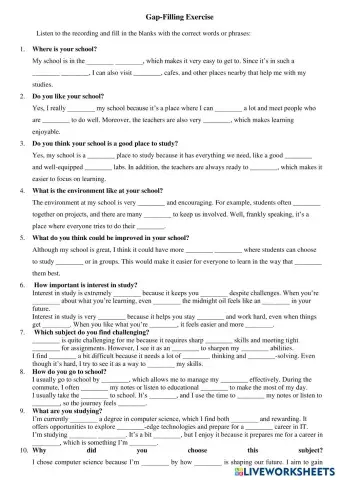
  1. Where is your school?
    My school is in the ________ ________, which makes it very easy to get to. Since it’s in such a ________ ________, I can also visit ________, cafes, and other places nearby that help me with my studies.
  2. Do you like your school?
    Yes, I really ________ my school because it’s a place where I can ________ a lot and meet people who are ________ to do well. Moreover, the teachers are also very ________, which makes learning enjoyable.
  3. Do you think your school is a good place to study?
    Yes, my school is a ________ place to study because it has everything we need, like a good ________ and well-equipped ________ labs. In addition, the teachers are always ready to ________, which makes it easier to focus on learning.
  4. What is the environment like at your school?
    The environment at my school is very ________ and encouraging. For example, students often ________ together on projects, and there are many ________ to keep us involved. Well, frankly speaking, it’s a place where everyone tries to do their ________.
  5. What do you think could be improved in your school?
    Although my school is great, I think it could have more ________ ________ where students can choose to study ________ or in groups. This would make it easier for everyone to learn in the way that ________ them best.
  6.  How important is interest in study?
    Interest in study is extremely ________ because it keeps you ________ despite challenges. When you’re ________ about what you’re learning, even ________ the midnight oil feels like an ________ in your future.
    Interest in study is very ________ because it helps you stay ________ and work hard, even when things get ________. When you like what you’re ________, it feels easier and more ________.
  7.  Which subject do you find challenging?
    ________ is quite challenging for me because it requires sharp ________ skills and meeting tight ________ for assignments. However, I see it as an ________ to sharpen my ________ abilities.
    I find ________ a bit difficult because it needs a lot of ________ thinking and ________-solving. Even though it’s hard, I try to see it as a way to ________ my skills.
  8. How do you go to school?
    I usually go to school by ________, which allows me to manage my ________ effectively. During the commute, I often ________ my notes or listen to educational ________ to make the most of my day.
    I usually take the ________ to school. It’s ________, and I use the time to ________ my notes or listen to ________, so the journey feels ________.
  9. What are you studying?
    I’m currently ________ a degree in computer science, which I find both ________ and rewarding. It offers opportunities to explore ________-edge technologies and prepare for a ________ career in IT.
    I’m studying ________ ________. It’s a bit ________, but I enjoy it because it prepares me for a career in ________, which is something I’m ________.
  10. Why did you choose this subject?
    I chose computer science because I’m ________ by how ________ is shaping our future. I aim to gain ________ in this field and use it to climb the ________ ladder.
    Well, I chose computer science because I’m really ________ in ________ and how it is ________ the world. I want to learn more about it and use this ________ to build my ________ career.

11.            What do you like most about your studies?

……………..is the balance between theoretical knowledge and practical application. For instance, during lab sessions, I gain hands-on …………………..which helps me sharpen my skills and stay ………………..

I like that my studies include both …………. and practice. For example, we have lab sessions where I can ………………. what I’ve learned. This makes studying more interesting and ……………….

     12.            Are you more interested in theoretical or practical subjects? Why?

I prefer …………… subjects because they allow me to gain hands-on experience and ………………….. real-world scenarios. This approach not only sharpens my skills but also builds my …………………. for future challenges.

I prefer practical subjects because I like to apply what I’ve learned in real situations. It makes learning more fun and gives me …………………… I can use in the future.

     13.            Do you find your studies difficult? Why or why not?

Sometimes, the workload can be…………………., especially when I have to meet tight deadlines. However, I stay motivated by setting ……………….. and managing my schedule effectively.

Sometimes my studies are a bit hard, especially when I have a lot of assignments or……………….. But I try to manage my time well and stay ………………….. which helps me deal with the workload.

14.  How do you usually prepare for exams?

I prepare for exams by ………………..a study schedule that helps me balance my workload. I also collaborate with classmates for group discussions and …………………. past papers to improve my understanding.

I prepare for exams by making a study plan so I can manage my time well. I also study with my classmates and practice past papers to …………………. my understanding of the topics.

15.  Do you prefer studying alone or with others? Why?

I prefer a mix of both. Studying alone helps me focus and ……………… my time effectively, while group study sessions are engaging and help me explore ………………….. perspectives.

I like both. When I study alone, I can ………………. better, but studying with others helps me learn from different ………………… and understand things more clearly

16.  What are your future plans after finishing your studies?

After completing my studies, I plan to ……………….. a career in software engineering. My ultimate goal is to climb the career ladder by gaining expertise in my field and making a meaningful impact in a reputable company.

After I …………….. my studies, I plan to work as a software engineer. I want to keep learning and improving my skills so I can build a ……………..career and contribute to interesting projects

  1.  
  2.  
  3.  


Crea y personaliza fichas interactivas para cada aula

LiveWorksheets facilita a profesorado, familias y personas que educan en casa el diseño y la entrega de materiales de aprendizaje atractivos. Solo tienes que subir un PDF o empezar desde cero para crear lo que necesites: desde fichas interactivas de matemáticas hasta ejercicios de comprensión lectora, fichas de multiplicación o actividades para infantil, todo en unos pocos clics. Nuestro editor de arrastrar y soltar funciona en todos los cursos y asignaturas, lo que te permite adaptar el contenido a tus programaciones, deberes o evaluaciones. Quienes enseñan inglés como segunda lengua (ESL) también pueden crear sus propias fichas, añadir cuadros de sonidos comunes o integrar actividades de ESL para hacer cada clase más participativa. Además, podrás diseñar fácilmente tareas diferenciadas y autocorregidas que ahorran tiempo y apoyan un mejor aprendizaje del alumnado.

Una biblioteca completa de recursos para K-12 y ESL

Accede a miles de fichas listas para usar en todas las asignaturas de K-12, incluidas actividades para infantil, matemáticas, práctica de multiplicación, comprensión lectora y recursos de ESL. Filtra por curso, materia o nivel de competencia para encontrar exactamente lo que necesitas, ya sea para un aula de primaria, una revisión en secundaria o actividades de práctica en bachillerato. El profesorado de ESL puede explorar nuestra colección en constante crecimiento de fichas y actividades de inglés como segunda lengua, diseñadas para apoyar a estudiantes de todos los niveles. Con nuevo contenido añadido de forma regular, LiveWorksheets es un recurso flexible que ayuda a lograr aprendizajes duraderos.