HOLY DAYS

Vocabulary - English Language

1

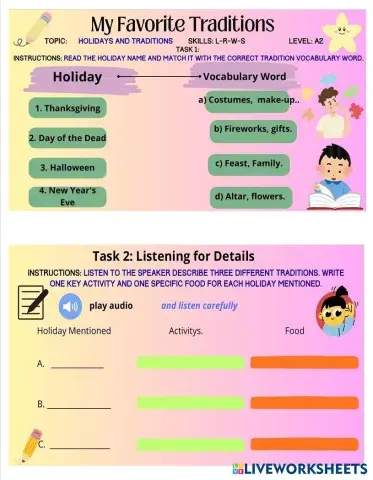
Student Guide: How to Use Your Interactive Worksheet


Welcome! This worksheet is designed to help you practice all four English language skills (Reading, Listening, Writing, and Speaking). Follow these 6 steps in sequence:


Phase 1: Input and Comprehension


  1. Vocabulary Power-Up (TASK 1): Start by reading the holiday names and drag the tradition vocabulary word that best describes each one into the correct column.
  2. Time to Listen! (TASK 2): Click "play audio" to listen to the description of the three traditions. While listening, write one key activity and one specific food in the designated spaces (A, B, C).
  3. Reading Check (TASK 3): Read the text about Christmas Eve in El Salvador. Then, drag the TRUE or FALSE labels next to the three statements to verify the information.


Phase 2: Production (W & S)


  1. Write Your Invitation (TASK 4A): In the "Write your invitation here" space, write your 5-7 sentence paragraph inviting Ben. Make sure to include the date, the description, and a question about his traditions.
  2. Record Your Voice (TASK 4B): Use the "REC" function (or your own recording app) to record yourself reading the invitation you just wrote. Focus on clear pronunciation and a friendly, natural tone.


Phase 3: Wrap-up and Analysis


  1. Reinforcement and Conclusion: Read the congratulatory message. Afterward, open the link provided at the bottom of the page to watch a video and check what similarities you find between the different celebrations you've learned about.

Cambridge IELTS 16 Reading Test 1

Reading - ESL

Each question in the Listening and Reading tests is worth one mark.

Questions which require letter / Roman numeral answers
For questions where the answers are letters or Roman numerals, you should write only the
number of answers required. For example, if the answer is a single letter or numeral, you
should write only one answer. If you have written more letters or numerals than are required,
the answer must be marked wrong.
Questions which require answers in the form of words or numbers
Answers may be written in upper or lower case.
Words in brackets are optional - they are correct, but not necessary.
Alternative answers are separated by a slash (/).
If you are asked to write an answer using a certain number of words and/or (a) number(s),
you will be penalised if you exceed this. For example, if a question specifies an answer
using NO MORE THAN THREE WORDS and the correct answer is 'black leather coat',
the answer 'coat of black leather' is incorrect.
In questions where you are expected to complete a gap, you should only transfer the
necessary missing word(s) onto the answer sheet. For example, to complete 'in the ...',
where the correct answer is 'morning', the answer 'in the morning' would be incorrect.
All answers require correct spelling (including words in brackets).
Both US and UK spelling are acceptable and are included in the answer key.
All standard alternatives for numbers, dates and currencies are acceptable.
All standard abbreviations are acceptable.

BRIGHT 10 GIỮA KỲ 1 LISTENING TEST 1

Vocabulary - English Language

TEST 1

For questions (1–5), choose the best answer (A, B or C).

Listen to a dialogue between Mark and Nancy.

1. Where does Mark go on Saturdays?

A. the mall                                        B. basketball practice                                   C. the supermarket

2. Who likes shopping for clothes?

A. Nancy                                          B. Mark                                                             C. Mark’s sister

3. Nancy doesn’t ______ .

A. do the washing-up                     B. do the laundry                                                         C. vacuum the rugs

4. What does Mark usually do in summer?

A. He goes on a picnic.                      B. He visits a museum.                                                             C. He visits his cousin.

5. What time do Mark and Nancy agree to meet?

A. 7:00                                              B. 10:00                                                             C. 11:30

Phần 2.

For questions 6 - 10

Write one word or a number or a date or a time.

You will hear a radio presenter giving some information about a music festival.

Redlands Music Festival

Starts on:

(6) …………………… August

Place:

Prospect Park, (7) …………………… Redlands

Tickets:

phone 730498 or buy from the festival (8) ……………………

Price of tickets:

(9) …………………… pounds

You can also buy:       food, T-shirts, hats and (10) …………………… at the festival.


HOLY DAYS

Vocabulary - ESL

 1

Student Guide: How to Use Your Interactive Worksheet


Welcome! This worksheet is designed to help you practice all four English language skills (Reading, Listening, Writing, and Speaking). Follow these 6 steps in sequence:


Phase 1: Input and Comprehension (R & L)


  1. Vocabulary Power-Up (TASK 1): Start by reading the holiday names and drag the tradition vocabulary word that best describes each one into the correct column.
  2. Time to Listen! (TASK 2): Click "play audio" to listen to the description of the three traditions. While listening, write one key activity and one specific food in the designated spaces (A, B, C).
  3. Reading Check (TASK 3): Read the text about Christmas Eve in El Salvador. Then, drag the TRUE or FALSE labels next to the three statements to verify the information.


Phase 2: Production (W & S)


  1. Write Your Invitation (TASK 4A): In the "Write your invitation here" space, write your 5-7 sentence paragraph inviting Ben. Make sure to include the date, the description, and a question about his traditions.
  2. Record Your Voice (TASK 4B): Use the "REC" function (or your own recording app) to record yourself reading the invitation you just wrote. Focus on clear pronunciation and a friendly, natural tone.


Phase 3: Wrap-up and Analysis


  1. Reinforcement and Conclusion: Read the congratulatory message. Afterward, open the link provided at the bottom of the page to watch a video and check what similarities you find between the different celebrations you've learned about

Diggory bones

Reading - ESL

Ниже составлен **рабочий лист для ученика**, основанный на методике продуктивного чтения и полностью учитывающий план урока из Teacher’s Book (Diggory Bones, Unit 7, PB69). Рабочий лист предназначен для самостоятельной работы с текстом до/во время/после просмотра видео или чтения.

---

## WORK SHEET

**Name:** ________________________  
**Class:** ________________________  
**Date:** ________________________  

**Story:** Diggory Bones (Part 2 – Pyramid & Secret Door)  
**Pupil’s Book page:** 69  

---

### BEFORE READING & WATCHING  
*(What do I already know? What will happen?)*

**Task 1. Remember the previous episode**  
In the last episode, Lyam thought he heard a sound.  
➜ What was the sound? (Guess) ________________________________  

**Task 2. Look at the first scene of the story (picture 1)**  
What is Diggory doing?  
- [ ] Crying  
- [ ] Laughing  
- [ ] Sleeping  

**Task 3. New words to check**  
Match the word to its meaning (guess before you read):

| Word | Meaning |
|------|---------|
| mirror | a) a tree with white juice for making rubber |
| bowl | b) you look into it and see yourself |
| cloth | c) a deep round dish |
| liquid | d) a piece of fabric |
| rubber trees | e) water, juice, milk (not solid) |

**Answers** (check after reading): mirror – b, bowl – c, cloth – d, liquid – e, rubber trees – a.

**Task 4. Prediction**  
Look at the pictures and read the title “Diggory Bones”.  
Write 2 things you think will happen in the story:

> 1. ________________________________________________  
> 2. ________________________________________________  

---

### WHILE READING & WATCHING  
*(Watch the video or read the text. Answer as you go.)*

**Task 5. Gist questions (watch first time – books closed)**  
Watch the video. Answer these 3 questions:

| Question | Your answer |
|----------|-------------|
| How many steps are there altogether on the pyramid? | ________ |
| What did the Mayas do in the round building? | ________ |
| Why did they put water in the bowl? | ________ |

**Task 6. Detailed questions (books open – watch again)**  
Now open your book to page 69. Watch again or read. Answer:

> **a)** How many steps are there on EACH face of the pyramid? ______  
> **b)** What time is the sun at its highest? ______  

**Task 7. True or False?**  
Read the story text. Write T (true) or F (false).

| Statement | T / F |
|-----------|-------|
| Quetzalcoatl was the god of war. | |
| The sun will be at its highest point at 11.28. | |
| Bowls full of water work like mirrors. | |
| Richard is not following them. | |
| Lyam wants to get the gold. | |

**Task 8. How do they feel?**  
Complete the table. Find the words in the story.

| Character | How does he feel? | Find the sentence in the text |
|-----------|------------------|-------------------------------|
| Lyam (frame 2-3) | angry | ________________________________ |
| Lyam (climbing stairs) | (choose: happy / scared / tired) | “I’m going to be very unhappy” |
| Diggory | joking | “That was a great joke” |

**Task 9. Answer in 1–2 sentences**  
Why are they running and in a hurry?

> ________________________________________________  

What may happen when the sun shines on the secret door?

> ________________________________________________  

---

### AFTER READING & WATCHING  
*(Understanding, thinking, and creating)*

**Task 10. Main idea**  
What is the most important thing in this part of the story? Choose one and explain why:

- [ ] The pyramid has 365 steps (one for each day)  
- [ ] The Mayas watched the sky and used water as mirrors  
- [ ] Diggory played a joke on Lyam  

Your explanation: ________________________________  

**Task 11. Story chain (retell in 4 steps)**  
Write 4 key events in order. Use your own words.

> 1. ________________________________________________  
> 2. ________________________________________________  
> 3. ________________________________________________  
> 4. ________________________________________________  

**Task 12. Predict the ending**  
How do you think the story will end? Write 2–3 sentences.

> ________________________________________________  
> ________________________________________________  

**Task 13. Vocabulary check**  
Find these words in the story. Write the sentence from the text.

| Word | Sentence from story |
|------|----------------------|
| brave | |
| fur | |
| clap | (not in this part – leave empty or write “not here”) |
| frightened | “Everyone who saw them felt … afraid” (same meaning) |

**Task 14. Personal response**  
Would you like to go on an adventure with Diggory Bones? Why / why not?

> ________________________________________________  

---

### SELF-CHECK (for you and your teacher)

| Can you do this? | Yes | A little | No |
|----------------|-----|----------|-----|
| I can answer: How many steps on each face? | ☐ | ☐ | ☐ |
| I can say why the Mayas put water in bowls. | ☐ | ☐ | ☐ |
| I understand the words: mirror, bowl, liquid. | ☐ | ☐ | ☐ |
| I can retell this part of the story. | ☐ | ☐ | ☐ |

*


Present Simple vs Present Continuous

Grammar - English Language

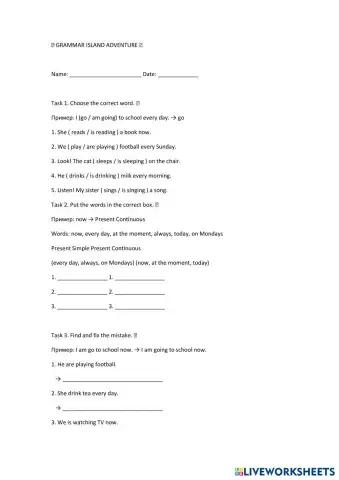
🌴 GRAMMAR ISLAND ADVENTURE 🌴


Name: _______________________ Date: _____________


Task 1. Choose the correct word. 🔍

Пример: I (go / am going) to school every day. → go

1. She ( reads / is reading ) a book now.

2. We ( play / are playing ) football every Sunday.

3. Look! The cat ( sleeps / is sleeping ) on the chair.

4. He ( drinks / is drinking ) milk every morning.

5. Listen! My sister ( sings / is singing ) a song.

Task 2. Put the words in the correct box. 📦

Пример: now → Present Continuous

Words: now, every day, at the moment, always, today, on Mondays

Present Simple Present Continuous

(every day, always, on Mondays) (now, at the moment, today)

1. ________________ 1. ________________

2. ________________ 2. ________________

3. ________________ 3. ________________


Task 3. Find and fix the mistake. ✏️

Пример: I am go to school now. → I am going to school now.

1. He are playing football.

   → ________________________________

2. She drink tea every day.

   → ________________________________

3. We is watching TV now.

   → ________________________________

4. They goes to the park on Sundays.

   → ________________________________


Task 4. Choose the right answer. ✅

1. My brother _______ a comic now.

   · A) reads

   · B) is reading

2. I _______ to music every evening.

   · A) listen

   · B) am listening

3. The girls _______ in the pool at the moment.

   · A) swim

   · B) are swimming

4. _______ he _______ his homework every day?

   · A) Do / do

   · B) Does / do

🎉 GREAT JOB! YOU ARE A GRAMMAR HERO! 🎉

A Rose for Emily | Timeline

AP Literature

Key Events in A Rose for Emily


Part 1


  • When Emily died, the whole town visited her funeral, the men visited through respectful affection, the women visited out of curiosity of what was inside of her house.
  • Alive-- Emily had been a tradition, a duty, and a care. 
  • In 1894, Colonel Sartoris sent out an edict that no negro woman should appear on the streets without an apron.
  • Colonel Sartoris made a tale saying that Miss Emily’s father had loaned money to the town, which suggested that Miss Emily would not need to pay taxes. 
  • When Jefferson's authorities ​​approached her about her taxes, she claimed that she did not have any tax. Even though Colonel Sartoris has been dead for 10 years. 


Part 2 


  • It cuts back to 30 years prior and 2 years after the death of her father, where a stench started to develop around her house.
  • The townspeople complained to the judge, and after the complaint was made, the Aldermen family met up and decided to deal with the problem themselves. Which led to them sneaking around her house in order to sprinkle lime around where the smell was.
  • The people around town started to pity Miss Emily for being left alone to herself after the death of her father, but she rejected them stating that her father was not dead. After some persuasion from the minister, she finally breaks down and admits it, after which her father would quickly be buried. The people theorized that this is due to the fact that her father drove away a lot of men who wanted to “steal” from her.


Part 3 


  • Emily begins dating Homer Barron. The townspeople are shocked to see a person of higher position dating somebody lower. Homer is seen as “unsuitable” for Emily.
  • The town starts to gossip regarding Emily’s relationship with Homer. Emily being a southern aristocrat associating herself with somebody like Homer (A Northerner of different social status) who’s seen below her status.
  • The baptist minister’s intervention in response to the gossip and concern. The town’s baptist minister sent to speak with Emily before the arrival of Emily’s cousins from Alabama. The conversation details are undisclosed.

Part 4


  • Emily isolates herself after she finds out that Homer Barron is into men, In this point of the story, Emily has become more reclusive, with her house described as decaying and the townspeople growing more curious about her life.
  • Emily had purchased arsenic, leading to people suspecting that he might harm herself with it.
  • Homer Barron’s disappearance, Homer Barron, who had been seen spending time with Emily, suddenly disappears. The townspeople assume that he left her, though his fate is still unknown.
  •  

Part 5


  • The townspeople enter Miss Emily’s house after her funeral.They explore the house and discover a locked upstairs room.
  • They find Homer’s skeleton lying in the bed, with an indentation in the pillow next to him and a long strand of Miss Emily’s gray hair.


Crea y personaliza fichas interactivas para cada aula

LiveWorksheets facilita a profesorado, familias y personas que educan en casa el diseño y la entrega de materiales de aprendizaje atractivos. Solo tienes que subir un PDF o empezar desde cero para crear lo que necesites: desde fichas interactivas de matemáticas hasta ejercicios de comprensión lectora, fichas de multiplicación o actividades para infantil, todo en unos pocos clics. Nuestro editor de arrastrar y soltar funciona en todos los cursos y asignaturas, lo que te permite adaptar el contenido a tus programaciones, deberes o evaluaciones. Quienes enseñan inglés como segunda lengua (ESL) también pueden crear sus propias fichas, añadir cuadros de sonidos comunes o integrar actividades de ESL para hacer cada clase más participativa. Además, podrás diseñar fácilmente tareas diferenciadas y autocorregidas que ahorran tiempo y apoyan un mejor aprendizaje del alumnado.

Una biblioteca completa de recursos para K-12 y ESL

Accede a miles de fichas listas para usar en todas las asignaturas de K-12, incluidas actividades para infantil, matemáticas, práctica de multiplicación, comprensión lectora y recursos de ESL. Filtra por curso, materia o nivel de competencia para encontrar exactamente lo que necesitas, ya sea para un aula de primaria, una revisión en secundaria o actividades de práctica en bachillerato. El profesorado de ESL puede explorar nuestra colección en constante crecimiento de fichas y actividades de inglés como segunda lengua, diseñadas para apoyar a estudiantes de todos los niveles. Con nuevo contenido añadido de forma regular, LiveWorksheets es un recurso flexible que ayuda a lograr aprendizajes duraderos.