Stalin's Bunker

Vocabulary - English Language


## 🎯 Lesson Vocabulary: Stalin's Bunker

Before reading, let's learn some key words:

| Word / Phrase | Part of Speech | Meaning (in context) |
| :--- | :--- | :--- |
| **Bunker** | Noun | An underground shelter, especially one built for military purposes. |
| **Conference hall** | Noun | A large room where meetings take place. |
| **Accommodate** | Verb | To have enough space for someone or something. |
| **Transverse corridor** | Noun phrase | A passageway that goes across a main area. |
| **To withstand pressure** | Verb phrase | To resist or survive a great physical force. |
| **Air-raid shelter** | Noun phrase | A building or room where people go to protect themselves from bombing. |
| **Descend** | Verb | To go down. |
| **Emergency exit** | Noun phrase | A special door used to leave a place quickly if there is a fire or other danger. |

---

## 📖 Reading: The Secret of Stalin's Bunker

**History of Samara Region in English Tasks**

This text is adapted from historical information and student presentations about this unique landmark .

Have you ever heard of a secret underground palace? In the city of Samara (formerly called Kuibyshev), there is a famous historical place called **Stalin's Bunker**.

During World War II, in 1942, Soviet leader Joseph Stalin needed a safe place to work in case of an air raid. So, the government built a massive, top-secret **bunker** 37 meters deep underground . To understand how deep that is, imagine a 14-story building turned upside down!

Almost 3,000 workers and 800 engineers built it in just eight months (from February to October 1942). They used the design of a Moscow metro station to create this hiding spot. The bunker has long **transverse corridors**, massive steel doors that can **withstand pressure** of up to 10 tons, and a **conference hall** for meetings .

Inside, there is a replica of Stalin's office, complete with a green cloth desk, an old telephone, and a white sofa. The corridors are narrow, and a long staircase of 192 steps leads down into the earth . Today, Stalin's Bunker is a museum. Visitors can **descend** the stairs, walk through the **emergency exit** corridors, and see what life was like during the war. It is one of Samara's most amazing attractions!

---

## 📝 Exercises

### Exercise 1: True or False?

*Read the sentences and write **T (True)** or **F (False)** next to each one.*

1.  Stalin's Bunker is located on the surface of the ground in Samara. ______
2.  The bunker was built in less than one year. ______
3.  The doors of the bunker are very weak and cannot hold much pressure. ______
4.  The bunker has a conference hall and a copy of Stalin's office. ______
5.  Only 100 workers participated in the construction of the bunker. ______

### Exercise 2: Fill in the Blanks

*Complete the sentences using words from the **Vocabulary** list above.*

1.  The workers built a long ____________________ to connect different parts of the bunker.
2.  The museum can ____________________ up to 100 tourists at the same time.
3.  During the war, the bunker worked as an ____________________ to protect people from bombs.
4.  It took 192 steps to ____________________ into the deepest part of the shelter.
5.  Stalin held important meetings in the large ____________________.

### Exercise 3: Matching

*Match the term on the left with the correct description on the right.*

| Term | Description |
| :--- | :--- |
| 1. Air-raid shelter | A. A huge, heavy gate used for security. |
| 2. Steel doors | B. A place to hide during a bombing. |
| 3. 1942 | C. Where Stalin sat and worked. |
| 4. The office | D. The year the bunker was built. |

*(Answer Key for teachers: Ex1: 1-F, 2-T, 3-F, 4-T, 5-F. Ex2: 1-transverse corridor, 2-accommodate, 3-air-raid shelter, 4-descend, 5-conference hall. Ex3: 1-B, 2-A, 3-D, 4-C.)*

Jarosława Pełszyk

Vocabulary - English Language

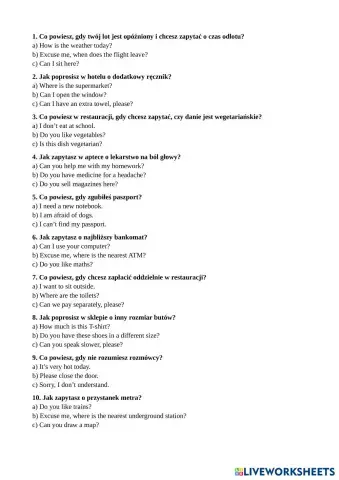
1. Co powiesz, gdy twój lot jest opóźniony i chcesz zapytać o czas odlotu?
a) How is the weather today?
b) Excuse me, when does the flight leave?
c) Can I sit here?

2. Jak poprosisz w hotelu o dodatkowy ręcznik?
a) Where is the supermarket?
b) Can I open the window?
c) Can I have an extra towel, please?

3. Co powiesz w restauracji, gdy chcesz zapytać, czy danie jest wegetariańskie?
a) I don’t eat at school.
b) Do you like vegetables?
c) Is this dish vegetarian?

4. Jak zapytasz w aptece o lekarstwo na ból głowy?
a) Can you help me with my homework?
b) Do you have medicine for a headache?
c) Do you sell magazines here?

5. Co powiesz, gdy zgubiłeś paszport?
a) I need a new notebook.
b) I am afraid of dogs.
c) I can’t find my passport.

6. Jak zapytasz o najbliższy bankomat?
a) Can I use your computer?
b) Excuse me, where is the nearest ATM?
c) Do you like maths?

7. Co powiesz, gdy chcesz zapłacić oddzielnie w restauracji?
a) I want to sit outside.
b) Where are the toilets?
c) Can we pay separately, please?

8. Jak poprosisz w sklepie o inny rozmiar butów?
a) How much is this T-shirt?
b) Do you have these shoes in a different size?
c) Can you speak slower, please?

9. Co powiesz, gdy nie rozumiesz rozmówcy?
a) It’s very hot today.
b) Please close the door.
c) Sorry, I don’t understand.

10. Jak zapytasz o przystanek metra?
a) Do you like trains?
b) Excuse me, where is the nearest underground station?
c) Can you draw a map?

11. Co powiesz, gdy chcesz sprawdzić godzinę odjazdu pociągu do Paryża?
a) What time does the train to Paris leave?
b) Do you have tickets for the concert?
c) Where do you usually eat?

12. Jak poprosisz w hotelu o budzenie na rano?
a) Can I have a wake-up call at 7 a.m., please?
b) Can I have the bill, please?
c) What’s your favourite sport?

13. Co powiesz, gdy chcesz wymienić pieniądze?
a) I don’t have enough time.
b) Do you like shopping?
c) Where can I change money?

14. Jak zapytasz o bezpłatne Wi-Fi w hotelu?
a) Is there a swimming pool?
b) Can I buy a ticket here?
c) Do you have free Wi-Fi?

15. Co powiesz, gdy chcesz zamówić taksówkę na rano?
a) Can you order a taxi for me at 8 a.m.?
b) Can I sit near the window?
c) What’s the time now?

16. Jak poprosisz o polecenie dobrej restauracji?
a) Where is the school?
b) Do you like this restaurant?
c) Can you recommend a good restaurant nearby?

17. Co powiesz, gdy chcesz kupić bilet w dwie strony?
a) I’d like a return ticket, please.
b) Can I have a coffee, please?
c) I want a one-way street.

18. Jak zapytasz o godzinę otwarcia muzeum?
a) Do you like history?
b) How much is the ticket?
c) What time does the museum open?

19. Co powiesz, gdy chcesz zapytać o najbliższą aptekę?
a) Can I have some water?
b) Excuse me, where is the nearest pharmacy?
c) Where are my keys?

20. Jak poprosisz o pomoc, gdy nie możesz znaleźć hotelu?
a) Can you help me with my bag?
b) Excuse me, can you help me find my hotel?
c) I like this city very much.


Crea y personaliza fichas interactivas para cada aula

LiveWorksheets facilita a profesorado, familias y personas que educan en casa el diseño y la entrega de materiales de aprendizaje atractivos. Solo tienes que subir un PDF o empezar desde cero para crear lo que necesites: desde fichas interactivas de matemáticas hasta ejercicios de comprensión lectora, fichas de multiplicación o actividades para infantil, todo en unos pocos clics. Nuestro editor de arrastrar y soltar funciona en todos los cursos y asignaturas, lo que te permite adaptar el contenido a tus programaciones, deberes o evaluaciones. Quienes enseñan inglés como segunda lengua (ESL) también pueden crear sus propias fichas, añadir cuadros de sonidos comunes o integrar actividades de ESL para hacer cada clase más participativa. Además, podrás diseñar fácilmente tareas diferenciadas y autocorregidas que ahorran tiempo y apoyan un mejor aprendizaje del alumnado.

Una biblioteca completa de recursos para K-12 y ESL

Accede a miles de fichas listas para usar en todas las asignaturas de K-12, incluidas actividades para infantil, matemáticas, práctica de multiplicación, comprensión lectora y recursos de ESL. Filtra por curso, materia o nivel de competencia para encontrar exactamente lo que necesitas, ya sea para un aula de primaria, una revisión en secundaria o actividades de práctica en bachillerato. El profesorado de ESL puede explorar nuestra colección en constante crecimiento de fichas y actividades de inglés como segunda lengua, diseñadas para apoyar a estudiantes de todos los niveles. Con nuevo contenido añadido de forma regular, LiveWorksheets es un recurso flexible que ayuda a lograr aprendizajes duraderos.