REVIEW

  • English Language
  • 5th grade

REVIEW

Grammar - English Language

COMPLETE


Aquí tienes una lista de ejercicios con need to / don’t need to y must / mustn’t, usando todos los pronombres. Incluyo solo ejercicios, y si quieres luego te doy las soluciones.

📝 Ejercicios con NEED TO / DON’T NEED TO

Completa las frases con need to o don’t need to + el verbo entre paréntesis.

  1. I __________ (buy) more bread. There’s plenty at home.

  2. You __________ (study) harder if you want to pass.

  3. He __________ (leave) now; he has time.

  4. She __________ (call) her doctor today; it’s important.

  5. It __________ (be) perfect, just acceptable.

  6. We __________ (take) an umbrella; it’s sunny.

  7. They __________ (finish) the project this week; the deadline is next month.

  8. You (plural) __________ (check) the timetable before travelling.

📝 Ejercicios con MUST / MUSTN’T

Completa con must o mustn’t y el verbo adecuado.

  1. I __________ (forget) my keys again.

  2. You __________ (touch) that cable; it’s dangerous.

  3. He __________ (wear) a tie at this restaurant.

  4. She __________ (be) late for the meeting.

  5. It __________ (make) noise after midnight.

  6. We __________ (clean) the room before leaving.

  7. They __________ (bring) food; it’s forbidden.

  8. You (plural) __________ (help) if you want; it’s not compulsory.

📝 Mezcla: NEED TO / DON’T NEED TO / MUST / MUSTN’T

Elige la opción correcta en cada frase.

  1. I (need to / mustn’t) tell you something important.

  2. You (don’t need to / must) pay now; you can pay later.

  3. He (must / don’t need to) smoke here. It’s prohibited.

  4. She (must / need to) finish this today; it's urgent.

  5. We (don’t need to / mustn’t) make noise in the library.

  6. They (must / don’t need to) take the exam again if they passed.

  7. You (mustn’t / need to) forget to send the email.

  8. It (must / don’t need to) be perfect, just acceptable.

Si quieres, te preparo también las soluciones, más ejercicios, o versiones tipo test. ¿Qué prefieres, Sara? 💬

U8 - WEATHER VOCABULARY & GRAMMAR WORKSHEET

Grammar - English Language

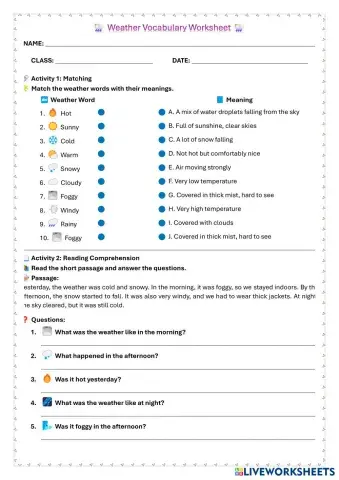
🔗 Activity 1: Matching

🧩 Instructions: You need to match each weather word (like “hot” or “windy”) with the correct meaning from the right column.

🧠 How to Solve It:

•             Read the weather word on the left carefully. Think about what that kind of weather looks or feels like.

•             Then read through all the definitions (A–J) on the right side.

•             Choose the letter that best explains the meaning of the word.

•             Write that letter next to the number of the word.

📌 Tip: Think about real-life examples — like how it feels when it's foggy or snowy.

________________________________________

📖 Activity 2: Reading Comprehension

📚 Instructions: Read the short story about the weather and then answer the questions.

🧠 How to Solve It:

•             Start by reading the passage slowly and carefully.

•             Underline or remember key weather words (e.g., “snowy,” “windy”).

•             Look at each question. Go back to the passage to find the part that answers it.

•             Answer using complete sentences or key words.

📌 Tip: Try reading each question before re-reading the passage so you know what to look for.

________________________________________

✏️ Activity 3: Fill in the Blanks

🖊️ Instructions: Fill in each sentence with the correct weather vocabulary word.

🧠 How to Solve It:

•             Read the full sentence to understand the meaning.

•             Think about what word fits the best: Does it describe sun, rain, cold, fog, etc.?

•             Choose the most suitable weather word from the list you learned.

📌 Tip: Think about the clue in the sentence — like “wore sunglasses” might go with “sunny.”

________________________________________

🧠 Activity 4: Multiple Choice

✅ Instructions: Choose the best answer from the options (A–D).

🧠 How to Solve It:

•             Read the question carefully.

•             Look at all the options before picking one.

•             Eliminate the ones that don’t make sense.

•             Pick the best-fitting and grammatically correct answer.

📌 Tip: Read the question and options aloud to check if they sound right.

________________________________________

🔤 Activity 5: Sentence Ordering

🧩 Instructions: Rearrange the mixed-up words to form a correct sentence.

🧠 How to Solve It:

•             Look for clues like question words (what, was) or starting words (It, The).

•             Remember how sentences are usually ordered in English:

Subject → Verb → Details (e.g., “It was sunny yesterday.”)

•             Rearrange the words until it makes a complete sentence.

📌 Tip: Say the words out loud in different orders until it sounds right.

________________________________________

🧑‍🏫 Final Tips:

•             Take your time — it’s okay to re-read or double-check your work.

•             Use your class vocabulary list or weather flashcards if you get stuck.

•             Ask yourself, “Does this make sense?” after every answer.

Repaso mates 6 primaria 1r tema

Addition and Subtraction - Math


🧮 EXAMEN DE MATEMÁTICAS – 6º de Primaria

Nombre: ________________________ Fecha: _______________

🧩 1. NÚMEROS DE HASTA 9 CIFRAS

1.1 Descompón el número 7 305 218 según el valor de cada cifra.
1.2 Escribe con letras el número 2 046 090.
1.3 Ordena de menor a mayor:
4 205 810 – 3 980 450 – 4 208 001 – 4 205 081
1.4 Redondea el número 8 746 392:

  • a la decena de millar
  • a la centena de millar

Problemas

1.5 En una ciudad hay 8 534 290 habitantes. En otra, 8 529 880.
¿Cuál tiene más habitantes y cuántos más tiene?

1.6 Un colegio ha recaudado 7 658 320 € para obras. Si se estima que costarán 7 650 000 €, ¿cuánto dinero sobrará aproximadamente si redondeamos a la centena de millar?

2. OPERACIONES COMBINADAS

2.1 Calcula:
a) ( (24 + 36) \div 6 \times 3 )
b) ( 480 - [ (25 \times 4) + (120 \div 3) ] )

Problemas

2.2 En una excursión hay 8 autobuses con 45 alumnos cada uno. Si cada alumno paga 18 €, ¿cuánto dinero se recauda en total?
2.3 Una tienda compra 350 cajas con 24 botellas cada una. Vende la mitad a 2 € por botella.
¿Cuánto dinero gana?

3. POTENCIAS

3.1 Expresa como potencia cuando sea posible:
a) ( 3 \times 3 \times 3 \times 3 = ____ )
b) ( 5 \times 5 = ____ )
c) ( 2^5 = ____ ) (escríbelo como multiplicación)

3.2 Indica cuál es mayor y por qué:
a) ( 4^3 ) o ( 3^4 )
b) ( 6^2 ) o ( 6^3 )

Problemas

3.3 Marta quiere pintar 4 paredes iguales de 3 m de alto y 5 m de ancho. ¿Cuántos metros cuadrados pintará en total? (Exprésalo también como una potencia).
3.4 Un dado tiene 6 caras. ¿Cuántos cubitos pequeños de 1 cm³ se pueden hacer con un cubo de 6 cm de lado?

🔢 4. POTENCIAS DE BASE 10

4.1 Completa:
a) ( 10^2 = ___ )
b) ( 10^4 = ___ )
c) ( 1 000 000 = 10^{__} )

4.2 Escribe en forma polinómica:
a) 54 203 = (5 × 10⁴) + (4 × 10³) + (2 × 10²) + (0 × 10¹) + (3 × 10⁰)
b) Escribe ahora el número 7 × 10⁶ + 2 × 10⁴ + 5 × 10² + 3 × 10⁰ en cifras.

Problemas

4.3 La distancia de la Tierra al Sol es de unos 150 000 000 km. Escríbelo en forma de potencia de 10.
4.4 Un ordenador puede almacenar ( 10^9 ) bytes en su memoria. Si otro puede almacenar ( 10^6 ) bytes, ¿cuántas veces más memoria tiene el primero?

5. RAÍZ CUADRADA

5.1 Calcula (mentalmente o con ayuda):
a) √49 =
b) √81 =
c) √50 está entre qué dos números naturales consecutivos?

Problemas

5.2 Un cuadrado tiene un área de 121 cm². ¿Cuánto mide su lado?
5.3 Una alfombra cuadrada mide 9 m². Si hacemos otra 4 veces más grande en área, ¿cuánto medirá su lado?

🏛️ 6. NÚMEROS ROMANOS

6.1 Escribe en números romanos:
a) 47 =
b) 328 =
c) 1999 =

6.2 Escribe en cifras normales:
a) LXXV =
b) CDXL =
c) MMXXV =

Problemas

6.3 En un reloj romano, la aguja marca las VIII. ¿Qué hora es?
6.4 Un monumento tiene grabado el año MCMXCIV. ¿A qué año corresponde?

BONUS (opcional)

Ordena de mayor a menor:
( 9^2, 10^1, 3^4, 5^3 )

Crea y personaliza fichas interactivas para cada aula

LiveWorksheets facilita a profesorado, familias y personas que educan en casa el diseño y la entrega de materiales de aprendizaje atractivos. Solo tienes que subir un PDF o empezar desde cero para crear lo que necesites: desde fichas interactivas de matemáticas hasta ejercicios de comprensión lectora, fichas de multiplicación o actividades para infantil, todo en unos pocos clics. Nuestro editor de arrastrar y soltar funciona en todos los cursos y asignaturas, lo que te permite adaptar el contenido a tus programaciones, deberes o evaluaciones. Quienes enseñan inglés como segunda lengua (ESL) también pueden crear sus propias fichas, añadir cuadros de sonidos comunes o integrar actividades de ESL para hacer cada clase más participativa. Además, podrás diseñar fácilmente tareas diferenciadas y autocorregidas que ahorran tiempo y apoyan un mejor aprendizaje del alumnado.

Una biblioteca completa de recursos para K-12 y ESL

Accede a miles de fichas listas para usar en todas las asignaturas de K-12, incluidas actividades para infantil, matemáticas, práctica de multiplicación, comprensión lectora y recursos de ESL. Filtra por curso, materia o nivel de competencia para encontrar exactamente lo que necesitas, ya sea para un aula de primaria, una revisión en secundaria o actividades de práctica en bachillerato. El profesorado de ESL puede explorar nuestra colección en constante crecimiento de fichas y actividades de inglés como segunda lengua, diseñadas para apoyar a estudiantes de todos los niveles. Con nuevo contenido añadido de forma regular, LiveWorksheets es un recurso flexible que ayuda a lograr aprendizajes duraderos.