Stalin's Bunker

Vocabulary - English Language


## 🎯 Lesson Vocabulary: Stalin's Bunker

Before reading, let's learn some key words:

| Word / Phrase | Part of Speech | Meaning (in context) |
| :--- | :--- | :--- |
| **Bunker** | Noun | An underground shelter, especially one built for military purposes. |
| **Conference hall** | Noun | A large room where meetings take place. |
| **Accommodate** | Verb | To have enough space for someone or something. |
| **Transverse corridor** | Noun phrase | A passageway that goes across a main area. |
| **To withstand pressure** | Verb phrase | To resist or survive a great physical force. |
| **Air-raid shelter** | Noun phrase | A building or room where people go to protect themselves from bombing. |
| **Descend** | Verb | To go down. |
| **Emergency exit** | Noun phrase | A special door used to leave a place quickly if there is a fire or other danger. |

---

## 📖 Reading: The Secret of Stalin's Bunker

**History of Samara Region in English Tasks**

This text is adapted from historical information and student presentations about this unique landmark .

Have you ever heard of a secret underground palace? In the city of Samara (formerly called Kuibyshev), there is a famous historical place called **Stalin's Bunker**.

During World War II, in 1942, Soviet leader Joseph Stalin needed a safe place to work in case of an air raid. So, the government built a massive, top-secret **bunker** 37 meters deep underground . To understand how deep that is, imagine a 14-story building turned upside down!

Almost 3,000 workers and 800 engineers built it in just eight months (from February to October 1942). They used the design of a Moscow metro station to create this hiding spot. The bunker has long **transverse corridors**, massive steel doors that can **withstand pressure** of up to 10 tons, and a **conference hall** for meetings .

Inside, there is a replica of Stalin's office, complete with a green cloth desk, an old telephone, and a white sofa. The corridors are narrow, and a long staircase of 192 steps leads down into the earth . Today, Stalin's Bunker is a museum. Visitors can **descend** the stairs, walk through the **emergency exit** corridors, and see what life was like during the war. It is one of Samara's most amazing attractions!

---

## 📝 Exercises

### Exercise 1: True or False?

*Read the sentences and write **T (True)** or **F (False)** next to each one.*

1.  Stalin's Bunker is located on the surface of the ground in Samara. ______
2.  The bunker was built in less than one year. ______
3.  The doors of the bunker are very weak and cannot hold much pressure. ______
4.  The bunker has a conference hall and a copy of Stalin's office. ______
5.  Only 100 workers participated in the construction of the bunker. ______

### Exercise 2: Fill in the Blanks

*Complete the sentences using words from the **Vocabulary** list above.*

1.  The workers built a long ____________________ to connect different parts of the bunker.
2.  The museum can ____________________ up to 100 tourists at the same time.
3.  During the war, the bunker worked as an ____________________ to protect people from bombs.
4.  It took 192 steps to ____________________ into the deepest part of the shelter.
5.  Stalin held important meetings in the large ____________________.

### Exercise 3: Matching

*Match the term on the left with the correct description on the right.*

| Term | Description |
| :--- | :--- |
| 1. Air-raid shelter | A. A huge, heavy gate used for security. |
| 2. Steel doors | B. A place to hide during a bombing. |
| 3. 1942 | C. Where Stalin sat and worked. |
| 4. The office | D. The year the bunker was built. |

*(Answer Key for teachers: Ex1: 1-F, 2-T, 3-F, 4-T, 5-F. Ex2: 1-transverse corridor, 2-accommodate, 3-air-raid shelter, 4-descend, 5-conference hall. Ex3: 1-B, 2-A, 3-D, 4-C.)*

Aglaya

  • English Language
  • 8th grade

Aglaya

Reading and Text Analysis - English Language

  • Why is mathematics important in daily life?
  • Can you name any famous mathematicians?
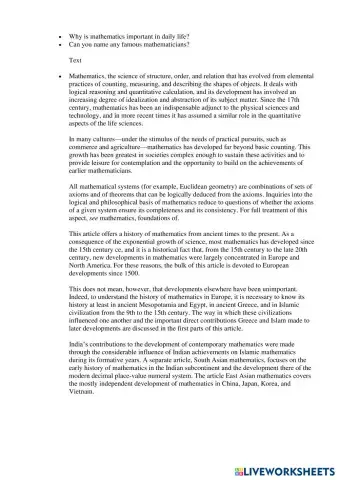
  • mathematics, the science of structure, order, and relation that has evolved from elemental practices of counting, measuring, and describing the shapes of objects. It deals with logical reasoning and quantitative calculation, and its development has involved an increasing degree of idealization and abstraction of its subject matter. Since the 17th century, mathematics has been an indispensable adjunct to the physical sciences and technology, and in more recent times it has assumed a similar role in the quantitative aspects of the life sciences.

    In many cultures—under the stimulus of the needs of practical pursuits, such as commerce and agriculture—mathematics has developed far beyond basic counting. This growth has been greatest in societies complex enough to sustain these activities and to provide leisure for contemplation and the opportunity to build on the achievements of earlier mathematicians.

    All mathematical systems (for example, Euclidean geometry) are combinations of sets of axioms and of theorems that can be logically deduced from the axioms. Inquiries into the logical and philosophical basis of mathematics reduce to questions of whether the axioms of a given system ensure its completeness and its consistency. For full treatment of this aspect, see mathematics, foundations of.

    This article offers a history of mathematics from ancient times to the present. As a consequence of the exponential growth of science, most mathematics has developed since the 15th century ce, and it is a historical fact that, from the 15th century to the late 20th century, new developments in mathematics were largely concentrated in Europe and North America. For these reasons, the bulk of this article is devoted to European developments since 1500.

    This does not mean, however, that developments elsewhere have been unimportant. Indeed, to understand the history of mathematics in Europe, it is necessary to know its history at least in ancient Mesopotamia and Egypt, in ancient Greece, and in Islamic civilization from the 9th to the 15th century. The way in which these civilizations influenced one another and the important direct contributions Greece and Islam made to later developments are discussed in the first parts of this article.

    India’s contributions to the development of contemporary mathematics were made through the considerable influence of Indian achievements on Islamic mathematics during its formative years. A separate article, South Asian mathematics, focuses on the early history of mathematics in the Indian subcontinent and the development there of the modern decimal place-value numeral system. The article East Asian mathematics covers the mostly independent development of mathematics in China, Japan, Korea, and Vietnam.

  • Match the words with their meanings.
  • structure -the process of thinking logically about something
  • reasoning-a way that parts are organized or arranged
  • quantitative-a general idea rather than a concrete object
  • abstraction-related to numbers or amounts
  • commerce-to support or keep something going
  • sustain-the activity of buying and selling goods
  • axiom-a statement that can be proved using facts and logic
  • theorem-a statement that is accepted as true without proof
  • civilization-the power to affect how someone or something develops
  • influence-an advanced human society with culture and knowledge
  • Fill in the blanks with correct words from the list:
    (structure, reasoning, commerce, influence, civilization)
  • Ancient _______ like Egypt and Greece made big progress in mathematics.
  • Logical _______ is important for solving problems.
  • Trade and _______ helped mathematics grow.
  • The _______ of India was strong in Islamic mathematics.
  • Geometry studies the _______ of shapes.
  • Choose the correct form.
  • Mathematics (has / have) been important since ancient times.
  • It (developed / has developed) far beyond basic counting.
  • Many cultures (were / have been) influenced by Greek mathematics.
  • Mathematicians (worked / have worked) for centuries to create new ideas.
  • Since the 17th century, mathematics (became / has become) a part of science.
  • Reading Comprehension

    Answer the questions:

  • What is mathematics described as in the first paragraph?
  • Why did mathematics develop in many cultures?
  • What are mathematical systems made of?
  • Where did most mathematical development occur after the 15th century?
  • Why is it important to study ancient civilizations to understand European mathematics?
  • How did India influence Islamic mathematics?

Crea y personaliza fichas interactivas para cada aula

LiveWorksheets facilita a profesorado, familias y personas que educan en casa el diseño y la entrega de materiales de aprendizaje atractivos. Solo tienes que subir un PDF o empezar desde cero para crear lo que necesites: desde fichas interactivas de matemáticas hasta ejercicios de comprensión lectora, fichas de multiplicación o actividades para infantil, todo en unos pocos clics. Nuestro editor de arrastrar y soltar funciona en todos los cursos y asignaturas, lo que te permite adaptar el contenido a tus programaciones, deberes o evaluaciones. Quienes enseñan inglés como segunda lengua (ESL) también pueden crear sus propias fichas, añadir cuadros de sonidos comunes o integrar actividades de ESL para hacer cada clase más participativa. Además, podrás diseñar fácilmente tareas diferenciadas y autocorregidas que ahorran tiempo y apoyan un mejor aprendizaje del alumnado.

Una biblioteca completa de recursos para K-12 y ESL

Accede a miles de fichas listas para usar en todas las asignaturas de K-12, incluidas actividades para infantil, matemáticas, práctica de multiplicación, comprensión lectora y recursos de ESL. Filtra por curso, materia o nivel de competencia para encontrar exactamente lo que necesitas, ya sea para un aula de primaria, una revisión en secundaria o actividades de práctica en bachillerato. El profesorado de ESL puede explorar nuestra colección en constante crecimiento de fichas y actividades de inglés como segunda lengua, diseñadas para apoyar a estudiantes de todos los niveles. Con nuevo contenido añadido de forma regular, LiveWorksheets es un recurso flexible que ayuda a lograr aprendizajes duraderos.