Reading Task 2

Reading - ESL

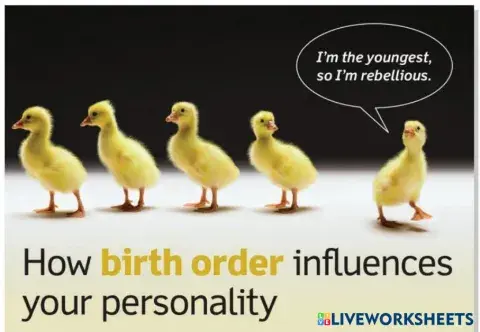
THE OLDEST CHILD

Firstborn children often have to look after their younger brothers and sisters, so they're usually sensible and responsible as adults.

They also tend to be ambitious, and they make good leaders. On the negative side, oldest children can be insecure and anxious. This is because -1-H. when the second child was born, they lost some of their parents' attention, and maybe they felt rejected

THE MIDDLE CHILD

Middle children are more relaxed than the oldest children, probably because -2- C. their parents were more relaxed themselves by the time the second child arrived. They're usually very sociable - the kind

of people who get on with everybody. They are also usually sensitive to what other people need, because -3-A. they grew up between older and younger brothers and sisters. For the same reason, they're often quite good at sorting out arguments, and they're always sympathetic to the ones on the losing side, or in general, to people who are having problems. On the other hand, middle children can sometimes be unambitious, and they can lack direction in life.

THE YOUNGEST CHILD

Youngest children are often very outgoing and charming. This is the way they try to get the attention of both their parents and their older brothers and sisters. They are often more rebellious, and this is probably because

-4-B. it's easier for them to break the rules - by the time they were born, their parents were more relaxed about discipline. They can also be immature and disorganized, and they often depend too much on other people, because -5-E. they have always been the baby of the family.

THE ONLY CHILD

Only children usually do very well at school, because they have a lot of contact with adults. They get a lot of love and attention from their parents, so they're typically self-confident. They're also independent, as they spend so much time by themselves. And because -6-F. they spend a lot of time with adults, they're often very organized. Only children can sometimes be spoilt, because -7-D. they are given everything they ask for by their parents. They can also be quite selfish and get impatient, especially when things go wrong. This is because -8-G. they've never had to sort out problems with other brothers and sisters.

The Arctic

Vocabulary - ESL

Задание 1. Перед просмотром: "Мозговой штурм" (Vocabulary + Prediction)

Instructions: Match the words to make word combinations. Then, guess which 3 of them will be in the video.

A B
1. Polar a) fishing
2. Ice b) bears
3. Dog c) station
4. Research d) sledges (sleighs)
5. Traditional e) caps

Your guess (3 items): ______ , ______ , ______ .
(Теперь смотри видео и проверь свою догадку)

---

Задание 2. Во время просмотра: "Грамматический детектив" (Grammar: Present Simple vs. Present Continuous)

Instructions: Watch the video and choose the correct verb form. Be careful! One form is for habits/general facts, the other is for now.

1. In the Arctic, it (is snowing / snows) a lot in winter.
2. Look! The man (drives / is driving) a snowmobile right now.
3. Every day, children (go / are going) to school by special transport.
4. At the moment, the scientist (studies / is studying) the ice.
5. Polar bears (live / are living) in this region, but we can't see them now.

---

Задание 3. После просмотра: "Редактор" (Ordering & Opinion)

Part A (Ordering): The sentences from the video are mixed up. Number them 1-4 in the correct logical order as they appear in the video.

___ People wear very warm clothes because it's freezing.
___ The Arctic is a beautiful but very cold place.
___ Animals like polar bears and arctic foxes hunt for food.
___ Children sometimes ride on dog sledges to get around.

Part B (Your Opinion): Answer the questions in full sentences.

1. Would you like to visit the Arctic? Why or why not? (Give 2 reasons).
---
---
2. What is the biggest difference between your city and the Arctic?
---
 

Crea y personaliza fichas interactivas para cada aula

LiveWorksheets facilita a profesorado, familias y personas que educan en casa el diseño y la entrega de materiales de aprendizaje atractivos. Solo tienes que subir un PDF o empezar desde cero para crear lo que necesites: desde fichas interactivas de matemáticas hasta ejercicios de comprensión lectora, fichas de multiplicación o actividades para infantil, todo en unos pocos clics. Nuestro editor de arrastrar y soltar funciona en todos los cursos y asignaturas, lo que te permite adaptar el contenido a tus programaciones, deberes o evaluaciones. Quienes enseñan inglés como segunda lengua (ESL) también pueden crear sus propias fichas, añadir cuadros de sonidos comunes o integrar actividades de ESL para hacer cada clase más participativa. Además, podrás diseñar fácilmente tareas diferenciadas y autocorregidas que ahorran tiempo y apoyan un mejor aprendizaje del alumnado.

Una biblioteca completa de recursos para K-12 y ESL

Accede a miles de fichas listas para usar en todas las asignaturas de K-12, incluidas actividades para infantil, matemáticas, práctica de multiplicación, comprensión lectora y recursos de ESL. Filtra por curso, materia o nivel de competencia para encontrar exactamente lo que necesitas, ya sea para un aula de primaria, una revisión en secundaria o actividades de práctica en bachillerato. El profesorado de ESL puede explorar nuestra colección en constante crecimiento de fichas y actividades de inglés como segunda lengua, diseñadas para apoyar a estudiantes de todos los niveles. Con nuevo contenido añadido de forma regular, LiveWorksheets es un recurso flexible que ayuda a lograr aprendizajes duraderos.